



Atelomycterus marnkalha Jacobsen & Bennett, 2007
Eastern banded catshark
Thêm quan sát của bạn vào Fish Watcher
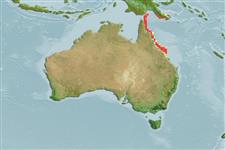
| Native range | All suitable habitat | Point map | Year 2050 |
|
| This map was computer-generated and has not yet been reviewed. |
| Atelomycterus marnkalha AquaMaps Data sources: GBIF OBIS |
Tải lên của bạn hình ảnh Và Video
Các tranh (Ảnh) | Google image Atelomycterus marnkalha
Male Hình ảnh của Jacobsen, I.P.
Các tranh (Ảnh) | Google image
Male Hình ảnh của Jacobsen, I.P.
Phân loại / Tên Tên thường gặp | Các synonym ( Các tên trùng) | Catalog of Fishes(Giống, Các loài) | ITIS | CoL | WoRMS | Cloffa
Lớp phụ Cá sụn (cá mập và cá đuối) (sharks and rays) > Carcharhiniformes (Ground sharks) > Atelomycteridae (Coloured catsharks)
Etymology: Atelomycterus: ateles (Gr.), imperfect, unfilled or exempt; mycteros (Gr.), nostril, referring to lack of posterior nasal valve (See ETYFish); marnkalha: Indigenous Australian (Rrumburriya clan) word for regional catshark species in Yanyuwa country, where one of the first specimens was recorded (See ETYFish).
Etymology: Atelomycterus: ateles (Gr.), imperfect, unfilled or exempt; mycteros (Gr.), nostril, referring to lack of posterior nasal valve (See ETYFish); marnkalha: Indigenous Australian (Rrumburriya clan) word for regional catshark species in Yanyuwa country, where one of the first specimens was recorded (See ETYFish).
Môi trường: môi trường / vùng khí hậu / Mức độ sâu / phạm vi phân phối Sinh thái học
biển sống nổi và đáy; mức độ sâu 11 - 74 m (Ref. 75152). Tropical; 9°S - 22°S, 143°E - 150°E (Ref. 75152)
Sự phân bố Lãnh thổ | Các khu vực của FAO | Các hệ sinh thái | Những lần xuất hiện | Bản đồ điểm | Những chỉ dẫn | Faunafri
Western Pacific: from Gladstone in Central East Queensland, Australia to the southern reaches of Papua New Guinea.
Bộ gần gũi / Khối lượng (Trọng lượng) / Tuổi
Chín muồi sinh dục: Lm ? range ? - 35.4 cm
Max length : 47.0 cm TL con đực/không giới tính; (Ref. 75152); 48.4 cm TL (female)
Max length : 47.0 cm TL con đực/không giới tính; (Ref. 75152); 48.4 cm TL (female)
Mô tả ngắn gọn Khóa để định loại | Hình thái học | Sinh trắc học
This relatively small species (up to 49 cm TL) is distinguished by the following set of characters: a relatively long snout, preoral length 4.7-5.1% TL; head length 19.3-19.9% TL, precaudal length 79.7-82.6% TL; short interdorsal space 12.2-13.9% TL; anal fin height 2.5-3.0% TL; comparatively long anal fin length 9.7-10.8 % TL and anal fin base-length 8.2-9.1% TL; adult claspers elongate, broad base, tapering moderately from base to tip; adult male claspers with outer length 7.2-9.0% TL, clasper base width 20.2-22.5% of clasper outer length; clasper glans covering more than half length of entire clasper; enlarged tab on cover rhipidion, which is moderately large, concealed predominantly by large cover rhipidion and exorhipidion; pseudosiphon over half length of cover rhipidion; large pseudopera; narrow clasper tip and of moderate width, bluntly pointed. Total vertebral 147-153 (N=16); precaudal counts 95–99 (n=16). Color pattern dominated by broad brownish saddles and transverse bands on tan/light brown background; prominent dark brown to black spots and white spots on dorsal and lateral surfaces.; dark brown to black spots concentrated predominantly on saddle margins and as irregular transverse lines in inter-saddle spaces; decreasing in number post second dorsal fin; significant numbers of small to medium sized white spots are found along entire length of animal; white spots increasing in concentration towards posterior end of animal (Ref. 75152).
Comparison: this species has posteroventally sloping dorsal fins; lower precaudal vertebrae count and smaller adult size when compared to A. baliensis, A. marmoratus and A. macleayi; it differs from A. fasciatus, the species with the most morphological similarities, in having a larger anal fin, lateral denticles with prominent shallow depressions, claspers of adult males with a cover rhipidion without an obvious notch and with prominent white spots and fewer, smaller black spots (Ref. 75152).
Body shape (shape guide): elongated.
Body shape (shape guide): elongated.
Specimens collected from a variety of environmental substrates ranging from sandy to course rubble at depths of capture from 10.6 to 74 m, with most records shallower than 50 m. Maximum size in total length for males 19.0- 47.0 cm and for females 17.8-48.4 cm TL. The average mass of adult males was 92.5% of the adult females, with considerable overlap between large males and small females. Mass of adult males 182.5-286.0 g (n=5, mean = 203.8, sd = 43.6); adult females 150-386.3 g (n=4, mean = 220.3, sd =111.2); while there was a considerable overlap in the mass of juveniles and adults for both males and females.
Smallest sexually mature female 35.4 cm TL with size at first maturity being possibly lower; while the smallest sexually mature male recorded was 34.5 cm TL. Reproduction is expected to be oviparous, although no egg casings were recorded from the sample specimens. This species feeds mainly on benthic invertebrates and small teleost species. Stomach content of 4 specimens included penaeid prawns, brachyuran crabs, cephalopods (Order Teuthida) and teleost species from the families Gobiidae and Platycephalidae (Ref. 75152).
Vòng đời và hành vi giao phối Chín muồi sinh dục | Sự tái sinh sản | Đẻ trứng | Các trứng | Sự sinh sản | Ấu trùng
Tài liệu tham khảo chính
Tải lên tài liệu tham khảo của bạn | Các tài liệu tham khảo | Người điều phối | Người cộng tác
Jacobsen, I.P. and M.P. Bennett, 2007. Description of a new species of catshark, Atelomycterus marnkalha n. sp. (Carcharhiniformes: Scyliorhinidae) from noeth-east Australia. Zootaxa 1520:19-36. (Ref. 75152)
Tình trạng Sách đỏ IUCN (Ref. 130435: Version 2025-2 (Global))
Data deficient (DD) ; Date assessed: 14 May 2015
CITES
Not Evaluated
Mối đe dọa đối với con người
Harmless
Sử dụng của con người
FAO - Publication: search | FishSource |
Thêm thông tin
Sinh thái dinh dưỡng
Thức ăn (con mồi)
Thành phần thức ăn
Thành phần thức ăn
Khẩu phần ăn
Các động vật ăn mồi
Thức ăn (con mồi)
Thành phần thức ăn
Thành phần thức ăn
Khẩu phần ăn
Các động vật ăn mồi
Sinh thái học
Sinh thái học
Sinh thái học
Biến động dân số
Các thông số tăng trưởng
Độ tuổi / kích thước tối đa
Chiều dài-trọng lượng tương đối
Chiều dài-chiều dài tương đối.
Chiều dài-tần số
Chuyển đổi khối lượng
Bổ xung
Sự phong phú
Các thông số tăng trưởng
Độ tuổi / kích thước tối đa
Chiều dài-trọng lượng tương đối
Chiều dài-chiều dài tương đối.
Chiều dài-tần số
Chuyển đổi khối lượng
Bổ xung
Sự phong phú
Vòng đời
Sự tái sinh sản
Chín muồi sinh dục
Độ trưởng thành/Mang liên quan
Sự sinh sản
Đẻ trứng
Tập hợp sinh sản
Các trứng
Sự phát triển của trứng
Ấu trùng
Sự biến động ấu trùng
Sự tái sinh sản
Chín muồi sinh dục
Độ trưởng thành/Mang liên quan
Sự sinh sản
Đẻ trứng
Tập hợp sinh sản
Các trứng
Sự phát triển của trứng
Ấu trùng
Sự biến động ấu trùng
Sự phân bố
Lãnh thổ
Các khu vực của FAO
Các hệ sinh thái
Những lần xuất hiện
Những chỉ dẫn
BRUVS - Video
Lãnh thổ
Các khu vực của FAO
Các hệ sinh thái
Những lần xuất hiện
Những chỉ dẫn
BRUVS - Video
Giải phẫu
Vùng mang
Não
sỏi tai
Vùng mang
Não
sỏi tai
Sinh lý học
Thành phần cơ thể
Chất dinh dưỡng
Thành phần ô-xy
Kiểu bơi
Tốc độ bơi
Sắc tố thị giác
Tiếng cá
Bệnh tật & Ký sinh trùng
Độc tính (LC50)
Thành phần cơ thể
Chất dinh dưỡng
Thành phần ô-xy
Kiểu bơi
Tốc độ bơi
Sắc tố thị giác
Tiếng cá
Bệnh tật & Ký sinh trùng
Độc tính (LC50)
Di truyền
Bộ gen
Di truyền
Sự dị hợp tử
Di sản
Đa dạng di truyền
Bộ gen
Di truyền
Sự dị hợp tử
Di sản
Đa dạng di truyền
Liên quan đến con người
Hệ thống nuôi trồng thủy sản
Các tổng quan nuôi trồng thủy sản
Các giống
Các trường hợp ngộ độc Ciguatera
Tem, tiền xu, v.v.
Hệ thống nuôi trồng thủy sản
Các tổng quan nuôi trồng thủy sản
Các giống
Các trường hợp ngộ độc Ciguatera
Tem, tiền xu, v.v.
Các công cụ
Sách điện tử | Hướng dẫn hiện trường | Tần suất chiều dài Wizard | Công cụ của vòng đời | Bản đồ điểm |
Bắt-MSY |
Báo cáo đặc biệt
Kiểm tra bảo trì bể cá | Kiểm tra các tờ thông tin về loài | Kiểm tra các tờ thông tin về nuôi trồng thủy sản
Tải xuống XML
Các nguồn internet
AFORO (otoliths) | Aquatic Commons | BHL | Cloffa | Websites from users | Check FishWatcher | CISTI | Catalog of Fishes: Giống, Các loài | DiscoverLife | ECOTOX | FAO - Publication: search | Faunafri | Fishipedia | Fishtrace | GloBI | Google Books | Google Scholar | Google | IGFA World Record | OneZoom | Open Tree of Life | Otolith Atlas of Taiwan Fishes | PubMed | Reef Life Survey | Socotra Atlas | TreeBase | Cây Đời sống | Wikipedia: Go, tìm | World Records Freshwater Fishing | Zoobank | Tạp chí Zoological Record
Ước tính dựa trên mô hình
Nhiệt độ ưa thích (Tài liệu tham khảo 123201): 25.6 - 27.4, mean 26.3 °C (based on 30 cells).
Chỉ số đa dạng phát sinh loài (Tài liệu tham khảo 82804): PD50 = 0.5157 [Uniqueness, from 0.5 = low to 2.0 = high].
Bayesian length-weight: a=0.00389 (0.00180 - 0.00842), b=3.12 (2.94 - 3.30), in cm total length, based on all LWR estimates for this body shape (Ref. 93245).
Mức dinh dưỡng (Tài liệu tham khảo 69278): 3.7 ±0.3 se; based on size and trophs of closest relatives
Thích nghi nhanh (Tài liệu tham khảo 120179): thấp, thời gian nhân đôi của chủng quần tối thiểu là 4.5 - 14 năm (Preliminary low fecundity).