



Atelomycterus marnkalha Jacobsen & Bennett, 2007
Eastern banded catshark
Aggiungete la vostra osservazione in Fish Watcher
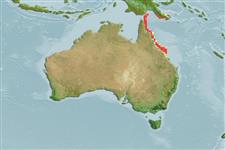
| Native range | All suitable habitat | Point map | Year 2050 |
|
| This map was computer-generated and has not yet been reviewed. |
| Atelomycterus marnkalha AquaMaps Data sources: GBIF OBIS |
Carica il tuo foto e Video
Immagini | Google image Atelomycterus marnkalha
Male Immagine di Jacobsen, I.P.
Immagini | Google image
Male Immagine di Jacobsen, I.P.
Classificazione / Nomi Nomi Comuni | Sinonimi | Catalog of Fishes(Genere, Specie) | ITIS | CoL | WoRMS | Cloffa
Elasmobranchi (squali e razze) (sharks and rays) > Carcharhiniformes (Ground sharks) > Atelomycteridae (Coloured catsharks)
Etymology: Atelomycterus: ateles (Gr.), imperfect, unfilled or exempt; mycteros (Gr.), nostril, referring to lack of posterior nasal valve (See ETYFish); marnkalha: Indigenous Australian (Rrumburriya clan) word for regional catshark species in Yanyuwa country, where one of the first specimens was recorded (See ETYFish).
Etymology: Atelomycterus: ateles (Gr.), imperfect, unfilled or exempt; mycteros (Gr.), nostril, referring to lack of posterior nasal valve (See ETYFish); marnkalha: Indigenous Australian (Rrumburriya clan) word for regional catshark species in Yanyuwa country, where one of the first specimens was recorded (See ETYFish).
Ambiente: milieu / zona climatica / distribuzione batimetrica / gamma di distribuzione Ecologia
marino benthopelagico; distribuzione batimetrica 11 - 74 m (Ref. 75152). Tropical; 9°S - 22°S, 143°E - 150°E (Ref. 75152)
Distribuzione Territories | Aree FAO | Ecosistemi | Presenze | Mappa dei ritrovamenti | Introduzioni | Faunafri
Western Pacific: from Gladstone in Central East Queensland, Australia to the southern reaches of Papua New Guinea.
Dimensione / Peso / Età
Maturità: Lm ? range ? - 35.4 cm
Max length : 47.0 cm TL maschio/sesso non determinato; (Ref. 75152); 48.4 cm TL (female)
Max length : 47.0 cm TL maschio/sesso non determinato; (Ref. 75152); 48.4 cm TL (female)
Breve descrizione Chiavi di identificazione | Morfologia | Morfometria
This relatively small species (up to 49 cm TL) is distinguished by the following set of characters: a relatively long snout, preoral length 4.7-5.1% TL; head length 19.3-19.9% TL, precaudal length 79.7-82.6% TL; short interdorsal space 12.2-13.9% TL; anal fin height 2.5-3.0% TL; comparatively long anal fin length 9.7-10.8 % TL and anal fin base-length 8.2-9.1% TL; adult claspers elongate, broad base, tapering moderately from base to tip; adult male claspers with outer length 7.2-9.0% TL, clasper base width 20.2-22.5% of clasper outer length; clasper glans covering more than half length of entire clasper; enlarged tab on cover rhipidion, which is moderately large, concealed predominantly by large cover rhipidion and exorhipidion; pseudosiphon over half length of cover rhipidion; large pseudopera; narrow clasper tip and of moderate width, bluntly pointed. Total vertebral 147-153 (N=16); precaudal counts 95–99 (n=16). Color pattern dominated by broad brownish saddles and transverse bands on tan/light brown background; prominent dark brown to black spots and white spots on dorsal and lateral surfaces.; dark brown to black spots concentrated predominantly on saddle margins and as irregular transverse lines in inter-saddle spaces; decreasing in number post second dorsal fin; significant numbers of small to medium sized white spots are found along entire length of animal; white spots increasing in concentration towards posterior end of animal (Ref. 75152).
Comparison: this species has posteroventally sloping dorsal fins; lower precaudal vertebrae count and smaller adult size when compared to A. baliensis, A. marmoratus and A. macleayi; it differs from A. fasciatus, the species with the most morphological similarities, in having a larger anal fin, lateral denticles with prominent shallow depressions, claspers of adult males with a cover rhipidion without an obvious notch and with prominent white spots and fewer, smaller black spots (Ref. 75152).
Body shape (shape guide): elongated.
Body shape (shape guide): elongated.
Specimens collected from a variety of environmental substrates ranging from sandy to course rubble at depths of capture from 10.6 to 74 m, with most records shallower than 50 m. Maximum size in total length for males 19.0- 47.0 cm and for females 17.8-48.4 cm TL. The average mass of adult males was 92.5% of the adult females, with considerable overlap between large males and small females. Mass of adult males 182.5-286.0 g (n=5, mean = 203.8, sd = 43.6); adult females 150-386.3 g (n=4, mean = 220.3, sd =111.2); while there was a considerable overlap in the mass of juveniles and adults for both males and females.
Smallest sexually mature female 35.4 cm TL with size at first maturity being possibly lower; while the smallest sexually mature male recorded was 34.5 cm TL. Reproduction is expected to be oviparous, although no egg casings were recorded from the sample specimens. This species feeds mainly on benthic invertebrates and small teleost species. Stomach content of 4 specimens included penaeid prawns, brachyuran crabs, cephalopods (Order Teuthida) and teleost species from the families Gobiidae and Platycephalidae (Ref. 75152).
Ciclo vitale e comportamento di accoppiamento Maturità | Riproduzione | Deposizione | Uova | Fecondità | Larve
Riferimento principale
Caricare le referenze | Bibliografia | Coordinatore | Collaboratori
Jacobsen, I.P. and M.P. Bennett, 2007. Description of a new species of catshark, Atelomycterus marnkalha n. sp. (Carcharhiniformes: Scyliorhinidae) from noeth-east Australia. Zootaxa 1520:19-36. (Ref. 75152)
Stato della Lista Rossa IUCN (Ref. 130435: Version 2025-2 (Global))
Data deficient (DD) ; Date assessed: 14 May 2015
CITES
Not Evaluated
Minaccia per l'uomo
Harmless
Usi umani
FAO - Publication: search | FishSource |
Informazioni ulteriori
Ecologia trofica
Articoli alimentari (prede)
Alimentazione
Consumo di cibo
Razioni alimentari
Predatori
Articoli alimentari (prede)
Alimentazione
Consumo di cibo
Razioni alimentari
Predatori
Ecologia
Ecologia
Ecologia
Dinamica della popolazione
Parametri di crescita
Età massima / dimensioni massime
Rapporto lunghezza-peso.
Lunghezza-lunghezza rel.
Lunghezza-frequenze
Conversione di massa
Reclutamento
Abbondanza
Parametri di crescita
Età massima / dimensioni massime
Rapporto lunghezza-peso.
Lunghezza-lunghezza rel.
Lunghezza-frequenze
Conversione di massa
Reclutamento
Abbondanza
Ciclo di vita
Riproduzione
Maturità
Maturità/Gli occhielli sono relativi.
Fecondità
Deposizione
Aggregazioni riproduttive
Uova
Sviluppo delle uova
Larve
Dinamica popolazioni larvali
Riproduzione
Maturità
Maturità/Gli occhielli sono relativi.
Fecondità
Deposizione
Aggregazioni riproduttive
Uova
Sviluppo delle uova
Larve
Dinamica popolazioni larvali
Anatomia
Area branchiale
Cervello
Otolite
Area branchiale
Cervello
Otolite
Fisiologia
Composizione corporea
Nutrienti
Consumo di ossigeno
Tipo di nuoto
Velocità di nuoto
Pigmenti visivi
Suono del pesce
Malattie e parassiti
Tossicità (LC50)
Composizione corporea
Nutrienti
Consumo di ossigeno
Tipo di nuoto
Velocità di nuoto
Pigmenti visivi
Suono del pesce
Malattie e parassiti
Tossicità (LC50)
Genetica
Genome
Genetica
Eterozigosi
Ereditarietà
Diversità genetica
Genome
Genetica
Eterozigosi
Ereditarietà
Diversità genetica
Legato all'uomo
Sistemi di acquacoltura
Profili di acquacoltura
Varietà
Casi di Ciguatera
Francobolli, monete, materiale vario.
Sistemi di acquacoltura
Profili di acquacoltura
Varietà
Casi di Ciguatera
Francobolli, monete, materiale vario.
Strumenti
Libro elettronico | Giuda pratica | Generatore frequenze di lunghezza | Strumento Parametri Biologici | Mappa dei ritrovamenti |
Cattura-MSY |
Rapporti speciali
Controllo della manutenzione dell'acquario | Verificare la presenza di schede informative sulle specie | Verifica delle schede informative sull'acquacoltura
Scarica XML
Fonti Internet
AFORO (otoliths) | Aquatic Commons | BHL | Cloffa | Websites from users | Check FishWatcher | CISTI | Catalog of Fishes: Genere, Specie | DiscoverLife | ECOTOX | FAO - Publication: search | Faunafri | Fishipedia | Fishtrace | GloBI | Google Books | Google Scholar | Google | IGFA World Record | OneZoom | Open Tree of Life | Otolith Atlas of Taiwan Fishes | PubMed | Reef Life Survey | Socotra Atlas | TreeBase | Tree of Life | Wikipedia: Go, ricerca | World Records Freshwater Fishing | Zoobank | Record zoologico
Stime basate su modelli
Temperatura preferita (Fonte Biblio. 123201): 25.6 - 27.4, mean 26.3 °C (based on 30 cells).
Indice di diversità filogenetica (Fonte Biblio. 82804): PD50 = 0.5157 [Uniqueness, from 0.5 = low to 2.0 = high].
Bayesian length-weight: a=0.00389 (0.00180 - 0.00842), b=3.12 (2.94 - 3.30), in cm total length, based on all LWR estimates for this body shape (Ref. 93245).
Livello trofico (Fonte Biblio. 69278): 3.7 ±0.3 se; based on size and trophs of closest relatives
Resilienza (Fonte Biblio. 120179): Basso, tempo minimo di raddoppiamento della popolazione 4.5 - 14 anni (Preliminary low fecundity).