



Atelomycterus marnkalha Jacobsen & Bennett, 2007
Eastern banded catshark
個人による観察記録の追加 Fish Watcher
| Native range | All suitable habitat | Point map | Year 2050 |
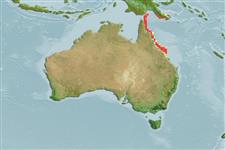
|
| This map was computer-generated and has not yet been reviewed. |
| Atelomycterus marnkalha AquaMaps Data sources: GBIF OBIS |
アップロード 写真 そして ビデオ
画像 | グーグルの画像 Atelomycterus marnkalha
Male 画像によって Jacobsen, I.P.
画像 | グーグルの画像
Male 画像によって Jacobsen, I.P.
分類 / 名前 共通名の | 類義語 | Catalog of Fishes(部類, 種) | ITIS | CoL | WoRMS | Cloffa
板鰓亜鋼(サメとエイ類) (sharks and rays) > Carcharhiniformes (Ground sharks) > Atelomycteridae (Coloured catsharks)
Etymology: Atelomycterus: ateles (Gr.), imperfect, unfilled or exempt; mycteros (Gr.), nostril, referring to lack of posterior nasal valve (See ETYFish); marnkalha: Indigenous Australian (Rrumburriya clan) word for regional catshark species in Yanyuwa country, where one of the first specimens was recorded (See ETYFish).
Etymology: Atelomycterus: ateles (Gr.), imperfect, unfilled or exempt; mycteros (Gr.), nostril, referring to lack of posterior nasal valve (See ETYFish); marnkalha: Indigenous Australian (Rrumburriya clan) word for regional catshark species in Yanyuwa country, where one of the first specimens was recorded (See ETYFish).
環境:環境 / 気候帯 / 深さの範囲 / 分布範囲 生態学
分布 領土 | 国連食糧農業機関の区域 | エコシステム | 事件 | 目的のマップ | 導入 | Faunafri
Western Pacific: from Gladstone in Central East Queensland, Australia to the southern reaches of Papua New Guinea.
サイズ / 重さ / 年齢
簡単な記述 検索表 | 形態学 | 形態計測学
This relatively small species (up to 49 cm TL) is distinguished by the following set of characters: a relatively long snout, preoral length 4.7-5.1% TL; head length 19.3-19.9% TL, precaudal length 79.7-82.6% TL; short interdorsal space 12.2-13.9% TL; anal fin height 2.5-3.0% TL; comparatively long anal fin length 9.7-10.8 % TL and anal fin base-length 8.2-9.1% TL; adult claspers elongate, broad base, tapering moderately from base to tip; adult male claspers with outer length 7.2-9.0% TL, clasper base width 20.2-22.5% of clasper outer length; clasper glans covering more than half length of entire clasper; enlarged tab on cover rhipidion, which is moderately large, concealed predominantly by large cover rhipidion and exorhipidion; pseudosiphon over half length of cover rhipidion; large pseudopera; narrow clasper tip and of moderate width, bluntly pointed. Total vertebral 147-153 (N=16); precaudal counts 95–99 (n=16). Color pattern dominated by broad brownish saddles and transverse bands on tan/light brown background; prominent dark brown to black spots and white spots on dorsal and lateral surfaces.; dark brown to black spots concentrated predominantly on saddle margins and as irregular transverse lines in inter-saddle spaces; decreasing in number post second dorsal fin; significant numbers of small to medium sized white spots are found along entire length of animal; white spots increasing in concentration towards posterior end of animal (Ref. 75152).
Comparison: this species has posteroventally sloping dorsal fins; lower precaudal vertebrae count and smaller adult size when compared to A. baliensis, A. marmoratus and A. macleayi; it differs from A. fasciatus, the species with the most morphological similarities, in having a larger anal fin, lateral denticles with prominent shallow depressions, claspers of adult males with a cover rhipidion without an obvious notch and with prominent white spots and fewer, smaller black spots (Ref. 75152).
Body shape (shape guide): elongated.
Body shape (shape guide): elongated.
Specimens collected from a variety of environmental substrates ranging from sandy to course rubble at depths of capture from 10.6 to 74 m, with most records shallower than 50 m. Maximum size in total length for males 19.0- 47.0 cm and for females 17.8-48.4 cm TL. The average mass of adult males was 92.5% of the adult females, with considerable overlap between large males and small females. Mass of adult males 182.5-286.0 g (n=5, mean = 203.8, sd = 43.6); adult females 150-386.3 g (n=4, mean = 220.3, sd =111.2); while there was a considerable overlap in the mass of juveniles and adults for both males and females.
Smallest sexually mature female 35.4 cm TL with size at first maturity being possibly lower; while the smallest sexually mature male recorded was 34.5 cm TL. Reproduction is expected to be oviparous, although no egg casings were recorded from the sample specimens. This species feeds mainly on benthic invertebrates and small teleost species. Stomach content of 4 specimens included penaeid prawns, brachyuran crabs, cephalopods (Order Teuthida) and teleost species from the families Gobiidae and Platycephalidae (Ref. 75152).
ライフサイクルと交尾行動 成熟 | 繁殖 | 放精 | 卵 | 生産力 | 幼生
主な参考文献
参考文献のアップロード | 参考文献 | コーディネーター | 協力者
Jacobsen, I.P. and M.P. Bennett, 2007. Description of a new species of catshark, Atelomycterus marnkalha n. sp. (Carcharhiniformes: Scyliorhinidae) from noeth-east Australia. Zootaxa 1520:19-36. (Ref. 75152)
CITES
Not Evaluated
人間に対する脅威
Harmless
人間の用途
FAO - Publication: search | FishSource |
より多くの情報
養殖生態
食料品(獲物)
餌の構成
摂食量
食料配給
捕食動物
食料品(獲物)
餌の構成
摂食量
食料配給
捕食動物
生態学
生態学
生態学
人口動態
成長のパラメーター
最大年齢/サイズ
長さ-重量比。
長短関係。
体長組成
質量変換
補充
豊度
成長のパラメーター
最大年齢/サイズ
長さ-重量比。
長短関係。
体長組成
質量変換
補充
豊度
解剖学
カマ
脳
オトリス
カマ
脳
オトリス
生理学
体組成
栄養素
酸素消費
水泳タイプ
泳ぐ速さ
視覚色素
フィッシュ・サウンド
病気と寄生虫
毒性(LC50)
体組成
栄養素
酸素消費
水泳タイプ
泳ぐ速さ
視覚色素
フィッシュ・サウンド
病気と寄生虫
毒性(LC50)
遺伝子の
ゲノム
遺伝子の
ヘテロ接合性
遺伝
遺伝的多様性
ゲノム
遺伝子の
ヘテロ接合性
遺伝
遺伝的多様性
用具
特記事項
XMLをダウンロードして下さい
インターネットの情報源
AFORO (otoliths) | Aquatic Commons | BHL | Cloffa | Websites from users | Check FishWatcher | CISTI | Catalog of Fishes: 部類, 種 | DiscoverLife | ECOTOX | FAO - Publication: search | Faunafri | Fishipedia | Fishtrace | GloBI | Google Books | Google Scholar | Google | IGFA World Record | OneZoom | Open Tree of Life | Otolith Atlas of Taiwan Fishes | PubMed | Reef Life Survey | Socotra Atlas | TreeBase | 生命の木 | Wikipedia: 行く, 検索する | World Records Freshwater Fishing | Zoobank | 動物に関する記録
モデルに基づく推定値
好ましい温度 (参照 123201): 25.6 - 27.4, mean 26.3 °C (based on 30 cells).
系統多様性指数 (参照 82804): PD50 = 0.5157 [Uniqueness, from 0.5 = low to 2.0 = high].
Bayesian length-weight: a=0.00389 (0.00180 - 0.00842), b=3.12 (2.94 - 3.30), in cm total length, based on all LWR estimates for this body shape (Ref. 93245).
栄養段階 (参照 69278): 3.7 ±0.3 se; based on size and trophs of closest relatives
回復力 (参照 120179): 低い, 4.5年~14年の倍増期間の最小個体群 (Preliminary low fecundity).