



Atelomycterus marnkalha Jacobsen & Bennett, 2007
Eastern banded catshark
Προσθέστε την παρατήρησή σας στο Fish Watcher
| Native range | All suitable habitat | Point map | Year 2050 |
|
| This map was computer-generated and has not yet been reviewed. |
| Atelomycterus marnkalha AquaMaps Data sources: GBIF OBIS |
Ανεβάστε το φωτογραφίες και Βίντεο
Φωτογραφίες | Google image Atelomycterus marnkalha
Male Εικόνα από Jacobsen, I.P.
Φωτογραφίες | Google image
Male Εικόνα από Jacobsen, I.P.
Ταξινόμηση / Ονόματα Κοινά ονόματα | Συνώνυμα | Catalog of Fishes(Γένος, Είδη) | ITIS | CoL | WoRMS | Cloffa
Ελασμοβράγχιοι (καρχαρίες και σαλάχια) (sharks and rays) > Carcharhiniformes (Ground sharks) > Atelomycteridae (Coloured catsharks)
Etymology: Atelomycterus: ateles (Gr.), imperfect, unfilled or exempt; mycteros (Gr.), nostril, referring to lack of posterior nasal valve (See ETYFish); marnkalha: Indigenous Australian (Rrumburriya clan) word for regional catshark species in Yanyuwa country, where one of the first specimens was recorded (See ETYFish).
Etymology: Atelomycterus: ateles (Gr.), imperfect, unfilled or exempt; mycteros (Gr.), nostril, referring to lack of posterior nasal valve (See ETYFish); marnkalha: Indigenous Australian (Rrumburriya clan) word for regional catshark species in Yanyuwa country, where one of the first specimens was recorded (See ETYFish).
Περιβάλλον: περιβάλλον / κλιματική ζώνη / εύρος βάθους / εύρος διανομής Οικολογία
Θαλασσινό(ά) βενθοπελαγικό; εύρος βάθους 11 - 74 m (Ref. 75152). Tropical; 9°S - 22°S, 143°E - 150°E (Ref. 75152)
Κατανομή Εδάφη | Περιοχές FAO | Οικοσυστήματα | Παρουσίες | Σημειακός χάρτης | Εισαγωγές | Faunafri
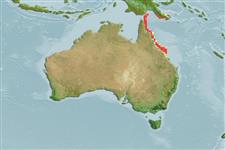
Western Pacific: from Gladstone in Central East Queensland, Australia to the southern reaches of Papua New Guinea.
Μέγεθος / Βάρος / Ηλικία
Γεννητική Ωρίμανση: Lm ? range ? - 35.4 cm
Max length : 47.0 cm TL αρσενικό/απροσδιόριστο; (Ref. 75152); 48.4 cm TL (female)
Max length : 47.0 cm TL αρσενικό/απροσδιόριστο; (Ref. 75152); 48.4 cm TL (female)
Σύντομη περιγραφή Κλείδες προσδιορισμού | Μορφολογία | Μορφομετρία
This relatively small species (up to 49 cm TL) is distinguished by the following set of characters: a relatively long snout, preoral length 4.7-5.1% TL; head length 19.3-19.9% TL, precaudal length 79.7-82.6% TL; short interdorsal space 12.2-13.9% TL; anal fin height 2.5-3.0% TL; comparatively long anal fin length 9.7-10.8 % TL and anal fin base-length 8.2-9.1% TL; adult claspers elongate, broad base, tapering moderately from base to tip; adult male claspers with outer length 7.2-9.0% TL, clasper base width 20.2-22.5% of clasper outer length; clasper glans covering more than half length of entire clasper; enlarged tab on cover rhipidion, which is moderately large, concealed predominantly by large cover rhipidion and exorhipidion; pseudosiphon over half length of cover rhipidion; large pseudopera; narrow clasper tip and of moderate width, bluntly pointed. Total vertebral 147-153 (N=16); precaudal counts 95–99 (n=16). Color pattern dominated by broad brownish saddles and transverse bands on tan/light brown background; prominent dark brown to black spots and white spots on dorsal and lateral surfaces.; dark brown to black spots concentrated predominantly on saddle margins and as irregular transverse lines in inter-saddle spaces; decreasing in number post second dorsal fin; significant numbers of small to medium sized white spots are found along entire length of animal; white spots increasing in concentration towards posterior end of animal (Ref. 75152).
Comparison: this species has posteroventally sloping dorsal fins; lower precaudal vertebrae count and smaller adult size when compared to A. baliensis, A. marmoratus and A. macleayi; it differs from A. fasciatus, the species with the most morphological similarities, in having a larger anal fin, lateral denticles with prominent shallow depressions, claspers of adult males with a cover rhipidion without an obvious notch and with prominent white spots and fewer, smaller black spots (Ref. 75152).
Body shape (shape guide): elongated.
Body shape (shape guide): elongated.
Specimens collected from a variety of environmental substrates ranging from sandy to course rubble at depths of capture from 10.6 to 74 m, with most records shallower than 50 m. Maximum size in total length for males 19.0- 47.0 cm and for females 17.8-48.4 cm TL. The average mass of adult males was 92.5% of the adult females, with considerable overlap between large males and small females. Mass of adult males 182.5-286.0 g (n=5, mean = 203.8, sd = 43.6); adult females 150-386.3 g (n=4, mean = 220.3, sd =111.2); while there was a considerable overlap in the mass of juveniles and adults for both males and females.
Smallest sexually mature female 35.4 cm TL with size at first maturity being possibly lower; while the smallest sexually mature male recorded was 34.5 cm TL. Reproduction is expected to be oviparous, although no egg casings were recorded from the sample specimens. This species feeds mainly on benthic invertebrates and small teleost species. Stomach content of 4 specimens included penaeid prawns, brachyuran crabs, cephalopods (Order Teuthida) and teleost species from the families Gobiidae and Platycephalidae (Ref. 75152).
Κύκλος ζωής και συμπεριφορά ζευγαρώματος Γεννητική Ωρίμανση | Αναπαραγωγή | Γεννοβολία | Αβγά | Γονιμότητα | Προνύμφες
Κύρια αναφορά
Ανεβάστε τις αναφορές σας | Αναφορές | Συντονιστής | Συνεργάτες
Jacobsen, I.P. and M.P. Bennett, 2007. Description of a new species of catshark, Atelomycterus marnkalha n. sp. (Carcharhiniformes: Scyliorhinidae) from noeth-east Australia. Zootaxa 1520:19-36. (Ref. 75152)
Κατάσταση Κόκκινου Καταλόγου IUCN (Ref. 130435: Version 2025-2 (Global))
Data deficient (DD) ; Date assessed: 14 May 2015
CITES
Not Evaluated
Απειλή για τον άνθρωπο
Harmless
Ανθρώπινες χρήσεις
FAO - Publication: search | FishSource |
Περισσότερες πληροφορίες
Τροφική Οικολογία
Τρόφιμα (θηράματα)
Σύσταση δίαιτας
Κατανάλωση τροφής
Μερίδες τροφίμων
Θηρευτές
Τρόφιμα (θηράματα)
Σύσταση δίαιτας
Κατανάλωση τροφής
Μερίδες τροφίμων
Θηρευτές
Οικολογία
Οικολογία
Οικολογία
Πληθυσμιακή δυναμική
Παράμετροι Αύξησης
Μέγιστες ηλικίες / μεγέθη
Μήκος-βάρος σχετ.
Μήκος-μήκος rel.
Μήκος-συχνότητες
Μετατροπή μάζας
Στρατολόγηση
Αφθονία
Παράμετροι Αύξησης
Μέγιστες ηλικίες / μεγέθη
Μήκος-βάρος σχετ.
Μήκος-μήκος rel.
Μήκος-συχνότητες
Μετατροπή μάζας
Στρατολόγηση
Αφθονία
Κύκλος ζωής
Αναπαραγωγή
Γεννητική Ωρίμανση
Ωριμότητα / Gills rel.
Γονιμότητα
Γεννοβολία
Συγκεντρώσεις αναπαραγωγής
Αβγά
Ανάπτυξη αυγών
Προνύμφες
Δυναμική προνυμφών
Αναπαραγωγή
Γεννητική Ωρίμανση
Ωριμότητα / Gills rel.
Γονιμότητα
Γεννοβολία
Συγκεντρώσεις αναπαραγωγής
Αβγά
Ανάπτυξη αυγών
Προνύμφες
Δυναμική προνυμφών
Ανατομία
Επιφάνεια βραγχίων
Εγκέφαλος
Ωτόλιθος
Επιφάνεια βραγχίων
Εγκέφαλος
Ωτόλιθος
Φυσιολογία
Σύνθεση σώματος
Θρεπτικά συστατικά
Κατανάλωση οξυγόνου
Τύπος κολύμβησης
Ταχύτητα κολύμβησης
Οπτικές χρωστικές ουσίες
Ήχος ψαριών
Ασθένειες & παράσιτα
Τοξικότητα (LC50)
Σύνθεση σώματος
Θρεπτικά συστατικά
Κατανάλωση οξυγόνου
Τύπος κολύμβησης
Ταχύτητα κολύμβησης
Οπτικές χρωστικές ουσίες
Ήχος ψαριών
Ασθένειες & παράσιτα
Τοξικότητα (LC50)
Γενετική
Γονιδίωμα
Γενετική
Ετεροζυγωτία
Κληρονομικότητα
Γενετική ποικιλομορφία
Γονιδίωμα
Γενετική
Ετεροζυγωτία
Κληρονομικότητα
Γενετική ποικιλομορφία
Ανθρώπινη σχέση
Συστήματα υδατοκαλλιέργειας
Προφίλ υδατοκαλλιεργειών
Στελέχοι
Περιπτώσεις Ciguatera
Γραμματόσημα, νομίσματα, διάφορα.
Συστήματα υδατοκαλλιέργειας
Προφίλ υδατοκαλλιεργειών
Στελέχοι
Περιπτώσεις Ciguatera
Γραμματόσημα, νομίσματα, διάφορα.
Εργαλεία
Ηλεκτρονικό βιβλίο | Οδηγός πεδίου | Ανάλυση κατά μήκος συνθέσεων | Εργαλείο ιστορίας ζωής | Σημειακός χάρτης |
Catch-MSY |
Ειδικές εκθέσεις
Έλεγχος για συντήρηση ενυδρείου | Ελέγξτε για ενημερωτικά δελτία ειδών | Ελέγξτε για ενημερωτικά δελτία υδατοκαλλιέργειας
Λήψη XML
Διαδικτυακές πηγές
AFORO (otoliths) | Aquatic Commons | BHL | Cloffa | Websites from users | Check FishWatcher | CISTI | Catalog of Fishes: Γένος, Είδη | DiscoverLife | ECOTOX | FAO - Publication: search | Faunafri | Fishipedia | Fishtrace | GloBI | Google Books | Google Scholar | Google | IGFA World Record | OneZoom | Open Tree of Life | Otolith Atlas of Taiwan Fishes | PubMed | Reef Life Survey | Socotra Atlas | TreeBase | Δέντρο Ζωής | Wikipedia: Go, αναζήτηση | World Records Freshwater Fishing | Zoobank | Zoological Record
Εκτιμήσεις βάσει μοντέλων
Προτιμώμενη θερμοκρασία (Αναφ. 123201): 25.6 - 27.4, mean 26.3 °C (based on 30 cells).
Δείκτης φυλογενετικής ποικιλότητας (Αναφ. 82804): PD50 = 0.5157 [Uniqueness, from 0.5 = low to 2.0 = high].
Bayesian length-weight: a=0.00389 (0.00180 - 0.00842), b=3.12 (2.94 - 3.30), in cm total length, based on all LWR estimates for this body shape (Ref. 93245).
Τροφικό Επίπεδο (Αναφ. 69278): 3.7 ±0.3 se; based on size and trophs of closest relatives
Ελαστικότητα (Αναφ. 120179): Χαμηλό, ελάχιστος χρόνος για διπλασιασμό πληθυσμού 4,5 - 14 έτη (Preliminary low fecundity).