



Atelomycterus marnkalha Jacobsen & Bennett, 2007
Eastern banded catshark
Añada su observación en Fish Watcher
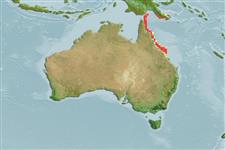
| Native range | All suitable habitat | Point map | Year 2050 |
|
| This map was computer-generated and has not yet been reviewed. |
| Atelomycterus marnkalha AquaMaps Data sources: GBIF OBIS |
Sube tu fotos y Vídeos
Imágenes | Google image Atelomycterus marnkalha
Male Foto de Jacobsen, I.P.
Imágenes | Google image
Male Foto de Jacobsen, I.P.
Clasificación / Nombres Nombres comunes | Sinónimos | Catalog of Fishes(Género, Especie) | ITIS | CoL | WoRMS | Cloffa
Elasmobranquios (tiburones y rayas) (sharks and rays) > Carcharhiniformes (Ground sharks) > Atelomycteridae (Coloured catsharks)
Etymology: Atelomycterus: ateles (Gr.), imperfect, unfilled or exempt; mycteros (Gr.), nostril, referring to lack of posterior nasal valve (See ETYFish); marnkalha: Indigenous Australian (Rrumburriya clan) word for regional catshark species in Yanyuwa country, where one of the first specimens was recorded (See ETYFish).
Etymology: Atelomycterus: ateles (Gr.), imperfect, unfilled or exempt; mycteros (Gr.), nostril, referring to lack of posterior nasal valve (See ETYFish); marnkalha: Indigenous Australian (Rrumburriya clan) word for regional catshark species in Yanyuwa country, where one of the first specimens was recorded (See ETYFish).
Entorno: milieu / zona climática / rango de profundidad / gama de distribución Ecología
marino bentopelágico; rango de profundidad 11 - 74 m (Ref. 75152). Tropical; 9°S - 22°S, 143°E - 150°E (Ref. 75152)
Distribución Territorios | Áreas FAO | Ecosistemas | Ocurrencias, apariciones | Mapa de puntos | Introducciones | Faunafri
Western Pacific: from Gladstone in Central East Queensland, Australia to the southern reaches of Papua New Guinea.
Tamaño / Peso / Edad
Madurez: Lm ? range ? - 35.4 cm
Max length : 47.0 cm TL macho / no sexado; (Ref. 75152); 48.4 cm TL (female)
Max length : 47.0 cm TL macho / no sexado; (Ref. 75152); 48.4 cm TL (female)
Descripción breve Claves de identificación | Morfología | Morfometría
This relatively small species (up to 49 cm TL) is distinguished by the following set of characters: a relatively long snout, preoral length 4.7-5.1% TL; head length 19.3-19.9% TL, precaudal length 79.7-82.6% TL; short interdorsal space 12.2-13.9% TL; anal fin height 2.5-3.0% TL; comparatively long anal fin length 9.7-10.8 % TL and anal fin base-length 8.2-9.1% TL; adult claspers elongate, broad base, tapering moderately from base to tip; adult male claspers with outer length 7.2-9.0% TL, clasper base width 20.2-22.5% of clasper outer length; clasper glans covering more than half length of entire clasper; enlarged tab on cover rhipidion, which is moderately large, concealed predominantly by large cover rhipidion and exorhipidion; pseudosiphon over half length of cover rhipidion; large pseudopera; narrow clasper tip and of moderate width, bluntly pointed. Total vertebral 147-153 (N=16); precaudal counts 95–99 (n=16). Color pattern dominated by broad brownish saddles and transverse bands on tan/light brown background; prominent dark brown to black spots and white spots on dorsal and lateral surfaces.; dark brown to black spots concentrated predominantly on saddle margins and as irregular transverse lines in inter-saddle spaces; decreasing in number post second dorsal fin; significant numbers of small to medium sized white spots are found along entire length of animal; white spots increasing in concentration towards posterior end of animal (Ref. 75152).
Comparison: this species has posteroventally sloping dorsal fins; lower precaudal vertebrae count and smaller adult size when compared to A. baliensis, A. marmoratus and A. macleayi; it differs from A. fasciatus, the species with the most morphological similarities, in having a larger anal fin, lateral denticles with prominent shallow depressions, claspers of adult males with a cover rhipidion without an obvious notch and with prominent white spots and fewer, smaller black spots (Ref. 75152).
Body shape (shape guide): elongated.
Body shape (shape guide): elongated.
Specimens collected from a variety of environmental substrates ranging from sandy to course rubble at depths of capture from 10.6 to 74 m, with most records shallower than 50 m. Maximum size in total length for males 19.0- 47.0 cm and for females 17.8-48.4 cm TL. The average mass of adult males was 92.5% of the adult females, with considerable overlap between large males and small females. Mass of adult males 182.5-286.0 g (n=5, mean = 203.8, sd = 43.6); adult females 150-386.3 g (n=4, mean = 220.3, sd =111.2); while there was a considerable overlap in the mass of juveniles and adults for both males and females.
Smallest sexually mature female 35.4 cm TL with size at first maturity being possibly lower; while the smallest sexually mature male recorded was 34.5 cm TL. Reproduction is expected to be oviparous, although no egg casings were recorded from the sample specimens. This species feeds mainly on benthic invertebrates and small teleost species. Stomach content of 4 specimens included penaeid prawns, brachyuran crabs, cephalopods (Order Teuthida) and teleost species from the families Gobiidae and Platycephalidae (Ref. 75152).
Ciclo vital y comportamiento de apareamiento Madurez | Reproducción | Puesta | Huevos | Fecundidad | Larva
Referencia principal
Suba sus referencias | Referencias | Coordinador | Colaboradores
Jacobsen, I.P. and M.P. Bennett, 2007. Description of a new species of catshark, Atelomycterus marnkalha n. sp. (Carcharhiniformes: Scyliorhinidae) from noeth-east Australia. Zootaxa 1520:19-36. (Ref. 75152)
Situación en la Lista Roja de la UICN (Ref. 130435: Version 2025-2 (Global))
Data deficient (DD) ; Date assessed: 14 May 2015
CITES
Not Evaluated
Amenaza para el ser humano
Harmless
Usos humanos
FAO - Publication: search | FishSource |
Más información
Ecología Trófica
Alimentos (presas)
Composición de la dieta
consumo de alimento
Raciones de comida
Despredadores
Alimentos (presas)
Composición de la dieta
consumo de alimento
Raciones de comida
Despredadores
Ecología
Ecología
Ecología
Dinámica de la población
Coeficiente del crecimiento para
Edades / tallas máximas
Longitud-peso rel.
Longitud-longitud rel.
Longitud-frecuencias
Conversión de masas
Reclutamiento
Abundancia
Coeficiente del crecimiento para
Edades / tallas máximas
Longitud-peso rel.
Longitud-longitud rel.
Longitud-frecuencias
Conversión de masas
Reclutamiento
Abundancia
Ciclo de vida
Reproducción
Madurez
Madurez/Gills rel.
Fecundidad
Puesta
Agregaciones de desove
Huevos
Desarrollo de los huevos
Larva
Dinámica larvaria
Reproducción
Madurez
Madurez/Gills rel.
Fecundidad
Puesta
Agregaciones de desove
Huevos
Desarrollo de los huevos
Larva
Dinámica larvaria
Distribución
Territorios
Áreas FAO
Ecosistemas
Ocurrencias, apariciones
Introducciones
BRUVS - Vídeos
Territorios
Áreas FAO
Ecosistemas
Ocurrencias, apariciones
Introducciones
BRUVS - Vídeos
Anatomía
Superficie branquial
Cerebro
Otolito
Superficie branquial
Cerebro
Otolito
Fisiología
Composición corporal
Nutrientes
Consumo del oxígeno
Tipo de natación
Velocidad de natación
Pigmentos visuales
Sonido de peces
Enfermedades y parásitos
Toxicidad (CL50)
Composición corporal
Nutrientes
Consumo del oxígeno
Tipo de natación
Velocidad de natación
Pigmentos visuales
Sonido de peces
Enfermedades y parásitos
Toxicidad (CL50)
Genética
Genoma
Genética
Heterocigosidad
heritabilidad
Diversidad genética
Genoma
Genética
Heterocigosidad
heritabilidad
Diversidad genética
Relacionados con el ser humano
Sistemas de acuicultura
Perfiles de acuicultura
Razas
Ciguatera cases
Sellos, monedas, varios
Sistemas de acuicultura
Perfiles de acuicultura
Razas
Ciguatera cases
Sellos, monedas, varios
Herramientas
Libro electrónico | Guía de campo | Asistente para frecuencias de tallas | Herramienta de ciclo de vida | Mapa de puntos |
Catch-MSY |
Informes especiales
Comprobar el mantenimiento del acuario | Buscar fichas sobre especies | Consulte las hojas informativas sobre acuicultura
Descargar XML
Fuentes de Internet
AFORO (otoliths) | Aquatic Commons | BHL | Cloffa | Websites from users | Check FishWatcher | CISTI | Catalog of Fishes: Género, Especie | DiscoverLife | ECOTOX | FAO - Publication: search | Faunafri | Fishipedia | Fishtrace | GloBI | Google Books | Google Scholar | Google | IGFA World Record | OneZoom | Open Tree of Life | Otolith Atlas of Taiwan Fishes | PubMed | Reef Life Survey | Socotra Atlas | TreeBase | Árbol de la vida | Wikipedia: Go, búsqueda | World Records Freshwater Fishing | Zoobank | Expediente Zoológico
Estimaciones basadas en modelos
Temperatura preferida (Referencia 123201): 25.6 - 27.4, mean 26.3 °C (based on 30 cells).
Índice de diversidad filogenética (Referencia 82804): PD50 = 0.5157 [Uniqueness, from 0.5 = low to 2.0 = high].
Bayesian length-weight: a=0.00389 (0.00180 - 0.00842), b=3.12 (2.94 - 3.30), in cm total length, based on all LWR estimates for this body shape (Ref. 93245).
Nivel trófico (Referencia 69278): 3.7 ±0.3 se; based on size and trophs of closest relatives
Resiliencia (Referencia 120179): Bajo, población duplicada en un tiempo mínimo de 4.5-14 años (Preliminary low fecundity).