



Tetrapleurodon spadiceus (Bean, 1887)
Mexican lamprey
Tải lên của bạn hình ảnh Và Video
Các tranh (Ảnh) | Google image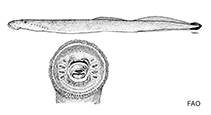 Tetrapleurodon spadiceus
Hình ảnh của FAO
Các tranh (Ảnh) | Google image
Hình ảnh của FAO
Phân loại / Tên Tên thường gặp | Các synonym ( Các tên trùng) | Catalog of Fishes(Giống, Các loài) | ITIS | CoL | WoRMS | Cloffa
> Petromyzontiformes (Lampreys) > Petromyzontidae (Northern lampreys) > Lampetrinae
Etymology: Tetrapleurodon: tetra (Gr.) four; pleura, (Gr.) side, odon (Gr.), tooth. i.e., lateral teeth, referring to four enlarged teeth on each side of mouth of T. spadiceus (See ETYFish); spadiceus: Latin for light- or nut-brown, referring to its color (See ETYFish).
More on author: Bean.
Etymology: Tetrapleurodon: tetra (Gr.) four; pleura, (Gr.) side, odon (Gr.), tooth. i.e., lateral teeth, referring to four enlarged teeth on each side of mouth of T. spadiceus (See ETYFish); spadiceus: Latin for light- or nut-brown, referring to its color (See ETYFish).
More on author: Bean.
Môi trường: môi trường / vùng khí hậu / Mức độ sâu / phạm vi phân phối Sinh thái học
; nước ngọt gần đáy; di cư trong nước ngọt (Ref. 126106). Tropical; 21°N - 19°N
Sự phân bố Lãnh thổ | Các khu vực của FAO | Các hệ sinh thái | Những lần xuất hiện | Bản đồ điểm | Những chỉ dẫn | Faunafri
North America: Celio, Duero and Lerma rivers and Lake Chapala, Mexico.
Bộ gần gũi / Khối lượng (Trọng lượng) / Tuổi
Chín muồi sinh dục: Lm ? range ? - ? cm
Max length : 31.0 cm TL con đực/không giới tính; (Ref. 89241)
Max length : 31.0 cm TL con đực/không giới tính; (Ref. 89241)
Mô tả ngắn gọn Khóa để định loại | Hình thái học | Sinh trắc học
Adults: 18-31 cm TL. Body wet weight of individuals measuring 18.7-22.5 cm TL, 21.3-26.3 g. Body proportions, as percentage of TL [based on 54 specimens, TL range inferred to be roughly 18-31 cm TL, Álvarez del Villar (1966)]: prebranchial length, 10.9-15.7; branchial length, 8.2-13.6; trunk length, 41.0-50.3; tail length, 27.2-34.3. Trunk myomeres, 60-65. Dentition: supraoral lamina, 2 unicuspid teeth, but 20% of individuals had 1-2 additional unicuspid teeth on the bridge; infraoral lamina, 5-9 unicuspid teeth, of which 4-5 are large and 0-4 are small (84% of specimens possess both large and small cusps); 4 endolaterals on each side, exceptionally 3 or 5; endolateral formula, typically 2-2-2-2, rarely, one of the teeth is tricuspid; 3 rows of anterials; first row of anterials, 6 unicuspid teeth; 1 row of exolaterals; 1 rows of posterials; first row of posterials, 21 unicuspid teeth; transverse lingual lamina weakly u-shaped, 17-22 unicuspid teeth, the median one or two unicuspid teeth slightly enlarged; longitudinal lingual laminae parentheses-shaped, each with 24-25 unicuspid teeth. Velar tentacles, 19-21, with tubercles; the dorsal wings are long, reaching the median tentacle. Lateral line neuromasts unpigmented. Caudal fin pigmentation, 75% or more. Caudal fin shape, spade-like. Oral fimbriae, 109-136. Oral papillae, 13-27.
Body shape (shape guide): eel-like.
Body shape (shape guide): eel-like.
Freshwater (Ref. 89241). Found in streams, rivers, and lakes over substrates of firm mud, silt, and rock (Ref. 57533). Spawning habitat is a fast-flowing, clear-water stream with a stony substrate. Eggs hatch between the months of November and January and ammocoetes undergo metamorphosis at the end of three years (Ref. 89241). Ammocoete larval stage duration also cited as four years (Ref. 57533). Ammocoetes live in the mud and feed on plankton (algae of the genera Rhizosolenia, Pleurosigma, Pinularia, Stauroneis, Amphora, and Cocconema, filamentous Chlorophyceae, rotifers, ciliates, and occasionally euglenoid flagellates). The mean total length reached at the end of the first year of larval life is 83 mm; at the end of two years, 135 mm; and at the end of three years, 146 mm. During the rainy season (July) of their first year, ammocoetes exhibit a shrinkage in their total length. Metamorphosis occurs in April-August (Ref. 89241). Parasitic (Ref. 57533). Following metamorphosis, adults migrate to Lake Chapala or the Duero River (Lerma River Basin) where they live as ectoparasites of fishes (carp and catfish) for two years. The diet appears to be predominantly blood. A large number of scales of Moxostoma austrinum and either of Algansea popoche, Yuriria alta, or Y. chapalae, as well as possibly Chirostoma sp. has been found mixed with blood in the intestine of adults. Attacks on the small cyprinids and the atherinopsid almost certainly resulted in their death. Around late June, early July they begin to migrate upstream to the spawning grounds in the upper reaches of the Celio River and die after spawning. Nine individuals in spawning readiness were collected on 19 November (water temperature was about 20°C). Fecundity, 6,617-9,095 eggs/female. Egg diameter, 0.7-0.8 mm. Is presumed to kill a certain number of commercial fish species (Algansea popoche and Chirostoma sp.) in Lake Chapala (Ref. 89241).
Vòng đời và hành vi giao phối Chín muồi sinh dục | Sự tái sinh sản | Đẻ trứng | Các trứng | Sự sinh sản | Ấu trùng
Tài liệu tham khảo chính
Tải lên tài liệu tham khảo của bạn | Các tài liệu tham khảo | Người điều phối | Người cộng tác
Hardisty, M.W., 1986. A general introduction to lampreys. p. 19-84. In J. Holcík (ed.) The Freshwater fishes of Europe. Vol. 1, Part 1. Petromyzontiformes. AULA-Verlag GmbH, Wiesbaden. 313 p. (Ref. 12268)
Tình trạng Sách đỏ IUCN (Ref. 130435: Version 2025-2 (Global))
Critically Endangered (CR) (D); Date assessed: 04 December 2018
CITES
Not Evaluated
Mối đe dọa đối với con người
Harmless
Sử dụng của con người
FAO - Publication: search | FishSource |
Thêm thông tin
Sinh thái dinh dưỡng
Thức ăn (con mồi)
Thành phần thức ăn
Thành phần thức ăn
Khẩu phần ăn
Các động vật ăn mồi
Thức ăn (con mồi)
Thành phần thức ăn
Thành phần thức ăn
Khẩu phần ăn
Các động vật ăn mồi
Biến động dân số
Các thông số tăng trưởng
Độ tuổi / kích thước tối đa
Chiều dài-trọng lượng tương đối
Chiều dài-chiều dài tương đối.
Chiều dài-tần số
Chuyển đổi khối lượng
Bổ xung
Sự phong phú
Các thông số tăng trưởng
Độ tuổi / kích thước tối đa
Chiều dài-trọng lượng tương đối
Chiều dài-chiều dài tương đối.
Chiều dài-tần số
Chuyển đổi khối lượng
Bổ xung
Sự phong phú
Vòng đời
Sự tái sinh sản
Chín muồi sinh dục
Độ trưởng thành/Mang liên quan
Sự sinh sản
Đẻ trứng
Tập hợp sinh sản
Các trứng
Sự phát triển của trứng
Ấu trùng
Sự biến động ấu trùng
Sự tái sinh sản
Chín muồi sinh dục
Độ trưởng thành/Mang liên quan
Sự sinh sản
Đẻ trứng
Tập hợp sinh sản
Các trứng
Sự phát triển của trứng
Ấu trùng
Sự biến động ấu trùng
Sự phân bố
Lãnh thổ
Các khu vực của FAO
Các hệ sinh thái
Những lần xuất hiện
Những chỉ dẫn
BRUVS - Video
Lãnh thổ
Các khu vực của FAO
Các hệ sinh thái
Những lần xuất hiện
Những chỉ dẫn
BRUVS - Video
Giải phẫu
Vùng mang
Não
sỏi tai
Vùng mang
Não
sỏi tai
Sinh lý học
Thành phần cơ thể
Chất dinh dưỡng
Thành phần ô-xy
Kiểu bơi
Tốc độ bơi
Sắc tố thị giác
Tiếng cá
Bệnh tật & Ký sinh trùng
Độc tính (LC50)
Thành phần cơ thể
Chất dinh dưỡng
Thành phần ô-xy
Kiểu bơi
Tốc độ bơi
Sắc tố thị giác
Tiếng cá
Bệnh tật & Ký sinh trùng
Độc tính (LC50)
Di truyền
Bộ gen
Di truyền
Sự dị hợp tử
Di sản
Đa dạng di truyền
Bộ gen
Di truyền
Sự dị hợp tử
Di sản
Đa dạng di truyền
Liên quan đến con người
Hệ thống nuôi trồng thủy sản
Các tổng quan nuôi trồng thủy sản
Các giống
Các trường hợp ngộ độc Ciguatera
Tem, tiền xu, v.v.
Hệ thống nuôi trồng thủy sản
Các tổng quan nuôi trồng thủy sản
Các giống
Các trường hợp ngộ độc Ciguatera
Tem, tiền xu, v.v.
Các công cụ
Sách điện tử | Hướng dẫn hiện trường | Khóa để định loại | Tần suất chiều dài Wizard | Công cụ của vòng đời | Bản đồ điểm |
Bắt-MSY |
Báo cáo đặc biệt
Kiểm tra bảo trì bể cá | Kiểm tra các tờ thông tin về loài | Kiểm tra các tờ thông tin về nuôi trồng thủy sản
Tải xuống XML
Các nguồn internet
AFORO (otoliths) | Aquatic Commons | BHL | Cloffa | Websites from users | Check FishWatcher | CISTI | Catalog of Fishes: Giống, Các loài | DiscoverLife | ECOTOX | FAO - Publication: search | Faunafri | Fishipedia | Fishtrace | GloBI | Google Books | Google Scholar | Google | IGFA World Record | OneZoom | Open Tree of Life | Otolith Atlas of Taiwan Fishes | PubMed | Reef Life Survey | Socotra Atlas | TreeBase | Cây Đời sống | Wikipedia: Go, tìm | World Records Freshwater Fishing | Tạp chí Zoological Record
Ước tính dựa trên mô hình
Chỉ số đa dạng phát sinh loài (Tài liệu tham khảo 82804): PD50 = 0.7500 [Uniqueness, from 0.5 = low to 2.0 = high].
Bayesian length-weight: a=0.00132 (0.00060 - 0.00290), b=2.99 (2.80 - 3.18), in cm total length, based on LWR estimates for this (Sub)family-body shape (Ref. 93245).
Mức dinh dưỡng (Tài liệu tham khảo 69278): 4.2 ±0.73 se; based on food items.
Thích nghi nhanh (Tài liệu tham khảo 120179): thấp, thời gian nhân đôi của chủng quần tối thiểu là 4.5 - 14 năm (Semelparous species, assuming tm (= tmax) > 4).