



Tetrapleurodon spadiceus (Bean, 1887)
Mexican lamprey
Envoyez vos Photos et vidéos
Images | Images Google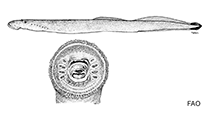 Tetrapleurodon spadiceus
Photo de FAO
Images | Images Google
Photo de FAO
Classification / Noms Noms communs | Synonymes | Catalog of Fishes(Genre, Espèce) | ITIS | CoL | WoRMS | Cloffa
> Petromyzontiformes (Lampreys) > Petromyzontidae (Northern lampreys) > Lampetrinae
Etymology: Tetrapleurodon: tetra (Gr.) four; pleura, (Gr.) side, odon (Gr.), tooth. i.e., lateral teeth, referring to four enlarged teeth on each side of mouth of T. spadiceus (See ETYFish); spadiceus: Latin for light- or nut-brown, referring to its color (See ETYFish).
More on author: Bean.
Etymology: Tetrapleurodon: tetra (Gr.) four; pleura, (Gr.) side, odon (Gr.), tooth. i.e., lateral teeth, referring to four enlarged teeth on each side of mouth of T. spadiceus (See ETYFish); spadiceus: Latin for light- or nut-brown, referring to its color (See ETYFish).
More on author: Bean.
Environnement : milieu / zone climatique / profondeur / gamme de distribution Écologie
; eau douce démersal; potamodrome (Ref. 126106). Tropical; 21°N - 19°N
Distribution Territoires | Zones FAO | Écosystèmes | Occurrences | Carte par point | Introductions | Faunafri
North America: Celio, Duero and Lerma rivers and Lake Chapala, Mexico.
Taille / Poids / Âge
Description synthétique Clés d'identification | Morphologie | Morphométrie
Adults: 18-31 cm TL. Body wet weight of individuals measuring 18.7-22.5 cm TL, 21.3-26.3 g. Body proportions, as percentage of TL [based on 54 specimens, TL range inferred to be roughly 18-31 cm TL, Álvarez del Villar (1966)]: prebranchial length, 10.9-15.7; branchial length, 8.2-13.6; trunk length, 41.0-50.3; tail length, 27.2-34.3. Trunk myomeres, 60-65. Dentition: supraoral lamina, 2 unicuspid teeth, but 20% of individuals had 1-2 additional unicuspid teeth on the bridge; infraoral lamina, 5-9 unicuspid teeth, of which 4-5 are large and 0-4 are small (84% of specimens possess both large and small cusps); 4 endolaterals on each side, exceptionally 3 or 5; endolateral formula, typically 2-2-2-2, rarely, one of the teeth is tricuspid; 3 rows of anterials; first row of anterials, 6 unicuspid teeth; 1 row of exolaterals; 1 rows of posterials; first row of posterials, 21 unicuspid teeth; transverse lingual lamina weakly u-shaped, 17-22 unicuspid teeth, the median one or two unicuspid teeth slightly enlarged; longitudinal lingual laminae parentheses-shaped, each with 24-25 unicuspid teeth. Velar tentacles, 19-21, with tubercles; the dorsal wings are long, reaching the median tentacle. Lateral line neuromasts unpigmented. Caudal fin pigmentation, 75% or more. Caudal fin shape, spade-like. Oral fimbriae, 109-136. Oral papillae, 13-27.
Body shape (shape guide): eel-like.
Body shape (shape guide): eel-like.
Freshwater (Ref. 89241). Found in streams, rivers, and lakes over substrates of firm mud, silt, and rock (Ref. 57533). Spawning habitat is a fast-flowing, clear-water stream with a stony substrate. Eggs hatch between the months of November and January and ammocoetes undergo metamorphosis at the end of three years (Ref. 89241). Ammocoete larval stage duration also cited as four years (Ref. 57533). Ammocoetes live in the mud and feed on plankton (algae of the genera Rhizosolenia, Pleurosigma, Pinularia, Stauroneis, Amphora, and Cocconema, filamentous Chlorophyceae, rotifers, ciliates, and occasionally euglenoid flagellates). The mean total length reached at the end of the first year of larval life is 83 mm; at the end of two years, 135 mm; and at the end of three years, 146 mm. During the rainy season (July) of their first year, ammocoetes exhibit a shrinkage in their total length. Metamorphosis occurs in April-August (Ref. 89241). Parasitic (Ref. 57533). Following metamorphosis, adults migrate to Lake Chapala or the Duero River (Lerma River Basin) where they live as ectoparasites of fishes (carp and catfish) for two years. The diet appears to be predominantly blood. A large number of scales of Moxostoma austrinum and either of Algansea popoche, Yuriria alta, or Y. chapalae, as well as possibly Chirostoma sp. has been found mixed with blood in the intestine of adults. Attacks on the small cyprinids and the atherinopsid almost certainly resulted in their death. Around late June, early July they begin to migrate upstream to the spawning grounds in the upper reaches of the Celio River and die after spawning. Nine individuals in spawning readiness were collected on 19 November (water temperature was about 20°C). Fecundity, 6,617-9,095 eggs/female. Egg diameter, 0.7-0.8 mm. Is presumed to kill a certain number of commercial fish species (Algansea popoche and Chirostoma sp.) in Lake Chapala (Ref. 89241).
Cycle de vie et comportement reproducteur Maturité | Reproduction | Frai | Œufs | Fécondité | Larves
Référence principale
Téléchargez vos références | Références | Coordinateur | Collaborateurs
Hardisty, M.W., 1986. A general introduction to lampreys. p. 19-84. In J. Holcík (ed.) The Freshwater fishes of Europe. Vol. 1, Part 1. Petromyzontiformes. AULA-Verlag GmbH, Wiesbaden. 313 p. (Ref. 12268)
Statut dans la liste rouge de l'IUCN (Ref. 130435: Version 2025-2 (Global))
Niveau de menace critique (CR) (D); Date assessed: 04 December 2018
CITES
Not Evaluated
Menace pour l'homme
Harmless
Utilisations par l'homme
FAO - Publication: search | FishSource |
Plus d'informations
Écologie trophique
Aliments (proies)
Composition du régime alimentaire
Consommation alimentaire
Rations alimentaires
Prédateurs
Aliments (proies)
Composition du régime alimentaire
Consommation alimentaire
Rations alimentaires
Prédateurs
Dynamique des populations
Paramètres de croissance
Âges / tailles maximales
Longueur-poids rel.
Rel. longueur-longueur.
Fréquences de longueurs
Conversion de masse
Recrutement
Abondance
Paramètres de croissance
Âges / tailles maximales
Longueur-poids rel.
Rel. longueur-longueur.
Fréquences de longueurs
Conversion de masse
Recrutement
Abondance
Anatomie
Surface branchiale
Cerveau
Otolithe
Surface branchiale
Cerveau
Otolithe
Physiologie
Composition corporelle
Nutriments
Consommation d'oxygène
Type de natation
Vitesse de nage
Pigments visuels
Son de poisson
Maladies et parasites
Toxicité (CL50)
Composition corporelle
Nutriments
Consommation d'oxygène
Type de natation
Vitesse de nage
Pigments visuels
Son de poisson
Maladies et parasites
Toxicité (CL50)
Génétique
génôme
Génétique
Hétérozygotie
Héritabilité
Diversité génétique
génôme
Génétique
Hétérozygotie
Héritabilité
Diversité génétique
Liées à l'homme
Systèmes d'aquaculture
Profils d'aquaculture
Souches
Cas de ciguatera
Timbres, pièces de monnaie, divers
Systèmes d'aquaculture
Profils d'aquaculture
Souches
Cas de ciguatera
Timbres, pièces de monnaie, divers
Outils
E-book | Guide de terrain | Clés d'identification | Générateur de fréquences de longueur | Outil de dynamique de population | Carte par point |
Capture-MSY |
Articles particuliers
Télécharger en XML
Sources Internet
AFORO (otoliths) | Aquatic Commons | BHL | Cloffa | Websites from users | FishWatcher | CISTI | Catalog of Fishes: Genre, Espèce | DiscoverLife | ECOTOX | FAO - Publication: search | Faunafri | Fishipedia | Fishtrace | GloBI | Google Books | Google Scholar | Google | IGFA World Record | OneZoom | Open Tree of Life | Otolith Atlas of Taiwan Fishes | PubMed | Reef Life Survey | Socotra Atlas | TreeBase | Arbre de Vie | Wikipedia: aller à, chercher | World Records Freshwater Fishing | Zoological Record
Estimations basées sur des modèles
Indice de diversité phylogénétique (Réf. 82804): PD50 = 0.7500 [Uniqueness, from 0.5 = low to 2.0 = high].
Bayesian length-weight: a=0.00132 (0.00060 - 0.00290), b=2.99 (2.80 - 3.18), in cm total length, based on LWR estimates for this (Sub)family-body shape (Ref. 93245).
Niveau trophique (Réf. 69278): 4.2 ±0.73 se; based on food items.
Résilience (Réf. 120179): Faible, temps minimum de doublement de population : 4,5 à 14 années (Semelparous species, assuming tm (= tmax) > 4).