



Tetrapleurodon spadiceus (Bean, 1887)
Mexican lamprey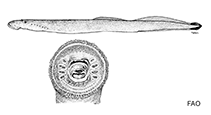
分类 / 名称 俗名 | 同种异名 | Catalog of Fishes(属, 种) | ITIS | CoL | WoRMS | Cloffa
Petromyzonti > Petromyzontiformes (Lampreys) > Petromyzontidae (Northern lampreys) > Lampetrinae
Etymology: Tetrapleurodon: tetra (Gr.) four; pleura, (Gr.) side, odon (Gr.), tooth. i.e., lateral teeth, referring to four enlarged teeth on each side of mouth of T. spadiceus (See ETYFish); spadiceus: Latin for light- or nut-brown, referring to its color (See ETYFish).
More on author: Bean.
Etymology: Tetrapleurodon: tetra (Gr.) four; pleura, (Gr.) side, odon (Gr.), tooth. i.e., lateral teeth, referring to four enlarged teeth on each side of mouth of T. spadiceus (See ETYFish); spadiceus: Latin for light- or nut-brown, referring to its color (See ETYFish).
More on author: Bean.
环境:氛围 / 气候带 / 深度上下限 / 分布范围 生态学
; 淡水 居于水底的; 河川洄游 (Ref. 126106). 熱帶; 21°N - 19°N
分布 领土 | FAO区域 | 生态系 | 标本纪录 | 分布图 | 简介 | Faunafri
North America: Celio, Duero and Lerma rivers and Lake Chapala, Mexico.
北美洲: Celio , Duero 與 Lerma 河與湖 Chapla ,墨西哥。
北美洲: Celio , Duero 與 Lerma 河與湖 Chapla ,墨西哥。
大小 / 重量 / 年龄
简单描述 检索表 | 型态特徵 | 形态测量图
Adults: 18-31 cm TL. Body wet weight of individuals measuring 18.7-22.5 cm TL, 21.3-26.3 g. Body proportions, as percentage of TL [based on 54 specimens, TL range inferred to be roughly 18-31 cm TL, Álvarez del Villar (1966)]: prebranchial length, 10.9-15.7; branchial length, 8.2-13.6; trunk length, 41.0-50.3; tail length, 27.2-34.3. Trunk myomeres, 60-65. Dentition: supraoral lamina, 2 unicuspid teeth, but 20% of individuals had 1-2 additional unicuspid teeth on the bridge; infraoral lamina, 5-9 unicuspid teeth, of which 4-5 are large and 0-4 are small (84% of specimens possess both large and small cusps); 4 endolaterals on each side, exceptionally 3 or 5; endolateral formula, typically 2-2-2-2, rarely, one of the teeth is tricuspid; 3 rows of anterials; first row of anterials, 6 unicuspid teeth; 1 row of exolaterals; 1 rows of posterials; first row of posterials, 21 unicuspid teeth; transverse lingual lamina weakly u-shaped, 17-22 unicuspid teeth, the median one or two unicuspid teeth slightly enlarged; longitudinal lingual laminae parentheses-shaped, each with 24-25 unicuspid teeth. Velar tentacles, 19-21, with tubercles; the dorsal wings are long, reaching the median tentacle. Lateral line neuromasts unpigmented. Caudal fin pigmentation, 75% or more. Caudal fin shape, spade-like. Oral fimbriae, 109-136. Oral papillae, 13-27.
Body shape (shape guide): eel-like.
Body shape (shape guide): eel-like.
Freshwater (Ref. 89241). Found in streams, rivers, and lakes over substrates of firm mud, silt, and rock (Ref. 57533). Spawning habitat is a fast-flowing, clear-water stream with a stony substrate. Eggs hatch between the months of November and January and ammocoetes undergo metamorphosis at the end of three years (Ref. 89241). Ammocoete larval stage duration also cited as four years (Ref. 57533). Ammocoetes live in the mud and feed on plankton (algae of the genera Rhizosolenia, Pleurosigma, Pinularia, Stauroneis, Amphora, and Cocconema, filamentous Chlorophyceae, rotifers, ciliates, and occasionally euglenoid flagellates). The mean total length reached at the end of the first year of larval life is 83 mm; at the end of two years, 135 mm; and at the end of three years, 146 mm. During the rainy season (July) of their first year, ammocoetes exhibit a shrinkage in their total length. Metamorphosis occurs in April-August (Ref. 89241). Parasitic (Ref. 57533). Following metamorphosis, adults migrate to Lake Chapala or the Duero River (Lerma River Basin) where they live as ectoparasites of fishes (carp and catfish) for two years. The diet appears to be predominantly blood. A large number of scales of Moxostoma austrinum and either of Algansea popoche, Yuriria alta, or Y. chapalae, as well as possibly Chirostoma sp. has been found mixed with blood in the intestine of adults. Attacks on the small cyprinids and the atherinopsid almost certainly resulted in their death. Around late June, early July they begin to migrate upstream to the spawning grounds in the upper reaches of the Celio River and die after spawning. Nine individuals in spawning readiness were collected on 19 November (water temperature was about 20°C). Fecundity, 6,617-9,095 eggs/female. Egg diameter, 0.7-0.8 mm. Is presumed to kill a certain number of commercial fish species (Algansea popoche and Chirostoma sp.) in Lake Chapala (Ref. 89241).
寄生的淡水种。
寄生的淡水种。
生命周期和交配行为 成熟度 | 繁殖 | 产卵场 | 卵 | 孕卵数 | 仔鱼
北美洲: Celio , Duero 與 Lerma 河與湖 Chapla ,墨西哥。
主要参考文献
上传您的参考资料 | 参考文献 | 合作者 | 合作者
Hardisty, M.W., 1986. A general introduction to lampreys. p. 19-84. In J. Holcík (ed.) The Freshwater fishes of Europe. Vol. 1, Part 1. Petromyzontiformes. AULA-Verlag GmbH, Wiesbaden. 313 p. (Ref. 12268)
CITES
Not Evaluated
对人类的威胁
无害处的
人类利用
FAO - Publication: search | FishSource |
更多信息
解剖学
鳃区
大脑
耳石
鳃区
大脑
耳石
生理学
身体成分
营养素
耗氧量
游泳类型
游泳速度
视觉色素
鱼声
疾病与寄生虫
毒性(半数致死浓度)
身体成分
营养素
耗氧量
游泳类型
游泳速度
视觉色素
鱼声
疾病与寄生虫
毒性(半数致死浓度)
遗传学
基因组
遗传学
异质性
遗传率
基因多样性
基因组
遗传学
异质性
遗传率
基因多样性
工具
特别资料
下载 XML
网络资源
AFORO (otoliths) | Aquatic Commons | BHL | Cloffa | Websites from users | 核实 FishWatcher | CISTI | Catalog of Fishes: 属, 种 | DiscoverLife | ECOTOX | FAO - Publication: search | Faunafri | Fishipedia | Fishtrace | GloBI | Google Books | Google Scholar | Google | IGFA World Record | OneZoom | Open Tree of Life | Otolith Atlas of Taiwan Fishes | PubMed | Reef Life Survey | Socotra Atlas | TreeBase | 树状分类阶层 | Wikipedia: 转至, 搜寻 | World Records Freshwater Fishing | 动物学的记录
基于模型的估算
系统发育多样性指数 (参考文献 82804): PD50 = 0.7500 [Uniqueness, from 0.5 = low to 2.0 = high].
Bayesian length-weight: a=0.00132 (0.00060 - 0.00290), b=2.99 (2.80 - 3.18), in cm total length, based on LWR estimates for this (Sub)family-body shape (Ref. 93245).
营养阶层 (参考文献 69278): 4.2 ±0.73 se; based on food items.
回复力 (参考文献 120179): 低的, 最小族群倍增时间4.5 - 14 年 (Semelparous species, assuming tm (= tmax) > 4).