



Beobachtung melden im Fish Watcher
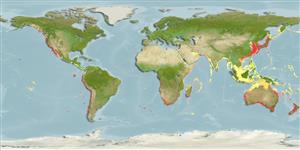
| Native range | All suitable habitat | Point map | Year 2050 |
|
| This map was computer-generated and has not yet been reviewed. |
| Sardinops sagax AquaMaps Data sources: GBIF OBIS |
Hochladen Photos und videos
Bilder | videos | Briefmarken, Münzen, Verschiedenes. | Google Bild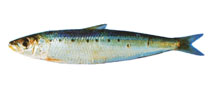 Sardinops sagax
Photo von SeaFIC
Bilder | videos | Briefmarken, Münzen, Verschiedenes. | Google Bild
Photo von SeaFIC
Klassifizierung / Names Namen | Synonyme | Catalog of Fishes(Gattung, Arten) | ITIS | CoL | WoRMS | Cloffa
> Clupeiformes (Herrings) > Alosidae (Shads and Sardines)
Etymology: Sardinops: Latin and Greek, sarda = sardine; name related to the island of Sardinia + Greek, ops = appearance (Ref. 45335); sagax: From the latin word 'sagax' which means of quick perception, acute, or alert (Ref. 6885).
More on author: Jenyns.
Etymology: Sardinops: Latin and Greek, sarda = sardine; name related to the island of Sardinia + Greek, ops = appearance (Ref. 45335); sagax: From the latin word 'sagax' which means of quick perception, acute, or alert (Ref. 6885).
More on author: Jenyns.
Umwelt: Milieu / Klimazone / Tiefenbereich / Verbreitungsgebiet Ökologie
seewasser pelagic-neritic; ozeanodrom (Ref. 138310); tiefenbereich 0 - 200 m (Ref. 188). Subtropical; 9°C - 21°C (Ref. 6390); 61°N - 47°S, 145°W - 180°E (Ref. 36641)
Verbreitung Territorien | FAO Gebiete | Ökosysteme | Vorkommen | Punkt Karte | Einführungen | Faunafri
Indo-Pacific: southern Africa to eastern Pacific (Ref. 27267). Three lineages were confirmed through cluster and parsimony analyses of haplotypic divergences: southern Africa (ocellatus) and Australia (neopilchardus); Chile (sagax) and California (caeruleus); and, Japan (melanostictus) (Ref. 36641).
Länge bei der ersten Reifung / Größe / Gewicht / Alter
Geschlechtsreife: Lm 9.0 range ? - ? cm
Max length : 39.5 cm SL Männchen/unbestimmt; (Ref. 9291); common length : 20.0 cm SL Männchen/unbestimmt; (Ref. 188); max. veröff. Gewicht: 486.00 g (Ref. 6885); max. veröff. Alter: 25 Jahre (Ref. 188)
Max length : 39.5 cm SL Männchen/unbestimmt; (Ref. 9291); common length : 20.0 cm SL Männchen/unbestimmt; (Ref. 188); max. veröff. Gewicht: 486.00 g (Ref. 6885); max. veröff. Alter: 25 Jahre (Ref. 188)
Kurzbeschreibung Bestimmungsschlüssel | Morphologie | Morphometrie
Rückenflossenstacheln (insgesamt) : 0; Rückenflossenweichstrahlen (insgesamt) : 13 - 21; Afterflossenstacheln: 0; Afterflossenweichstrahlen: 12 - 23; Wirbelzahl: 48 - 54. Body cylindrical and elongate; ventral part of operculum with clear cut bony striae radiating downwards; belly rounded with ventral scutes; back blue green; flanks white, with 1 to 3 series of dark spots along the middle (Ref. 55763). The radiating bony striae on the operculum distinguish this species from all other clupeids in the area. The radiating bony striae on the operculum distinguish this fish from all other clupeids in the area. In New Zealand the species appears to grow larger (21.3 cm standard length; cf. 19.7 cm), has slightly larger eggs and a higher mean number of vertebrae (50.52; cf. 49 to 50.08 in various samples) (Ref. 859).
Body shape (shape guide): fusiform / normal; Cross section: compressed.
Body shape (shape guide): fusiform / normal; Cross section: compressed.
Neritic (Ref. 11230). A coastal species that forms large schools (Ref. 188). Adults occur at temperatures ranging from 16° to 23°C in summer and from 10° to 18°C in winter. They feed mainly on planktonic crustaceans. Young fish feed on zooplankton such as copepod and adults on phytoplankton (Ref. 39882). Oviparous, with pelagic eggs, and pelagic larvae (Ref. 265). Possibly can live up to 25 years (Ref. 265). In the California region, pilchards make northward migrations early in summer and travel back south again in autumn. With each year of life, the migration becomes farther (Ref. 6885). Marketed fresh, frozen or canned. Utilized mainly for fish meal; but also eaten fried and broiled (Ref. 9988). Main source of landing: NE Pacific: Mexico (Ref. 4931).
Lebenszyklus und Paarungsverhalten Geschlechtsreife | Fortpflanzung | Ablaichen | Eier | Fruchtbarkeit | Larven
Oviparous (Ref. 265). In the Gulf of California, some individuals spawn in their first year, but most in their second (Ref. 188).
In Australia (as S. neopilchardus), this species breeds in spring and summer in southern part of range, and in summer and autumn in northern part, apparently related to seasonal movement of the limiting 14°C and 21°C isotherms, then autumn to early spring (Ref. 6390). It was believed that individual Australian pilchards only spawn once or twice in a season (Ref. 26422, 26424), but research on related species suggests that they may spawn a number of times (Ref. 6882). Batch fecundities range from about 10,000 eggs in 13 cm long females to about 45,000 eggs in females of about 18 cm (Ref. 26420).
Hauptreferenz
Laden Sie Ihre Referenzen hoch | Referenzen | Koordinator | Partner
Whitehead, P.J.P., 1985. FAO Species Catalogue. Vol. 7. Clupeoid fishes of the world (suborder Clupeoidei). An annotated and illustrated catalogue of the herrings, sardines, pilchards, sprats, shads, anchovies and wolf-herrings. FAO Fish. Synop. 125(7/1):1-303. Rome: FAO. (Ref. 188)
IUCN Rote Liste Status (Ref. 130435: Version 2025-2 (Global))
nicht bedroht (LC) ; Date assessed: 18 July 2018
CITES
Not Evaluated
Bedrohung für Menschen
Harmless
Nutzung durch Menschen
Fischereien: hoch kommerziell; Köder: usually
FAO - Fischereien: landungen, Artbeschreibung; Publication: search | FishSource | Das Meer um uns herum
Mehr Information
Trophische Ökologie
Lebensmittel (Beutetiere)
Nahrungszusammensetzung
Nahrungsaufnahme
Lebensmittelrationen
Räuber
Lebensmittel (Beutetiere)
Nahrungszusammensetzung
Nahrungsaufnahme
Lebensmittelrationen
Räuber
Populationsdynamik
Wachstumsparameter
Max. Alter/Größen
Länge-Gewicht-Rel.
Länge-Länge-Verhältnis.
Längenhäufigkeiten
Massenkonvertierung
Rekrutierung
Dichte
Wachstumsparameter
Max. Alter/Größen
Länge-Gewicht-Rel.
Länge-Länge-Verhältnis.
Längenhäufigkeiten
Massenkonvertierung
Rekrutierung
Dichte
Lebenszyklus
Fortpflanzung
Geschlechtsreife
Reifung/Kiemen rel.
Fruchtbarkeit
Ablaichen
Laichaggregationen
Eier
Eientwicklung
Larven
Larven Pop.Dyn.
Fortpflanzung
Geschlechtsreife
Reifung/Kiemen rel.
Fruchtbarkeit
Ablaichen
Laichaggregationen
Eier
Eientwicklung
Larven
Larven Pop.Dyn.
Physiologie
Körperliche Zusammensetzung
Nährstoffe
Sauerstoffverbrauch
Schwimmart
Schwimmgeschwindigkeit
Visuelle Pigmente
Fischgeräusche
Krankheiten und Parasiten
Toxizität (LC50s)
Körperliche Zusammensetzung
Nährstoffe
Sauerstoffverbrauch
Schwimmart
Schwimmgeschwindigkeit
Visuelle Pigmente
Fischgeräusche
Krankheiten und Parasiten
Toxizität (LC50s)
Menschenbezogen
Aquakultur-Systeme
Aquakultur Profile
Zuchtlinien
Ciguatera-Fälle
Briefmarken, Münzen, Verschiedenes.
Aquakultur-Systeme
Aquakultur Profile
Zuchtlinien
Ciguatera-Fälle
Briefmarken, Münzen, Verschiedenes.
Tools
E-Book | Feldführer | Bestimmungsschlüssel | Längenhäufigkeits Tool | Lebensdaten Tool | Punkt Karte |
Catch-MSY |
Zusatzinformationen
Download XML
Zusammenfassung | Punktdaten | Namen | Photos
Internet Quellen
AFORO (otoliths) | Aquatic Commons | BHL | Cloffa | Websites from users | FishWatcher Einträge suchen | CISTI | Catalog of Fishes: Gattung, Arten | DiscoverLife | ECOTOX | FAO - Fischereien: landungen, Artbeschreibung; Publication: search | Faunafri | Fishipedia | Fishtrace | GloBI | Google Books | Google Scholar | Google | IGFA World Record | Nationale Datenbanken | OceanAdapt | OneZoom | Open Tree of Life | OsteoBase: skull, spine | Otolith Atlas of Taiwan Fishes | Öffentliche Aquarien | PubMed | Reef Life Survey | Socotra Atlas | TreeBase | Tree of Life | Wikipedia: Gehe zu, Suchen | World Records Freshwater Fishing | Zoologischer Rekord
Schätzungen auf der Grundlage von Modellen
Bevorzugte Temperatur (Ref. 123201): 9.5 - 25.2, mean 17.9 °C (based on 938 cells).
Phylogenetischer Diversitätsindex (Ref. 82804): PD50 = 1.0000 [Uniqueness, from 0.5 = low to 2.0 = high].
Bayesian length-weight: a=0.00776 (0.00640 - 0.00942), b=3.10 (3.05 - 3.15), in cm total length, based on LWR estimates for this species (Ref. 93245).
Trophische Ebene (Ref. 69278): 2.8 ±0.1 se; based on diet studies.
Generation time: 2.6 (2.2 - 2.8) years. Estimated as median ln(3)/K based on 58 growth studies.
Widerstandsfähigkeit (Ref. 120179): mittel, Verdopplung der Population dauert 1,4 - 4,4 Jahre. (K=0.45; tm=2; tmax=13-25; Fec=10,000).
Prior r = 0.54, 95% CL = 0.36 - 0.81, Based on 6 full stock assessments.
Nährstoffe (Ref. 124155): Calcium = 185 [49, 457] mg/100g; Iron = 2.12 [0.69, 5.66] mg/100g; Protein = 20.5 [17.9, 22.6] %; Omega3 = 0.762 [0.385, 1.536] g/100g; Selenium = 43.3 [13.0, 137.7] μg/100g; VitaminA = 14.8 [2.9, 62.4] μg/100g; Zinc = 1.85 [0.57, 3.60] mg/100g (wet weight); based on nutrient studies.