



Glaucostegus obtusus (Müller & Henle, 1841)
Widenose guitarfish
上传你的 图片 和 影像
照片 | 谷歌图片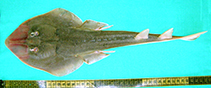 Glaucostegus obtusus
图片提供人 Osmany, H.B.
照片 | 谷歌图片
图片提供人 Osmany, H.B.
分类 / 名称 俗名 | 同种异名 | Catalog of Fishes(属, 种) | ITIS | CoL | WoRMS | Cloffa
Elasmobranchii 板鳃亚纲 (鲨鱼与 鱼) (sharks and rays) > Rhinopristiformes (Shovelnose rays) > Glaucostegidae (Giant guitarfishes)
More on authors: Müller & Henle.
More on authors: Müller & Henle.
环境:氛围 / 气候带 / 深度上下限 / 分布范围 生态学
分布 领土 | FAO区域 | 生态系 | 标本纪录 | 分布图 | 简介 | Faunafri
Northern Indian Ocean: Pakistan to Thailand, with eastern limits unclear (Ref. 114953). South African records refer to Rhinobatos blochii and Rhinobatos leucospilus (Compagno pers. comm.).
印度-西太平洋: 巴基斯坦外海到 '馬來列島' 與那 '東的 Indies', 更多特殊的紀錄從區域不確認。 南非記錄指的是 Rhinobatos blochii 與 Rhinobatos leucospilus(Compagno pers. comm.)。
印度-西太平洋: 巴基斯坦外海到 '馬來列島' 與那 '東的 Indies', 更多特殊的紀錄從區域不確認。 南非記錄指的是 Rhinobatos blochii 與 Rhinobatos leucospilus(Compagno pers. comm.)。
大小 / 重量 / 年龄
简单描述 检索表 | 型态特徵 | 形态测量图
This species is distinguished by the following: colour uniform greyish to brownish body and shovel-shaped disc; short snout broadly triangular, broad oblique nostrils with an oval anterior opening; disc flattened centrally, its length ca 1.2 times its width, anterior margin largely convex, outer corner broadly rounded to abruptly angular; snout relatively obtuse, ca. 80° angle, tip broadly rounded and not extended forward as a lobe, very small orbit its length ca 6.5 time preorbital length, 2.5-2.7 in interorbital space; rostral ridges are well separated, margin of cranium sharply demarcated before eyes; one small spiracular fold; nostrils much shorter than mouth, subequal to internasal width, ca. 50-52 nasal lamellae; anterior nasal flaps barely penetrating into internasal space, the interspace equal to 2.4-2.5 times length of posterior nasal aperture; rough skin covered with small denticles, enlarged slightly and more granular on dorsal surface than ventrally; along midline of the body in young are thorns in irregular row, irregular in shape, often obscure in adults; no obvious patch on each shoulder or greatly enlarged thorns in snout tip and around orbits; long tail, 1.4-1.6 times disc length; short dorsal fins, apices rounded, close together, interspace exceeding twice base length of first dorsal fin, well separated from pelvic fins (Ref. 114953).
Body shape (shape guide): elongated; Cross section: flattened.
Body shape (shape guide): elongated; Cross section: flattened.
Found inshore and offshore (Ref. 9909). Ovoviviparous (Ref. 50449). Biology little known (Ref. 9909); but males are known to be mature ca. 48 cm TL (Ref. 114953). Probably utilized where it occurs, but details lacking (Ref. 9909).
发现于岸边了与外海.(参考文献 9909) 卵胎生的.(参考文献 50449) 生物学特性知道的很少.(参考文献 9909) 可能利用了在哪里它出现, 但是细说缺乏.(参考文献 9909)
发现于岸边了与外海.(参考文献 9909) 卵胎生的.(参考文献 50449) 生物学特性知道的很少.(参考文献 9909) 可能利用了在哪里它出现, 但是细说缺乏.(参考文献 9909)
生命周期和交配行为 成熟度 | 繁殖 | 产卵场 | 卵 | 孕卵数 | 仔鱼
Exhibit ovoviparity (aplacental viviparity), with embryos feeding initially on yolk, then receiving additional nourishment from the mother by indirect absorption of uterine fluid enriched with mucus, fat or protein through specialised structures (Ref. 50449).印度-西太平洋: 巴基斯坦外海到 '馬來列島' 與那 '東的 Indies', 更多特殊的紀錄從區域不確認。 南非記錄指的是 Rhinobatos blochii 與 Rhinobatos leucospilus(Compagno pers. comm.)。
主要参考文献
上传您的参考资料 | 参考文献 | 合作者 | 合作者
Compagno, L.J.V., 1999. Checklist of living elasmobranchs. p. 471-498. In W.C. Hamlett (ed.) Sharks, skates, and rays: the biology of elasmobranch fishes. Johns Hopkins University Press, Maryland. (Ref. 35766)
世界自然保护联盟红皮书 (Ref. 130435: Version 2025-2 (Global))
极度濒危 (CR) (A2bd); Date assessed: 03 December 2018
对人类的威胁
无害处的
人类利用
FAO - Publication: search | FishSource |
更多信息
营养生态学
食物(猎物)
食性组成
食物消耗量
口粮
捕食者
食物(猎物)
食性组成
食物消耗量
口粮
捕食者
生态学
生态学
生态学
人口动态
成长参数
最大年龄/尺寸
长度-重量关系
长短关系
体长-频率
质量转换
入添量
丰度
成长参数
最大年龄/尺寸
长度-重量关系
长短关系
体长-频率
质量转换
入添量
丰度
工具
特别资料
下载 XML
网络资源
AFORO (otoliths) | Aquatic Commons | BHL | Cloffa | Websites from users | 核实 FishWatcher | CISTI | Catalog of Fishes: 属, 种 | DiscoverLife | ECOTOX | FAO - Publication: search | Faunafri | Fishipedia | Fishtrace | GloBI | Google Books | Google Scholar | Google | IGFA World Record | OneZoom | Open Tree of Life | Otolith Atlas of Taiwan Fishes | PubMed | Reef Life Survey | Socotra Atlas | TreeBase | 树状分类阶层 | Wikipedia: 转至, 搜寻 | World Records Freshwater Fishing | 动物学的记录
基于模型的估算
系统发育多样性指数 (参考文献 82804): PD50 = 0.5020 [Uniqueness, from 0.5 = low to 2.0 = high].
Bayesian length-weight: a=0.00347 (0.00143 - 0.00840), b=3.10 (2.89 - 3.31), in cm total length, based on LWR estimates for this (Sub)family-body shape (Ref. 93245).
营养阶层 (参考文献 69278): 3.5 ±0.5 se; based on size and trophs of closest relatives
回复力 (参考文献 120179): 低的, 最小族群倍增时间4.5 - 14 年 (Fec assumed to be <100).