



Glaucostegus obtusus (Müller & Henle, 1841)
Widenose guitarfish
Carica il tuo foto e Video
Immagini | Google image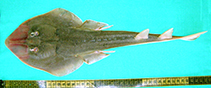 Glaucostegus obtusus
Immagine di Osmany, H.B.
Immagini | Google image
Immagine di Osmany, H.B.
Classificazione / Nomi Nomi Comuni | Sinonimi | Catalog of Fishes(Genere, Specie) | ITIS | CoL | WoRMS | Cloffa
Elasmobranchi (squali e razze) (sharks and rays) > Rhinopristiformes (Shovelnose rays) > Glaucostegidae (Giant guitarfishes)
More on authors: Müller & Henle.
More on authors: Müller & Henle.
Ambiente: milieu / zona climatica / distribuzione batimetrica / gamma di distribuzione Ecologia
marino demersale; distribuzione batimetrica ? - 60 m (Ref. 114953). Tropical; 25°N - 0°N, 61°E - 105°E (Ref. 114953)
Distribuzione Territories | Aree FAO | Ecosistemi | Presenze | Mappa dei ritrovamenti | Introduzioni | Faunafri
Northern Indian Ocean: Pakistan to Thailand, with eastern limits unclear (Ref. 114953). South African records refer to Rhinobatos blochii and Rhinobatos leucospilus (Compagno pers. comm.).
Dimensione / Peso / Età
Breve descrizione Chiavi di identificazione | Morfologia | Morfometria
This species is distinguished by the following: colour uniform greyish to brownish body and shovel-shaped disc; short snout broadly triangular, broad oblique nostrils with an oval anterior opening; disc flattened centrally, its length ca 1.2 times its width, anterior margin largely convex, outer corner broadly rounded to abruptly angular; snout relatively obtuse, ca. 80° angle, tip broadly rounded and not extended forward as a lobe, very small orbit its length ca 6.5 time preorbital length, 2.5-2.7 in interorbital space; rostral ridges are well separated, margin of cranium sharply demarcated before eyes; one small spiracular fold; nostrils much shorter than mouth, subequal to internasal width, ca. 50-52 nasal lamellae; anterior nasal flaps barely penetrating into internasal space, the interspace equal to 2.4-2.5 times length of posterior nasal aperture; rough skin covered with small denticles, enlarged slightly and more granular on dorsal surface than ventrally; along midline of the body in young are thorns in irregular row, irregular in shape, often obscure in adults; no obvious patch on each shoulder or greatly enlarged thorns in snout tip and around orbits; long tail, 1.4-1.6 times disc length; short dorsal fins, apices rounded, close together, interspace exceeding twice base length of first dorsal fin, well separated from pelvic fins (Ref. 114953).
Body shape (shape guide): elongated; Cross section: flattened.
Body shape (shape guide): elongated; Cross section: flattened.
Found inshore and offshore (Ref. 9909). Ovoviviparous (Ref. 50449). Biology little known (Ref. 9909); but males are known to be mature ca. 48 cm TL (Ref. 114953). Probably utilized where it occurs, but details lacking (Ref. 9909).
Ciclo vitale e comportamento di accoppiamento Maturità | Riproduzione | Deposizione | Uova | Fecondità | Larve
Exhibit ovoviparity (aplacental viviparity), with embryos feeding initially on yolk, then receiving additional nourishment from the mother by indirect absorption of uterine fluid enriched with mucus, fat or protein through specialised structures (Ref. 50449).
Riferimento principale
Caricare le referenze | Bibliografia | Coordinatore | Collaboratori
Compagno, L.J.V., 1999. Checklist of living elasmobranchs. p. 471-498. In W.C. Hamlett (ed.) Sharks, skates, and rays: the biology of elasmobranch fishes. Johns Hopkins University Press, Maryland. (Ref. 35766)
Stato della Lista Rossa IUCN (Ref. 130435: Version 2025-2 (Global))
Critically Endangered (CR) (A2bd); Date assessed: 03 December 2018
Minaccia per l'uomo
Harmless
Usi umani
FAO - Publication: search | FishSource |
Informazioni ulteriori
Ecologia trofica
Articoli alimentari (prede)
Alimentazione
Consumo di cibo
Razioni alimentari
Predatori
Articoli alimentari (prede)
Alimentazione
Consumo di cibo
Razioni alimentari
Predatori
Ecologia
Ecologia
Ecologia
Dinamica della popolazione
Parametri di crescita
Età massima / dimensioni massime
Rapporto lunghezza-peso.
Lunghezza-lunghezza rel.
Lunghezza-frequenze
Conversione di massa
Reclutamento
Abbondanza
Parametri di crescita
Età massima / dimensioni massime
Rapporto lunghezza-peso.
Lunghezza-lunghezza rel.
Lunghezza-frequenze
Conversione di massa
Reclutamento
Abbondanza
Ciclo di vita
Riproduzione
Maturità
Maturità/Gli occhielli sono relativi.
Fecondità
Deposizione
Aggregazioni riproduttive
Uova
Sviluppo delle uova
Larve
Dinamica popolazioni larvali
Riproduzione
Maturità
Maturità/Gli occhielli sono relativi.
Fecondità
Deposizione
Aggregazioni riproduttive
Uova
Sviluppo delle uova
Larve
Dinamica popolazioni larvali
Anatomia
Area branchiale
Cervello
Otolite
Area branchiale
Cervello
Otolite
Fisiologia
Composizione corporea
Nutrienti
Consumo di ossigeno
Tipo di nuoto
Velocità di nuoto
Pigmenti visivi
Suono del pesce
Malattie e parassiti
Tossicità (LC50)
Composizione corporea
Nutrienti
Consumo di ossigeno
Tipo di nuoto
Velocità di nuoto
Pigmenti visivi
Suono del pesce
Malattie e parassiti
Tossicità (LC50)
Genetica
Genome
Genetica
Eterozigosi
Ereditarietà
Diversità genetica
Genome
Genetica
Eterozigosi
Ereditarietà
Diversità genetica
Legato all'uomo
Sistemi di acquacoltura
Profili di acquacoltura
Varietà
Casi di Ciguatera
Francobolli, monete, materiale vario.
Sistemi di acquacoltura
Profili di acquacoltura
Varietà
Casi di Ciguatera
Francobolli, monete, materiale vario.
Strumenti
Libro elettronico | Giuda pratica | Chiavi di identificazione | Generatore frequenze di lunghezza | Strumento Parametri Biologici | Mappa dei ritrovamenti |
Cattura-MSY |
Rapporti speciali
Controllo della manutenzione dell'acquario | Verificare la presenza di schede informative sulle specie | Verifica delle schede informative sull'acquacoltura
Scarica XML
Fonti Internet
AFORO (otoliths) | Aquatic Commons | BHL | Cloffa | Websites from users | Check FishWatcher | CISTI | Catalog of Fishes: Genere, Specie | DiscoverLife | ECOTOX | FAO - Publication: search | Faunafri | Fishipedia | Fishtrace | GloBI | Google Books | Google Scholar | Google | IGFA World Record | OneZoom | Open Tree of Life | Otolith Atlas of Taiwan Fishes | PubMed | Reef Life Survey | Socotra Atlas | TreeBase | Tree of Life | Wikipedia: Go, ricerca | World Records Freshwater Fishing | Record zoologico
Stime basate su modelli
Indice di diversità filogenetica (Fonte Biblio. 82804): PD50 = 0.5020 [Uniqueness, from 0.5 = low to 2.0 = high].
Bayesian length-weight: a=0.00347 (0.00143 - 0.00840), b=3.10 (2.89 - 3.31), in cm total length, based on LWR estimates for this (Sub)family-body shape (Ref. 93245).
Livello trofico (Fonte Biblio. 69278): 3.5 ±0.5 se; based on size and trophs of closest relatives
Resilienza (Fonte Biblio. 120179): Basso, tempo minimo di raddoppiamento della popolazione 4.5 - 14 anni (Fec assumed to be <100).