



Glaucostegus obtusus (Müller & Henle, 1841)
Widenose guitarfish
Envoyez vos Photos et vidéos
Images | Images Google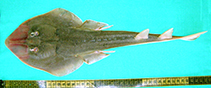 Glaucostegus obtusus
Photo de Osmany, H.B.
Images | Images Google
Photo de Osmany, H.B.
Classification / Noms Noms communs | Synonymes | Catalog of Fishes(Genre, Espèce) | ITIS | CoL | WoRMS | Cloffa
Élasmobranches (requins et raies) (sharks and rays) > Rhinopristiformes (Shovelnose rays) > Glaucostegidae (Giant guitarfishes)
More on authors: Müller & Henle.
More on authors: Müller & Henle.
Environnement : milieu / zone climatique / profondeur / gamme de distribution Écologie
Distribution Territoires | Zones FAO | Écosystèmes | Occurrences | Carte par point | Introductions | Faunafri
Northern Indian Ocean: Pakistan to Thailand, with eastern limits unclear (Ref. 114953). South African records refer to Rhinobatos blochii and Rhinobatos leucospilus (Compagno pers. comm.).
Taille / Poids / Âge
Description synthétique Clés d'identification | Morphologie | Morphométrie
This species is distinguished by the following: colour uniform greyish to brownish body and shovel-shaped disc; short snout broadly triangular, broad oblique nostrils with an oval anterior opening; disc flattened centrally, its length ca 1.2 times its width, anterior margin largely convex, outer corner broadly rounded to abruptly angular; snout relatively obtuse, ca. 80° angle, tip broadly rounded and not extended forward as a lobe, very small orbit its length ca 6.5 time preorbital length, 2.5-2.7 in interorbital space; rostral ridges are well separated, margin of cranium sharply demarcated before eyes; one small spiracular fold; nostrils much shorter than mouth, subequal to internasal width, ca. 50-52 nasal lamellae; anterior nasal flaps barely penetrating into internasal space, the interspace equal to 2.4-2.5 times length of posterior nasal aperture; rough skin covered with small denticles, enlarged slightly and more granular on dorsal surface than ventrally; along midline of the body in young are thorns in irregular row, irregular in shape, often obscure in adults; no obvious patch on each shoulder or greatly enlarged thorns in snout tip and around orbits; long tail, 1.4-1.6 times disc length; short dorsal fins, apices rounded, close together, interspace exceeding twice base length of first dorsal fin, well separated from pelvic fins (Ref. 114953).
Body shape (shape guide): elongated; Cross section: flattened.
Body shape (shape guide): elongated; Cross section: flattened.
Found inshore and offshore (Ref. 9909). Ovoviviparous (Ref. 50449). Biology little known (Ref. 9909); but males are known to be mature ca. 48 cm TL (Ref. 114953). Probably utilized where it occurs, but details lacking (Ref. 9909).
Cycle de vie et comportement reproducteur Maturité | Reproduction | Frai | Œufs | Fécondité | Larves
Exhibit ovoviparity (aplacental viviparity), with embryos feeding initially on yolk, then receiving additional nourishment from the mother by indirect absorption of uterine fluid enriched with mucus, fat or protein through specialised structures (Ref. 50449).
Référence principale
Téléchargez vos références | Références | Coordinateur | Collaborateurs
Compagno, L.J.V., 1999. Checklist of living elasmobranchs. p. 471-498. In W.C. Hamlett (ed.) Sharks, skates, and rays: the biology of elasmobranch fishes. Johns Hopkins University Press, Maryland. (Ref. 35766)
Statut dans la liste rouge de l'IUCN (Ref. 130435: Version 2025-2 (Global))
Niveau de menace critique (CR) (A2bd); Date assessed: 03 December 2018
Menace pour l'homme
Harmless
Utilisations par l'homme
FAO - Publication: search | FishSource |
Plus d'informations
Écologie trophique
Aliments (proies)
Composition du régime alimentaire
Consommation alimentaire
Rations alimentaires
Prédateurs
Aliments (proies)
Composition du régime alimentaire
Consommation alimentaire
Rations alimentaires
Prédateurs
Écologie
Écologie
Écologie
Dynamique des populations
Paramètres de croissance
Âges / tailles maximales
Longueur-poids rel.
Rel. longueur-longueur.
Fréquences de longueurs
Conversion de masse
Recrutement
Abondance
Paramètres de croissance
Âges / tailles maximales
Longueur-poids rel.
Rel. longueur-longueur.
Fréquences de longueurs
Conversion de masse
Recrutement
Abondance
Cycle de vie
Reproduction
Maturité
Maturité/épines rel.
Fécondité
Frai
Agrégats de frai
Œufs
Développement de l'œuf
Larves
Dynamique des populations larvaires
Reproduction
Maturité
Maturité/épines rel.
Fécondité
Frai
Agrégats de frai
Œufs
Développement de l'œuf
Larves
Dynamique des populations larvaires
Anatomie
Surface branchiale
Cerveau
Otolithe
Surface branchiale
Cerveau
Otolithe
Physiologie
Composition corporelle
Nutriments
Consommation d'oxygène
Type de natation
Vitesse de nage
Pigments visuels
Son de poisson
Maladies et parasites
Toxicité (CL50)
Composition corporelle
Nutriments
Consommation d'oxygène
Type de natation
Vitesse de nage
Pigments visuels
Son de poisson
Maladies et parasites
Toxicité (CL50)
Génétique
génôme
Génétique
Hétérozygotie
Héritabilité
Diversité génétique
génôme
Génétique
Hétérozygotie
Héritabilité
Diversité génétique
Liées à l'homme
Systèmes d'aquaculture
Profils d'aquaculture
Souches
Cas de ciguatera
Timbres, pièces de monnaie, divers
Systèmes d'aquaculture
Profils d'aquaculture
Souches
Cas de ciguatera
Timbres, pièces de monnaie, divers
Outils
E-book | Guide de terrain | Clés d'identification | Générateur de fréquences de longueur | Outil de dynamique de population | Carte par point |
Capture-MSY |
Articles particuliers
Télécharger en XML
Sources Internet
AFORO (otoliths) | Aquatic Commons | BHL | Cloffa | Websites from users | FishWatcher | CISTI | Catalog of Fishes: Genre, Espèce | DiscoverLife | ECOTOX | FAO - Publication: search | Faunafri | Fishipedia | Fishtrace | GloBI | Google Books | Google Scholar | Google | IGFA World Record | OneZoom | Open Tree of Life | Otolith Atlas of Taiwan Fishes | PubMed | Reef Life Survey | Socotra Atlas | TreeBase | Arbre de Vie | Wikipedia: aller à, chercher | World Records Freshwater Fishing | Zoological Record
Estimations basées sur des modèles
Indice de diversité phylogénétique (Réf. 82804): PD50 = 0.5020 [Uniqueness, from 0.5 = low to 2.0 = high].
Bayesian length-weight: a=0.00347 (0.00143 - 0.00840), b=3.10 (2.89 - 3.31), in cm total length, based on LWR estimates for this (Sub)family-body shape (Ref. 93245).
Niveau trophique (Réf. 69278): 3.5 ±0.5 se; based on size and trophs of closest relatives
Résilience (Réf. 120179): Faible, temps minimum de doublement de population : 4,5 à 14 années (Fec assumed to be <100).