



Glaucostegus obtusus (Müller & Henle, 1841)
Widenose guitarfish
Uploaden van uw Foto's en video's
Afbeeldingen | Google afbeelding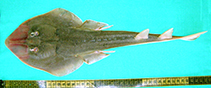 Glaucostegus obtusus
Afbeelding van Osmany, H.B.
Afbeeldingen | Google afbeelding
Afbeelding van Osmany, H.B.
Classificatie / Namen Lokale namen | Synoniemen | Catalog of Fishes(Genus, Soort(en)) | ITIS | CoL | WoRMS | Cloffa
Elasmobranchii (haaien en roggen) (sharks and rays) > Rhinopristiformes (Shovelnose rays) > Glaucostegidae (Giant guitarfishes)
More on authors: Müller & Henle.
More on authors: Müller & Henle.
Milieu: milieu / Klimaatzone / Diepte / verspreidingsgebied Ecologie
Verspreiding Gebieden | FAO regio's | Ecosystemen | Voorkomen | Verspreidingskaart | Introducties | Faunafri
Northern Indian Ocean: Pakistan to Thailand, with eastern limits unclear (Ref. 114953). South African records refer to Rhinobatos blochii and Rhinobatos leucospilus (Compagno pers. comm.).
Grootte / Gewicht / Leeftijd
Korte beschrijving Determinatiesleutels | Morfologie | Morfometrie
This species is distinguished by the following: colour uniform greyish to brownish body and shovel-shaped disc; short snout broadly triangular, broad oblique nostrils with an oval anterior opening; disc flattened centrally, its length ca 1.2 times its width, anterior margin largely convex, outer corner broadly rounded to abruptly angular; snout relatively obtuse, ca. 80° angle, tip broadly rounded and not extended forward as a lobe, very small orbit its length ca 6.5 time preorbital length, 2.5-2.7 in interorbital space; rostral ridges are well separated, margin of cranium sharply demarcated before eyes; one small spiracular fold; nostrils much shorter than mouth, subequal to internasal width, ca. 50-52 nasal lamellae; anterior nasal flaps barely penetrating into internasal space, the interspace equal to 2.4-2.5 times length of posterior nasal aperture; rough skin covered with small denticles, enlarged slightly and more granular on dorsal surface than ventrally; along midline of the body in young are thorns in irregular row, irregular in shape, often obscure in adults; no obvious patch on each shoulder or greatly enlarged thorns in snout tip and around orbits; long tail, 1.4-1.6 times disc length; short dorsal fins, apices rounded, close together, interspace exceeding twice base length of first dorsal fin, well separated from pelvic fins (Ref. 114953).
Body shape (shape guide): elongated; Cross section: flattened.
Body shape (shape guide): elongated; Cross section: flattened.
Found inshore and offshore (Ref. 9909). Ovoviviparous (Ref. 50449). Biology little known (Ref. 9909); but males are known to be mature ca. 48 cm TL (Ref. 114953). Probably utilized where it occurs, but details lacking (Ref. 9909).
Levenscyclus en paargedrag Maturiteit | Voortplanting | Paaien | Eieren | Fecunditeit | Larven
Exhibit ovoviparity (aplacental viviparity), with embryos feeding initially on yolk, then receiving additional nourishment from the mother by indirect absorption of uterine fluid enriched with mucus, fat or protein through specialised structures (Ref. 50449).
Hoofdreferentie
Upload uw referenties | Referenties | Coördinator | Medewerkers
Compagno, L.J.V., 1999. Checklist of living elasmobranchs. p. 471-498. In W.C. Hamlett (ed.) Sharks, skates, and rays: the biology of elasmobranch fishes. Johns Hopkins University Press, Maryland. (Ref. 35766)
Status op de Rode Lijst van het IUCN (Ref. 130435: Version 2025-2 (Global))
Ernstig bedreigd (CR) (A2bd); Date assessed: 03 December 2018
Gevaar voor de mens
Harmless
Gebruik door de mens
FAO - Publication: search | FishSource |
Meer informatie
Trofische ecologie
Voedsel (prooien)
Dieetsamenstelling
Voedselconsumptie
Voedselrantsoenen
Predatoren
Voedsel (prooien)
Dieetsamenstelling
Voedselconsumptie
Voedselrantsoenen
Predatoren
Ecologie
Ecologie
Ecologie
Populatiedynamica
Groeiparameters
Max. leeftijden / maten
Lengte-gewicht rel.
Lengte-lengte rel.
Lengtefrequenties
Massaconversie
Rekrutering
Abundantie
Groeiparameters
Max. leeftijden / maten
Lengte-gewicht rel.
Lengte-lengte rel.
Lengtefrequenties
Massaconversie
Rekrutering
Abundantie
Levenscyclus
Voortplanting
Maturiteit
Rijpheid/kieuwen rel.
Fecunditeit
Paaien
Paaibestanden
Eieren
Ontwikkeling van de eieren
Larven
Larvale populatiedynamiek
Voortplanting
Maturiteit
Rijpheid/kieuwen rel.
Fecunditeit
Paaien
Paaibestanden
Eieren
Ontwikkeling van de eieren
Larven
Larvale populatiedynamiek
Anatomie
Kieuwoppervlak
Hersenen
Otoliet
Kieuwoppervlak
Hersenen
Otoliet
Fysiologie
Lichaamssamenstelling
Voedingsstoffen
Zuurstofverbruik
Type zwemmen
Zwemsnelheid
Visuele pigmenten
Vis geluid
Ziekten en parasieten
Toxiciteit (LC50)
Lichaamssamenstelling
Voedingsstoffen
Zuurstofverbruik
Type zwemmen
Zwemsnelheid
Visuele pigmenten
Vis geluid
Ziekten en parasieten
Toxiciteit (LC50)
Genetica
genoom
Genetica
Heterozygositeit
Erfelijkheid
Genetische diversiteit
genoom
Genetica
Heterozygositeit
Erfelijkheid
Genetische diversiteit
Menselijk gerelateerd
Aquacultuursystemen
Aquacultuurprofielen
Kweeklijnen
Ciguatera gevallen
Postzegels, munten, diversen.
Aquacultuursystemen
Aquacultuurprofielen
Kweeklijnen
Ciguatera gevallen
Postzegels, munten, diversen.
Tools
E-boek | Veldgids | Determinatiesleutels | Lengtefrequentie Tool | Levenscyclus tool | Verspreidingskaart |
Vangst-MSY |
Speciale rapporten
Bekijk gegevens voor het houden in een aquarium | Bekijk Fact Sheets voor de soort | Bekijk Aquacultuur Fact Sheets
Download XML
Internetbronnen
AFORO (otoliths) | Aquatic Commons | BHL | Cloffa | Websites from users | Bekijk FishWatcher | CISTI | Catalog of Fishes: Genus, Soort(en) | DiscoverLife | ECOTOX | FAO - Publication: search | Faunafri | Fishipedia | Fishtrace | GloBI | Google Books | Google Scholar | Google | IGFA World Record | OneZoom | Open Tree of Life | Otolith Atlas of Taiwan Fishes | PubMed | Reef Life Survey | Socotra Atlas | TreeBase | Tree of Life | Wikipedia: ga naar, zoek | World Records Freshwater Fishing | Zoological Record
Schattingen op basis van modellen
Fylogenetische diversiteitsindex (Ref. 82804): PD50 = 0.5020 [Uniqueness, from 0.5 = low to 2.0 = high].
Bayesian length-weight: a=0.00347 (0.00143 - 0.00840), b=3.10 (2.89 - 3.31), in cm total length, based on LWR estimates for this (Sub)family-body shape (Ref. 93245).
Trofisch niveau (Ref. 69278): 3.5 ±0.5 se; based on size and trophs of closest relatives
Weerstandsvermogen (Ref. 120179): laag, minimale populatieverdubbelingstijd 4,5-14 jaar (Fec assumed to be <100).