



Envoyez vos Photos et vidéos
Images | Images Google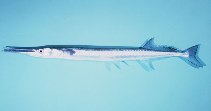 Tylosurus acus
Photo de Randall, J.E.
Images | Images Google
Photo de Randall, J.E.
Classification / Noms Noms communs | Synonymes | Catalog of Fishes(Genre, Espèce) | ITIS | CoL | WoRMS | Cloffa
> Beloniformes (Needle fishes) > Belonidae (Needlefishes)
Etymology: Tylosurus: Greek, tylos = callus + Greek, oura = tail (Ref. 45335).
More on author: Lacepède.
Etymology: Tylosurus: Greek, tylos = callus + Greek, oura = tail (Ref. 45335).
More on author: Lacepède.
Taxonomic Remarks
The 3 subspecies were upraised at species rank, as provisionally accepted names, , until more works are conducted on T. acus susbepcies to fix their status.
Environnement : milieu / zone climatique / profondeur / gamme de distribution Écologie
marin récifal; profondeur 0 - ? m. Subtropical; 43°N - , 98°W - 36°E
Distribution Territoires | Zones FAO | Écosystèmes | Occurrences | Carte par point | Introductions | Faunafri
Western Atlantic: Massachusetts, USA to Brazil. Eastern Atlantic: off Morocco and the Mediterranean (Ref. 5505).
Longueur à la première maturité / Taille / Poids / Âge
Maturité: Lm 47.3, range 45 - 50 cm
Max length : 153 cm TL mâle / non sexé; (Ref. 26340); common length : 90.0 cm SL mâle / non sexé; (Ref. 3129); poids max. publié: 3.7 kg (Ref. 4699)
Max length : 153 cm TL mâle / non sexé; (Ref. 26340); common length : 90.0 cm SL mâle / non sexé; (Ref. 3129); poids max. publié: 3.7 kg (Ref. 4699)
Description synthétique Clés d'identification | Morphologie | Morphométrie
Épines dorsales (Total) : 0; Rayons mous dorsaux (Total) : 20 - 27; Épines anales: 0; Rayons mous anaux: 20 - 24; Vertèbres: 90 - 95. Diagnosis: body elongate; upper and lower jaws extremely long, forming a stout beak armed with very sharp teeth; gill rakers absent (Ref. 57228, 90102). Nostrils in depression before eyes (nasal pit); pelvic fins abdominal; 20-26 dorsal-fin rays; anal fin short, 9.7-11.7 times in body length; small, black lateral keel on either sides of caudal peduncle; caudal fin deeply forked (Ref. 57228).
Body shape (shape guide): elongated; Cross section: circular.
Body shape (shape guide): elongated; Cross section: circular.
Inhabits oceanic and neritic waters (Ref. 26340). Feeds on small fishes. Oviparous (Ref. 205). Eggs may be found attached to objects in the water by tendrils on the egg's surface (Ref. 205). Although sold fresh and salted, its market is limited due to the green-colored flesh (Ref. 5217). Circumglobal in tropical seas and divisible into four subspecies (Ref 90102).
Cycle de vie et comportement reproducteur Maturité | Reproduction | Frai | Œufs | Fécondité | Larves
Référence principale
Téléchargez vos références | Références | Coordinateur : Collette, Bruce B. | Collaborateurs
Robins, C.R. and G.C. Ray, 1986. A field guide to Atlantic coast fishes of North America. Houghton Mifflin Company, Boston, U.S.A. 354 p. (Ref. 7251)
Statut dans la liste rouge de l'IUCN (Ref. 130435: Version 2025-2 (Global))
Préoccupation mineure (LC) ; Date assessed: 10 July 2012
CITES
Not Evaluated
Menace pour l'homme
Traumatogenic (Ref. 26235)
Utilisations par l'homme
Pêcheries: commercial; pêche sportive: oui
FAO - Publication: search | FishSource |
Plus d'informations
Écologie trophique
Aliments (proies)
Composition du régime alimentaire
Consommation alimentaire
Rations alimentaires
Prédateurs
Aliments (proies)
Composition du régime alimentaire
Consommation alimentaire
Rations alimentaires
Prédateurs
Dynamique des populations
Paramètres de croissance
Âges / tailles maximales
Longueur-poids rel.
Rel. longueur-longueur.
Fréquences de longueurs
Conversion de masse
Recrutement
Abondance
Paramètres de croissance
Âges / tailles maximales
Longueur-poids rel.
Rel. longueur-longueur.
Fréquences de longueurs
Conversion de masse
Recrutement
Abondance
Cycle de vie
Reproduction
Maturité
Maturité/épines rel.
Fécondité
Frai
Agrégats de frai
Œufs
Développement de l'œuf
Larves
Dynamique des populations larvaires
Reproduction
Maturité
Maturité/épines rel.
Fécondité
Frai
Agrégats de frai
Œufs
Développement de l'œuf
Larves
Dynamique des populations larvaires
Anatomie
Surface branchiale
Cerveau
Otolithe
Surface branchiale
Cerveau
Otolithe
Physiologie
Composition corporelle
Nutriments
Consommation d'oxygène
Type de natation
Vitesse de nage
Pigments visuels
Son de poisson
Maladies et parasites
Toxicité (CL50)
Composition corporelle
Nutriments
Consommation d'oxygène
Type de natation
Vitesse de nage
Pigments visuels
Son de poisson
Maladies et parasites
Toxicité (CL50)
Génétique
génôme
Génétique
Hétérozygotie
Héritabilité
Diversité génétique
génôme
Génétique
Hétérozygotie
Héritabilité
Diversité génétique
Liées à l'homme
Systèmes d'aquaculture
Profils d'aquaculture
Souches
Cas de ciguatera
Timbres, pièces de monnaie, divers
Systèmes d'aquaculture
Profils d'aquaculture
Souches
Cas de ciguatera
Timbres, pièces de monnaie, divers
Outils
E-book | Guide de terrain | Clés d'identification | Générateur de fréquences de longueur | Outil de dynamique de population | Carte par point |
Capture-MSY |
Articles particuliers
Télécharger en XML
Sources Internet
AFORO (otoliths) | Aquatic Commons | BHL | Cloffa | Websites from users | FishWatcher | CISTI | Catalog of Fishes: Genre, Espèce | DiscoverLife | ECOTOX | FAO - Publication: search | Faunafri | Fishipedia | Fishtrace | GloBI | Google Books | Google Scholar | Google | IGFA World Record | Bases de données nationales | OneZoom | Open Tree of Life | Otolith Atlas of Taiwan Fishes | PubMed | Reef Life Survey | Socotra Atlas | TreeBase | Arbre de Vie | Wikipedia: aller à, chercher | World Records Freshwater Fishing | Zoological Record
Estimations basées sur des modèles
Température préférée (Réf. 123201): 20 - 28.5, mean 26.5 °C (based on 1282 cells).
Indice de diversité phylogénétique (Réf. 82804): PD50 = 0.5010 [Uniqueness, from 0.5 = low to 2.0 = high].
Bayesian length-weight: a=0.00093 (0.00049 - 0.00177), b=3.10 (2.94 - 3.26), in cm total length, based on LWR estimates for this species & (Sub)family-body (Ref. 93245).
Niveau trophique (Réf. 69278): 4.5 ±0.6 se; based on diet studies.
Generation time: 2.5 ( na - na) years. Estimated as median ln(3)/K based on 1 growth studies.
Résilience (Réf. 120179): Haut, temps minimum de doublement de population inférieur à 15 mois (Preliminary K or Fecundity.).
Nutriments (Ref. 124155): Calcium = 33 [8, 135] mg/100g; Iron = 0.498 [0.212, 1.475] mg/100g; Protein = 17.2 [14.4, 20.3] %; Omega3 = 0.16 [0.06, 0.47] g/100g; Selenium = 16.9 [6.9, 46.1] μg/100g; VitaminA = 102 [14, 608] μg/100g; Zinc = 0.447 [0.259, 0.773] mg/100g (wet weight);