



Notoglanidium macrostoma (Pellegrin, 1909)
Flatnose catfish
Adicionar o seu Fotografias e vídeos
Fotografias | Imagem do Google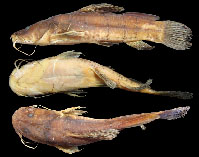 Notoglanidium macrostoma
Fotografia de RMCA/Musschoot, T.
Fotografias | Imagem do Google
Fotografia de RMCA/Musschoot, T.
Classificação / Nomes Nomes comuns | Sinónimos | Catalog of Fishes(Género, Espécies) | ITIS | CoL | WoRMS | Cloffa
> Siluriformes (Catfishes) > Auchenoglanididae (Flatnose catfishes)
Etymology: Notoglanidium: Greek, noton = back + Greek, glanis = a fish that can eat the bait without touching the hook; a cat fish; diminutive (Ref. 45335); macrostoma: From Greek, makros (big) and stoma (mouth), referring to the large mouth of the species (Ref. 94168). The species name macrostomus (Ref. 58032) is an unjustified emendation, as it is a compound noun and therefore must not agree in gender with the genus name (Ref. 98168).
More on author: Pellegrin.
Etymology: Notoglanidium: Greek, noton = back + Greek, glanis = a fish that can eat the bait without touching the hook; a cat fish; diminutive (Ref. 45335); macrostoma: From Greek, makros (big) and stoma (mouth), referring to the large mouth of the species (Ref. 94168). The species name macrostomus (Ref. 58032) is an unjustified emendation, as it is a compound noun and therefore must not agree in gender with the genus name (Ref. 98168).
More on author: Pellegrin.
Ambiente: milieu / zona climática / intervalo de profundidade / gama de distribuição Ecologia
; Água doce demersal; pH range: 6.5 - 8.0; dH range: 4 - 25. Tropical; 23°C - 27°C (Ref. 1672); 5°N - 10°S
Distribuição Territórios | Áreas FAO | Ecossistemas | Ocorrências | Mapa dos pontos | Introduções | Faunafri
Africa: Lower Guinea river basins, from Sanaga River in Cameroon to Chiloango in Angola (Ref. 81642, 94168). Also in the northern half of the Congo River basin (Ref. 94168), including the Dja in Cameroon (Ref. 27938), Sangha in Congo Republic (Ref. 94168) and the middle Congo River basin in Democratic Republic of the Congo (Ref. 27938, 94168).
Tamanho / Peso / Idade
Descrição breve Chaves de identificação | Morfologia | Morfometria
Espinhos dorsais (total) : 2; Raios dorsais moles (total) : 7 - 8; Espinhos anais: 0; Raios anais moles: 10 - 12; Vértebras: 38. Diagnosis: combined premaxillary tooth plate very broad, 33.5-41.7% of head length vs. 30.1-35.3% in N. boutchangai, and less than 30% in the other species; eye diameter large, 9.1-13.3% of head length vs. smaller in N. maculatum, N. pallidum and N. depierrei, but overlapping with eye size range of the other species; interorbital distance rather large, 28.0-36.6% of head length vs. 24.0% or less in N. akiri, N. depierrei, N. pallidum and N. pembetadi; only 7 soft dorsal-fin rays vs. more than 8 in N. depierrei, N. maculatum, N. pallidum, N. pembetadi, N. thomasi and N. walkeri; dorsal fin spine rather long, 6.9-14.7% of standard length vs. shorter in N. depierrei, N. maculatum, N. pembetadi and N. thomasi (Ref. 94168).
Body shape (shape guide): elongated.
Body shape (shape guide): elongated.
Feeding on a wide variety of foods, including such things as fish fry and eggs, crustaceans, insect larvae, and plant material (Ref. 6868).
Ciclo de vida e comportamento de acasalamento Maturidade | Reprodução | Desova | Ovos | Fecundidade | Larvas
Referência principal
Carregar as suas referências | Referências | Coordenador | Colaboradores
Geerinckx, T., E. Vreven, M. Dierick, L.V. Hoorebeke and D. Adriaens, 2013. Revision of Notoglanidium and related genera (Siluriformes: Claroteidae) based on morphology and osteology. Zootaxa 3691(1):165-191. (Ref. 94168)
Categoria na Lista Vermelha da IUCN (Ref. 130435: Version 2025-2 (Global))
Preocupação menor (LC) ; Date assessed: 16 February 2009
CITES
Not Evaluated
Ameaça para o homem
Harmless
Utilização humana
FAO - Publication: search | FishSource |
Mais informação
Ecologia Trófica
Produtos alimentares (presas)
Composição da dieta
Consumo alimentar
Rações alimentares
Predadores
Produtos alimentares (presas)
Composição da dieta
Consumo alimentar
Rações alimentares
Predadores
Dinâmica das populações
Parâmetros de crescimento
Idades / tamanhos máximos
Comprimento-peso rel.
Comprimento-comprimento rel.
Frequência de comprimento
Conversão de massa
Recrutamento
Abundância
Parâmetros de crescimento
Idades / tamanhos máximos
Comprimento-peso rel.
Comprimento-comprimento rel.
Frequência de comprimento
Conversão de massa
Recrutamento
Abundância
Ciclo de vida
Reprodução
Maturidade
Maturidade/Rel. das guelras
Fecundidade
Desova
Agregações de desova
Ovos
Desenvolvimento dos ovos
Larvas
Dinâmica larvar
Reprodução
Maturidade
Maturidade/Rel. das guelras
Fecundidade
Desova
Agregações de desova
Ovos
Desenvolvimento dos ovos
Larvas
Dinâmica larvar
Anatomia
Área branquial
Cérebro
Otólitos
Área branquial
Cérebro
Otólitos
Fisiologia
Composição corporal
Nutrientes
Consumo de oxigénio
Tipo de natação
Velocidade de natação
Pigmentos visuais
Som de peixe
Doenças e Parasitas
Toxicidade (LC50s)
Composição corporal
Nutrientes
Consumo de oxigénio
Tipo de natação
Velocidade de natação
Pigmentos visuais
Som de peixe
Doenças e Parasitas
Toxicidade (LC50s)
Genética
genoma
Genética
Heterozigotia
Hereditariedade
Diversidade genética
genoma
Genética
Heterozigotia
Hereditariedade
Diversidade genética
Relacionado com o ser humano
Sistemas de aquacultura
Perfis para aquacultura
Estirpes
Casos de Ciguatera
Selos, moedas, diversos.
Sistemas de aquacultura
Perfis para aquacultura
Estirpes
Casos de Ciguatera
Selos, moedas, diversos.
Ferramentas
E-book | Guia de campo | Chaves de identificação | Ferramenta auxiliar de frequências de comprimento | Ferramenta sobre a história de vida | Mapa dos pontos |
Captura-MSY |
Relatórios especiais
Descarregue XML
Fontes da internet
AFORO (otoliths) | Aquatic Commons | BHL | Cloffa | Websites from users | Consultar FishWatcher | CISTI | Catalog of Fishes: Género, Espécies | DiscoverLife | ECOTOX | FAO - Publication: search | Faunafri | Fishipedia | Fishtrace | GloBI | Google Books | Google Scholar | Google | IGFA World Record | OneZoom | Open Tree of Life | Otolith Atlas of Taiwan Fishes | PubMed | Reef Life Survey | Socotra Atlas | TreeBase | Árvore da vida | Wikipedia: ir para, procurar | World Records Freshwater Fishing | Registo zoológico
Estimativas baseadas em modelos
Índice de diversidade filogenética (Ref. 82804): PD50 = 0.5020 [Uniqueness, from 0.5 = low to 2.0 = high].
Bayesian length-weight: a=0.00525 (0.00219 - 0.01260), b=3.09 (2.87 - 3.31), in cm total length, based on LWR estimates for this (Sub)family-body shape (Ref. 93245).
Nível Trófico (Ref. 69278): 3.8 ±0.59 se; based on food items.
Resiliência (Ref. 120179): Elevada, tempo mínimo de duplicação da população menor que 15 meses (Preliminary K or Fecundity.).