



Notoglanidium macrostoma (Pellegrin, 1909)
Flatnose catfish
Hochladen Photos und videos
Bilder | Google Bild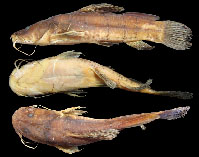 Notoglanidium macrostoma
Photo von RMCA/Musschoot, T.
Bilder | Google Bild
Photo von RMCA/Musschoot, T.
Klassifizierung / Names Namen | Synonyme | Catalog of Fishes(Gattung, Arten) | ITIS | CoL | WoRMS | Cloffa
> Siluriformes (Catfishes) > Auchenoglanididae (Flatnose catfishes)
Etymology: Notoglanidium: Greek, noton = back + Greek, glanis = a fish that can eat the bait without touching the hook; a cat fish; diminutive (Ref. 45335); macrostoma: From Greek, makros (big) and stoma (mouth), referring to the large mouth of the species (Ref. 94168). The species name macrostomus (Ref. 58032) is an unjustified emendation, as it is a compound noun and therefore must not agree in gender with the genus name (Ref. 98168).
More on author: Pellegrin.
Etymology: Notoglanidium: Greek, noton = back + Greek, glanis = a fish that can eat the bait without touching the hook; a cat fish; diminutive (Ref. 45335); macrostoma: From Greek, makros (big) and stoma (mouth), referring to the large mouth of the species (Ref. 94168). The species name macrostomus (Ref. 58032) is an unjustified emendation, as it is a compound noun and therefore must not agree in gender with the genus name (Ref. 98168).
More on author: Pellegrin.
Umwelt: Milieu / Klimazone / Tiefenbereich / Verbreitungsgebiet Ökologie
; süßwasser demersal; pH range: 6.5 - 8.0; dH range: 4 - 25. Tropical; 23°C - 27°C (Ref. 1672); 5°N - 10°S
Verbreitung Territorien | FAO Gebiete | Ökosysteme | Vorkommen | Punkt Karte | Einführungen | Faunafri
Africa: Lower Guinea river basins, from Sanaga River in Cameroon to Chiloango in Angola (Ref. 81642, 94168). Also in the northern half of the Congo River basin (Ref. 94168), including the Dja in Cameroon (Ref. 27938), Sangha in Congo Republic (Ref. 94168) and the middle Congo River basin in Democratic Republic of the Congo (Ref. 27938, 94168).
Größe / Gewicht / Alter
Kurzbeschreibung Bestimmungsschlüssel | Morphologie | Morphometrie
Rückenflossenstacheln (insgesamt) : 2; Rückenflossenweichstrahlen (insgesamt) : 7 - 8; Afterflossenstacheln: 0; Afterflossenweichstrahlen: 10 - 12; Wirbelzahl: 38. Diagnosis: combined premaxillary tooth plate very broad, 33.5-41.7% of head length vs. 30.1-35.3% in N. boutchangai, and less than 30% in the other species; eye diameter large, 9.1-13.3% of head length vs. smaller in N. maculatum, N. pallidum and N. depierrei, but overlapping with eye size range of the other species; interorbital distance rather large, 28.0-36.6% of head length vs. 24.0% or less in N. akiri, N. depierrei, N. pallidum and N. pembetadi; only 7 soft dorsal-fin rays vs. more than 8 in N. depierrei, N. maculatum, N. pallidum, N. pembetadi, N. thomasi and N. walkeri; dorsal fin spine rather long, 6.9-14.7% of standard length vs. shorter in N. depierrei, N. maculatum, N. pembetadi and N. thomasi (Ref. 94168).
Body shape (shape guide): elongated.
Body shape (shape guide): elongated.
Feeding on a wide variety of foods, including such things as fish fry and eggs, crustaceans, insect larvae, and plant material (Ref. 6868).
Lebenszyklus und Paarungsverhalten Geschlechtsreife | Fortpflanzung | Ablaichen | Eier | Fruchtbarkeit | Larven
Hauptreferenz
Laden Sie Ihre Referenzen hoch | Referenzen | Koordinator | Partner
Geerinckx, T., E. Vreven, M. Dierick, L.V. Hoorebeke and D. Adriaens, 2013. Revision of Notoglanidium and related genera (Siluriformes: Claroteidae) based on morphology and osteology. Zootaxa 3691(1):165-191. (Ref. 94168)
IUCN Rote Liste Status (Ref. 130435: Version 2025-2 (Global))
nicht bedroht (LC) ; Date assessed: 16 February 2009
CITES
Not Evaluated
Bedrohung für Menschen
Harmless
Nutzung durch Menschen
FAO - Publication: search | FishSource |
Mehr Information
Trophische Ökologie
Lebensmittel (Beutetiere)
Nahrungszusammensetzung
Nahrungsaufnahme
Lebensmittelrationen
Räuber
Lebensmittel (Beutetiere)
Nahrungszusammensetzung
Nahrungsaufnahme
Lebensmittelrationen
Räuber
Populationsdynamik
Wachstumsparameter
Max. Alter/Größen
Länge-Gewicht-Rel.
Länge-Länge-Verhältnis.
Längenhäufigkeiten
Massenkonvertierung
Rekrutierung
Dichte
Wachstumsparameter
Max. Alter/Größen
Länge-Gewicht-Rel.
Länge-Länge-Verhältnis.
Längenhäufigkeiten
Massenkonvertierung
Rekrutierung
Dichte
Lebenszyklus
Fortpflanzung
Geschlechtsreife
Reifung/Kiemen rel.
Fruchtbarkeit
Ablaichen
Laichaggregationen
Eier
Eientwicklung
Larven
Larven Pop.Dyn.
Fortpflanzung
Geschlechtsreife
Reifung/Kiemen rel.
Fruchtbarkeit
Ablaichen
Laichaggregationen
Eier
Eientwicklung
Larven
Larven Pop.Dyn.
Anatomie
Kiemenoberfläche
Gehirn
Otolith
Kiemenoberfläche
Gehirn
Otolith
Physiologie
Körperliche Zusammensetzung
Nährstoffe
Sauerstoffverbrauch
Schwimmart
Schwimmgeschwindigkeit
Visuelle Pigmente
Fischgeräusche
Krankheiten und Parasiten
Toxizität (LC50s)
Körperliche Zusammensetzung
Nährstoffe
Sauerstoffverbrauch
Schwimmart
Schwimmgeschwindigkeit
Visuelle Pigmente
Fischgeräusche
Krankheiten und Parasiten
Toxizität (LC50s)
Genetik
Genom
Genetik
Heterozygotie
Vererbbarkeit
Genetische Vielfalt
Genom
Genetik
Heterozygotie
Vererbbarkeit
Genetische Vielfalt
Menschenbezogen
Aquakultur-Systeme
Aquakultur Profile
Zuchtlinien
Ciguatera-Fälle
Briefmarken, Münzen, Verschiedenes.
Aquakultur-Systeme
Aquakultur Profile
Zuchtlinien
Ciguatera-Fälle
Briefmarken, Münzen, Verschiedenes.
Tools
E-Book | Feldführer | Bestimmungsschlüssel | Längenhäufigkeits Tool | Lebensdaten Tool | Punkt Karte |
Catch-MSY |
Zusatzinformationen
Download XML
Zusammenfassung | Punktdaten | Namen | Photos
Internet Quellen
AFORO (otoliths) | Aquatic Commons | BHL | Cloffa | Websites from users | FishWatcher Einträge suchen | CISTI | Catalog of Fishes: Gattung, Arten | DiscoverLife | ECOTOX | FAO - Publication: search | Faunafri | Fishipedia | Fishtrace | GloBI | Google Books | Google Scholar | Google | IGFA World Record | OneZoom | Open Tree of Life | Otolith Atlas of Taiwan Fishes | PubMed | Reef Life Survey | Socotra Atlas | TreeBase | Tree of Life | Wikipedia: Gehe zu, Suchen | World Records Freshwater Fishing | Zoologischer Rekord
Schätzungen auf der Grundlage von Modellen
Phylogenetischer Diversitätsindex (Ref. 82804): PD50 = 0.5020 [Uniqueness, from 0.5 = low to 2.0 = high].
Bayesian length-weight: a=0.00525 (0.00219 - 0.01260), b=3.09 (2.87 - 3.31), in cm total length, based on LWR estimates for this (Sub)family-body shape (Ref. 93245).
Trophische Ebene (Ref. 69278): 3.8 ±0.59 se; based on food items.
Widerstandsfähigkeit (Ref. 120179): hoch, Verdopplung der Population dauert weniger als 15 Monate. (Preliminary K or Fecundity.).