Elasmobranchii (hajar och rockor) (sharks and rays) >
Squatiniformes (Angel sharks) >
Squatinidae (Angel sharks)
Etymology: Squatina: Latin for skate, which angel sharks superficially resemble, presumably tautonymous with Squalus squatina Linnaeus 1758 (no species mentioned) (See ETYFish); californica: -ica (L.), belonging to: California (USA), referring to type locality in San Francisco Bay (See ETYFish).
More on author: Ayres.
Issue
It is sympatric with S. armata.
Environment: milieu / climate zone / djupintervall / distribution range
Ekologi
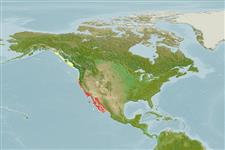
marina bottenlevande; djupintervall 3 - 205 m (Ref. 9253), usually 3 - 46 m (Ref. 54903). Subtropical; 52°N - 7°N, 130°W - 77°W
Eastern Pacific: Canada to Gulf of California, south to Panama.
Length at first maturity / Size / Vikt / Age
Könsmognad: Lm 97.0, range 86 - 108 cm
Max length : 152 cm TL hane/ej könsbestämd; (Ref. 247); rapporterad maxålder: 35 år (Ref. 6147)
Short description
Bestämningsnycklar | Morfologi | Morfometri
Taggstrålar i ryggfenan (totalt) : 0; Taggstrålar i analfenan: 0.
Body shape (shape guide): other.
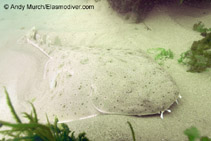
Found on the continental shelf and littoral areas (Ref. 247).A sluggish and inactive species that buries itself in sand or mud (Ref. 247). Also found around rocks, heads of submarine canyons, and sometimes near kelp forests (Ref. 247). Feeds on bottom and epibenthic fishes, including croakers, California halibut, and squid (Ref. 247). Ovoviviparous (Ref. 50449). Can whip up its head and snap very quickly when touched, provoked, harassed, or speared, and can inflict painful lacerations (Ref. 247).
Ovoviviparous, embryos feed solely on yolk (Ref. 50449).
Compagno, L.J.V., 1984. FAO Species Catalogue. Vol. 4. Sharks of the world. An annotated and illustrated catalogue of shark species known to date. Part 1 - Hexanchiformes to Lamniformes. FAO Fish. Synop. 125(4/1):1-249. Rome, FAO. (Ref. 247)
IUCN Red List Status (Ref. 130435: Version 2025-1)
Human uses
Fiskeri: kommersiell
Verktyg
Special reports
Download XML
Internet-källor
Estimates based on models
Preferred temperature (Ref.
123201): 12.5 - 25.9, mean 21 °C (based on 60 cells).
Phylogenetic diversity index (Ref.
82804): PD
50 = 0.5000 [Uniqueness, from 0.5 = low to 2.0 = high].
Bayesian length-weight: a=0.00676 (0.00295 - 0.01551), b=3.07 (2.88 - 3.26), in cm total length, based on LWR estimates for this Genus-body shape (Ref.
93245).
Trofisk nivå (Ref.
69278): 4.1 ±0.4 se; based on diet studies.
Resiliens (Ref.
120179): Mycket låg, lägsta populationsfördubblingstid mer än 14 år (K=0.15-0.16; tm=8-13; tmax=35; Fec=6).
Fishing Vulnerability (Ref.
59153): High to very high vulnerability (67 of 100).
🛈
Nutrients (Ref.
124155): Calcium = 17.5 [3.6, 86.6] mg/100g; Iron = 0.795 [0.206, 2.275] mg/100g; Protein = 19.9 [17.8, 21.8] %; Omega3 = 0.363 [0.162, 0.801] g/100g; Selenium = 26.5 [7.5, 76.0] μg/100g; VitaminA = 9.99 [3.53, 27.74] μg/100g; Zinc = 0.421 [0.203, 0.760] mg/100g (wet weight);