



Spatuloricaria terracanticum Londoño-Burbano, Urbano-Bonilla, Rojas-Molina, Ramírez-Gil & Prada-Pedreros, 2018
Ανεβάστε το φωτογραφίες και Βίντεο
Google image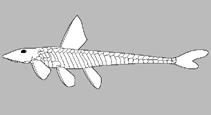 No image available for this species;
drawing shows typical species in Loricariidae.
Google image
drawing shows typical species in Loricariidae.
Ταξινόμηση / Ονόματα Κοινά ονόματα | Συνώνυμα | Catalog of Fishes(Γένος, Είδη) | ITIS | CoL | WoRMS | Cloffa
> Siluriformes (Catfishes) > Loricariidae (Armored catfishes) > Loricariinae
Etymology: Spatuloricaria: Latin, spatula, spathe = spatula, spatule + Latin, lorica, loricare = cuirass of corslet of leather; 1706 (Ref. 45335); terracanticum: Name from Latin 'terra' or earth and 'canticum' for song; dedicated to the Llanos work songs (cantos de vaquería).
Etymology: Spatuloricaria: Latin, spatula, spathe = spatula, spatule + Latin, lorica, loricare = cuirass of corslet of leather; 1706 (Ref. 45335); terracanticum: Name from Latin 'terra' or earth and 'canticum' for song; dedicated to the Llanos work songs (cantos de vaquería).
Περιβάλλον: περιβάλλον / κλιματική ζώνη / εύρος βάθους / εύρος διανομής Οικολογία
Θαλασσινό(ά) βενθικό(ς). Tropical
Κατανομή Εδάφη | Περιοχές FAO | Οικοσυστήματα | Παρουσίες | Σημειακός χάρτης | Εισαγωγές | Faunafri
South America: Colombia.
Μέγεθος / Βάρος / Ηλικία
Γεννητική Ωρίμανση: Lm ? range ? - ? cm
Max length : 28.6 cm SL αρσενικό/απροσδιόριστο; (Ref. 119417)
Max length : 28.6 cm SL αρσενικό/απροσδιόριστο; (Ref. 119417)
Σύντομη περιγραφή Κλείδες προσδιορισμού | Μορφολογία | Μορφομετρία
Ραχιαίες άκανθες (συνολικά) : 1; Μαλακές ραχιαίες ακτίνες (συνολικά) : 7; Εδρικές άκανθες: 1; Μαλακές εδρικές ακτίνες: 5. This species is distinguished from all its congeners by having a small group of plates posterior to the urogenital pore (vs. plates absent) and by having a broad, dark brown bar on the first pre-dorsal plate, which occupies the entire plate, reaching the preopercle, and sometimes reaching the second pre-dorsal plate (vs. no bar except in S. evansii); differs further, except from S. euacanthagenys, by having the abdominal surface with scattered, very small plates leaving naked areas (vs. abdomen totally naked or abdominal region partially to completely covered with larger plates); differs S. euacanthagenys and S. fimbriata by having 5 transverse dark brown bars on the dorsal region (vs. 4, and 3 in S. curvispina, 6 in S. caquetae); differs from S. caquetae, S. evansii, S. fimbriata, S. nudiventris, S. tuira by having preanal plates (vs. absent) (Ref. 119417).
Cross section: angular.
Cross section: angular.
This species prefer areas of the river with moderate slopes (between 0 and 3%) over substrates consisting of stones (less than 20 cm of diameter) and sand (observations indicate 80% rocks and 20% sand). Specimens captured at altitudes ranging from 197 to 350 m asl; water varies from high turbidity (316 mg/l total solids) to slightly clear, with pH between 6.4 and 8.2, conductivity between 30 and 302 µS/cm, oxygen concentration between 1.6 and 7.64 mg/l, with percent of saturation between 22.5 to 98.8%, water temperature between 22.5 and 28.58°C. This species has been captured with other species of loricariids (Chaetostoma formosae, C. joropo, Farlowella mariaelenae, Lamontichthys llanero), as well as characids (Creagrutus bolivari, Gephyrocharax valencia, Hemibrycon metae, Odontostilbe splendida), a cichlid (Bujurquina mariae), and apteronotids (Apteronotus apurensis, A. galvisi) (Ref. 119417).
Κύκλος ζωής και συμπεριφορά ζευγαρώματος Γεννητική Ωρίμανση | Αναπαραγωγή | Γεννοβολία | Αβγά | Γονιμότητα | Προνύμφες
Κύρια αναφορά
Ανεβάστε τις αναφορές σας | Αναφορές | Συντονιστής : Fisch-Muller, Sonia | Συνεργάτες
Londoño-Burbano, A., A. Urbano-Bonilla, Y. Rojas-Molina, H. Ramírez-Gil and S. Prada-Pedreros, 2018. A new species of Spatuloricaria Schultz, 1944 (Siluriformes: Loricariidae), from the Orinoco River basin, Colombia. Copeia 106(4):611-621. (Ref. 119417)
Κατάσταση Κόκκινου Καταλόγου IUCN (Ref. 130435: Version 2025-2 (Global))
Least Concern (LC) ; Date assessed: 24 November 2020
CITES
Not Evaluated
Απειλή για τον άνθρωπο
Harmless
Ανθρώπινες χρήσεις
FAO - Publication: search | FishSource |
Περισσότερες πληροφορίες
Τροφική Οικολογία
Τρόφιμα (θηράματα)
Σύσταση δίαιτας
Κατανάλωση τροφής
Μερίδες τροφίμων
Θηρευτές
Τρόφιμα (θηράματα)
Σύσταση δίαιτας
Κατανάλωση τροφής
Μερίδες τροφίμων
Θηρευτές
Οικολογία
Οικολογία
Οικολογία
Πληθυσμιακή δυναμική
Παράμετροι Αύξησης
Μέγιστες ηλικίες / μεγέθη
Μήκος-βάρος σχετ.
Μήκος-μήκος rel.
Μήκος-συχνότητες
Μετατροπή μάζας
Στρατολόγηση
Αφθονία
Παράμετροι Αύξησης
Μέγιστες ηλικίες / μεγέθη
Μήκος-βάρος σχετ.
Μήκος-μήκος rel.
Μήκος-συχνότητες
Μετατροπή μάζας
Στρατολόγηση
Αφθονία
Κύκλος ζωής
Αναπαραγωγή
Γεννητική Ωρίμανση
Ωριμότητα / Gills rel.
Γονιμότητα
Γεννοβολία
Συγκεντρώσεις αναπαραγωγής
Αβγά
Ανάπτυξη αυγών
Προνύμφες
Δυναμική προνυμφών
Αναπαραγωγή
Γεννητική Ωρίμανση
Ωριμότητα / Gills rel.
Γονιμότητα
Γεννοβολία
Συγκεντρώσεις αναπαραγωγής
Αβγά
Ανάπτυξη αυγών
Προνύμφες
Δυναμική προνυμφών
Ανατομία
Επιφάνεια βραγχίων
Εγκέφαλος
Ωτόλιθος
Επιφάνεια βραγχίων
Εγκέφαλος
Ωτόλιθος
Φυσιολογία
Σύνθεση σώματος
Θρεπτικά συστατικά
Κατανάλωση οξυγόνου
Τύπος κολύμβησης
Ταχύτητα κολύμβησης
Οπτικές χρωστικές ουσίες
Ήχος ψαριών
Ασθένειες & παράσιτα
Τοξικότητα (LC50)
Σύνθεση σώματος
Θρεπτικά συστατικά
Κατανάλωση οξυγόνου
Τύπος κολύμβησης
Ταχύτητα κολύμβησης
Οπτικές χρωστικές ουσίες
Ήχος ψαριών
Ασθένειες & παράσιτα
Τοξικότητα (LC50)
Γενετική
Γονιδίωμα
Γενετική
Ετεροζυγωτία
Κληρονομικότητα
Γενετική ποικιλομορφία
Γονιδίωμα
Γενετική
Ετεροζυγωτία
Κληρονομικότητα
Γενετική ποικιλομορφία
Ανθρώπινη σχέση
Συστήματα υδατοκαλλιέργειας
Προφίλ υδατοκαλλιεργειών
Στελέχοι
Περιπτώσεις Ciguatera
Γραμματόσημα, νομίσματα, διάφορα.
Συστήματα υδατοκαλλιέργειας
Προφίλ υδατοκαλλιεργειών
Στελέχοι
Περιπτώσεις Ciguatera
Γραμματόσημα, νομίσματα, διάφορα.
Εργαλεία
Ηλεκτρονικό βιβλίο | Οδηγός πεδίου | Ανάλυση κατά μήκος συνθέσεων | Εργαλείο ιστορίας ζωής | Σημειακός χάρτης |
Catch-MSY |
Ειδικές εκθέσεις
Έλεγχος για συντήρηση ενυδρείου | Ελέγξτε για ενημερωτικά δελτία ειδών | Ελέγξτε για ενημερωτικά δελτία υδατοκαλλιέργειας
Λήψη XML
Διαδικτυακές πηγές
AFORO (otoliths) | Aquatic Commons | BHL | Cloffa | Websites from users | Check FishWatcher | CISTI | Catalog of Fishes: Γένος, Είδη | DiscoverLife | ECOTOX | FAO - Publication: search | Faunafri | Fishipedia | Fishtrace | GloBI | Google Books | Google Scholar | Google | IGFA World Record | OneZoom | Open Tree of Life | Otolith Atlas of Taiwan Fishes | PubMed | Reef Life Survey | Socotra Atlas | TreeBase | Δέντρο Ζωής | Wikipedia: Go, αναζήτηση | World Records Freshwater Fishing | Zoobank | Zoological Record
Εκτιμήσεις βάσει μοντέλων
Δείκτης φυλογενετικής ποικιλότητας (Αναφ. 82804): PD50 = 0.5001 [Uniqueness, from 0.5 = low to 2.0 = high].
Bayesian length-weight: a=0.00398 (0.00185 - 0.00857), b=3.11 (2.93 - 3.29), in cm total length, based on LWR estimates for this (Sub)family-body shape (Ref. 93245).
Τροφικό Επίπεδο (Αναφ. 69278): 2.4 ±0.2 se; based on size and trophs of closest relatives
Ελαστικότητα (Αναφ. 120179): Μεσαίο(α), ελάχιστος χρόνος για διπλασιασμό πληθυσμού 1,4 - 4,4 έτη (Preliminary K or Fecundity.).