



Spatuloricaria terracanticum Londoño-Burbano, Urbano-Bonilla, Rojas-Molina, Ramírez-Gil & Prada-Pedreros, 2018
Envoyez vos Photos et vidéos
Images Google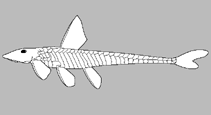 No image available for this species;
drawing shows typical species in Loricariidae.
Images Google
drawing shows typical species in Loricariidae.
Classification / Noms Noms communs | Synonymes | Catalog of Fishes(Genre, Espèce) | ITIS | CoL | WoRMS | Cloffa
> Siluriformes (Catfishes) > Loricariidae (Armored catfishes) > Loricariinae
Etymology: Spatuloricaria: Latin, spatula, spathe = spatula, spatule + Latin, lorica, loricare = cuirass of corslet of leather; 1706 (Ref. 45335); terracanticum: Name from Latin 'terra' or earth and 'canticum' for song; dedicated to the Llanos work songs (cantos de vaquería).
Etymology: Spatuloricaria: Latin, spatula, spathe = spatula, spatule + Latin, lorica, loricare = cuirass of corslet of leather; 1706 (Ref. 45335); terracanticum: Name from Latin 'terra' or earth and 'canticum' for song; dedicated to the Llanos work songs (cantos de vaquería).
Environnement : milieu / zone climatique / profondeur / gamme de distribution Écologie
marin démersal. Tropical
Distribution Territoires | Zones FAO | Écosystèmes | Occurrences | Carte par point | Introductions | Faunafri
South America: Colombia.
Taille / Poids / Âge
Description synthétique Clés d'identification | Morphologie | Morphométrie
Épines dorsales (Total) : 1; Rayons mous dorsaux (Total) : 7; Épines anales: 1; Rayons mous anaux: 5. This species is distinguished from all its congeners by having a small group of plates posterior to the urogenital pore (vs. plates absent) and by having a broad, dark brown bar on the first pre-dorsal plate, which occupies the entire plate, reaching the preopercle, and sometimes reaching the second pre-dorsal plate (vs. no bar except in S. evansii); differs further, except from S. euacanthagenys, by having the abdominal surface with scattered, very small plates leaving naked areas (vs. abdomen totally naked or abdominal region partially to completely covered with larger plates); differs S. euacanthagenys and S. fimbriata by having 5 transverse dark brown bars on the dorsal region (vs. 4, and 3 in S. curvispina, 6 in S. caquetae); differs from S. caquetae, S. evansii, S. fimbriata, S. nudiventris, S. tuira by having preanal plates (vs. absent) (Ref. 119417).
Cross section: angular.
Cross section: angular.
This species prefer areas of the river with moderate slopes (between 0 and 3%) over substrates consisting of stones (less than 20 cm of diameter) and sand (observations indicate 80% rocks and 20% sand). Specimens captured at altitudes ranging from 197 to 350 m asl; water varies from high turbidity (316 mg/l total solids) to slightly clear, with pH between 6.4 and 8.2, conductivity between 30 and 302 µS/cm, oxygen concentration between 1.6 and 7.64 mg/l, with percent of saturation between 22.5 to 98.8%, water temperature between 22.5 and 28.58°C. This species has been captured with other species of loricariids (Chaetostoma formosae, C. joropo, Farlowella mariaelenae, Lamontichthys llanero), as well as characids (Creagrutus bolivari, Gephyrocharax valencia, Hemibrycon metae, Odontostilbe splendida), a cichlid (Bujurquina mariae), and apteronotids (Apteronotus apurensis, A. galvisi) (Ref. 119417).
Cycle de vie et comportement reproducteur Maturité | Reproduction | Frai | Œufs | Fécondité | Larves
Référence principale
Téléchargez vos références | Références | Coordinateur : Fisch-Muller, Sonia | Collaborateurs
Londoño-Burbano, A., A. Urbano-Bonilla, Y. Rojas-Molina, H. Ramírez-Gil and S. Prada-Pedreros, 2018. A new species of Spatuloricaria Schultz, 1944 (Siluriformes: Loricariidae), from the Orinoco River basin, Colombia. Copeia 106(4):611-621. (Ref. 119417)
Statut dans la liste rouge de l'IUCN (Ref. 130435: Version 2025-2 (Global))
Préoccupation mineure (LC) ; Date assessed: 24 November 2020
CITES
Not Evaluated
Menace pour l'homme
Harmless
Utilisations par l'homme
FAO - Publication: search | FishSource |
Plus d'informations
Écologie trophique
Aliments (proies)
Composition du régime alimentaire
Consommation alimentaire
Rations alimentaires
Prédateurs
Aliments (proies)
Composition du régime alimentaire
Consommation alimentaire
Rations alimentaires
Prédateurs
Écologie
Écologie
Écologie
Dynamique des populations
Paramètres de croissance
Âges / tailles maximales
Longueur-poids rel.
Rel. longueur-longueur.
Fréquences de longueurs
Conversion de masse
Recrutement
Abondance
Paramètres de croissance
Âges / tailles maximales
Longueur-poids rel.
Rel. longueur-longueur.
Fréquences de longueurs
Conversion de masse
Recrutement
Abondance
Cycle de vie
Reproduction
Maturité
Maturité/épines rel.
Fécondité
Frai
Agrégats de frai
Œufs
Développement de l'œuf
Larves
Dynamique des populations larvaires
Reproduction
Maturité
Maturité/épines rel.
Fécondité
Frai
Agrégats de frai
Œufs
Développement de l'œuf
Larves
Dynamique des populations larvaires
Anatomie
Surface branchiale
Cerveau
Otolithe
Surface branchiale
Cerveau
Otolithe
Physiologie
Composition corporelle
Nutriments
Consommation d'oxygène
Type de natation
Vitesse de nage
Pigments visuels
Son de poisson
Maladies et parasites
Toxicité (CL50)
Composition corporelle
Nutriments
Consommation d'oxygène
Type de natation
Vitesse de nage
Pigments visuels
Son de poisson
Maladies et parasites
Toxicité (CL50)
Génétique
génôme
Génétique
Hétérozygotie
Héritabilité
Diversité génétique
génôme
Génétique
Hétérozygotie
Héritabilité
Diversité génétique
Liées à l'homme
Systèmes d'aquaculture
Profils d'aquaculture
Souches
Cas de ciguatera
Timbres, pièces de monnaie, divers
Systèmes d'aquaculture
Profils d'aquaculture
Souches
Cas de ciguatera
Timbres, pièces de monnaie, divers
Outils
E-book | Guide de terrain | Générateur de fréquences de longueur | Outil de dynamique de population | Carte par point |
Capture-MSY |
Articles particuliers
Télécharger en XML
Sources Internet
AFORO (otoliths) | Aquatic Commons | BHL | Cloffa | Websites from users | FishWatcher | CISTI | Catalog of Fishes: Genre, Espèce | DiscoverLife | ECOTOX | FAO - Publication: search | Faunafri | Fishipedia | Fishtrace | GloBI | Google Books | Google Scholar | Google | IGFA World Record | OneZoom | Open Tree of Life | Otolith Atlas of Taiwan Fishes | PubMed | Reef Life Survey | Socotra Atlas | TreeBase | Arbre de Vie | Wikipedia: aller à, chercher | World Records Freshwater Fishing | Zoobank | Zoological Record
Estimations basées sur des modèles
Indice de diversité phylogénétique (Réf. 82804): PD50 = 0.5001 [Uniqueness, from 0.5 = low to 2.0 = high].
Bayesian length-weight: a=0.00398 (0.00185 - 0.00857), b=3.11 (2.93 - 3.29), in cm total length, based on LWR estimates for this (Sub)family-body shape (Ref. 93245).
Niveau trophique (Réf. 69278): 2.4 ±0.2 se; based on size and trophs of closest relatives
Résilience (Réf. 120179): Milieu, temps minimum de doublement de population : 1,4 à 4,4 années (Preliminary K or Fecundity.).