



Spatuloricaria terracanticum Londoño-Burbano, Urbano-Bonilla, Rojas-Molina, Ramírez-Gil & Prada-Pedreros, 2018
Uploaden van uw Foto's en video's
Google afbeelding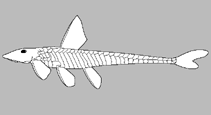 No image available for this species;
drawing shows typical species in Loricariidae.
Google afbeelding
drawing shows typical species in Loricariidae.
Classificatie / Namen Lokale namen | Synoniemen | Catalog of Fishes(Genus, Soort(en)) | ITIS | CoL | WoRMS | Cloffa
> Siluriformes (Catfishes) > Loricariidae (Armored catfishes) > Loricariinae
Etymology: Spatuloricaria: Latin, spatula, spathe = spatula, spatule + Latin, lorica, loricare = cuirass of corslet of leather; 1706 (Ref. 45335); terracanticum: Name from Latin 'terra' or earth and 'canticum' for song; dedicated to the Llanos work songs (cantos de vaquería).
Etymology: Spatuloricaria: Latin, spatula, spathe = spatula, spatule + Latin, lorica, loricare = cuirass of corslet of leather; 1706 (Ref. 45335); terracanticum: Name from Latin 'terra' or earth and 'canticum' for song; dedicated to the Llanos work songs (cantos de vaquería).
Milieu: milieu / Klimaatzone / Diepte / verspreidingsgebied Ecologie
marien demersaal. Tropical
Verspreiding Gebieden | FAO regio's | Ecosystemen | Voorkomen | Verspreidingskaart | Introducties | Faunafri
South America: Colombia.
Grootte / Gewicht / Leeftijd
Maturiteit: Lm ? range ? - ? cm
Max length : 28.6 cm SL mannelijk / geslacht onbekend; (Ref. 119417)
Max length : 28.6 cm SL mannelijk / geslacht onbekend; (Ref. 119417)
Korte beschrijving Determinatiesleutels | Morfologie | Morfometrie
Dorsale stekels (totaal) : 1; Dorsale zachte stralen (totaal) : 7; Anale stekels: 1; Anale zachte stralen: 5. This species is distinguished from all its congeners by having a small group of plates posterior to the urogenital pore (vs. plates absent) and by having a broad, dark brown bar on the first pre-dorsal plate, which occupies the entire plate, reaching the preopercle, and sometimes reaching the second pre-dorsal plate (vs. no bar except in S. evansii); differs further, except from S. euacanthagenys, by having the abdominal surface with scattered, very small plates leaving naked areas (vs. abdomen totally naked or abdominal region partially to completely covered with larger plates); differs S. euacanthagenys and S. fimbriata by having 5 transverse dark brown bars on the dorsal region (vs. 4, and 3 in S. curvispina, 6 in S. caquetae); differs from S. caquetae, S. evansii, S. fimbriata, S. nudiventris, S. tuira by having preanal plates (vs. absent) (Ref. 119417).
Cross section: angular.
Cross section: angular.
This species prefer areas of the river with moderate slopes (between 0 and 3%) over substrates consisting of stones (less than 20 cm of diameter) and sand (observations indicate 80% rocks and 20% sand). Specimens captured at altitudes ranging from 197 to 350 m asl; water varies from high turbidity (316 mg/l total solids) to slightly clear, with pH between 6.4 and 8.2, conductivity between 30 and 302 µS/cm, oxygen concentration between 1.6 and 7.64 mg/l, with percent of saturation between 22.5 to 98.8%, water temperature between 22.5 and 28.58°C. This species has been captured with other species of loricariids (Chaetostoma formosae, C. joropo, Farlowella mariaelenae, Lamontichthys llanero), as well as characids (Creagrutus bolivari, Gephyrocharax valencia, Hemibrycon metae, Odontostilbe splendida), a cichlid (Bujurquina mariae), and apteronotids (Apteronotus apurensis, A. galvisi) (Ref. 119417).
Levenscyclus en paargedrag Maturiteit | Voortplanting | Paaien | Eieren | Fecunditeit | Larven
Hoofdreferentie
Upload uw referenties | Referenties | Coördinator : Fisch-Muller, Sonia | Medewerkers
Londoño-Burbano, A., A. Urbano-Bonilla, Y. Rojas-Molina, H. Ramírez-Gil and S. Prada-Pedreros, 2018. A new species of Spatuloricaria Schultz, 1944 (Siluriformes: Loricariidae), from the Orinoco River basin, Colombia. Copeia 106(4):611-621. (Ref. 119417)
Status op de Rode Lijst van het IUCN (Ref. 130435: Version 2025-2 (Global))
Niet bedreigd (LC) ; Date assessed: 24 November 2020
CITES
Not Evaluated
Gevaar voor de mens
Harmless
Gebruik door de mens
FAO - Publication: search | FishSource |
Meer informatie
Trofische ecologie
Voedsel (prooien)
Dieetsamenstelling
Voedselconsumptie
Voedselrantsoenen
Predatoren
Voedsel (prooien)
Dieetsamenstelling
Voedselconsumptie
Voedselrantsoenen
Predatoren
Ecologie
Ecologie
Ecologie
Populatiedynamica
Groeiparameters
Max. leeftijden / maten
Lengte-gewicht rel.
Lengte-lengte rel.
Lengtefrequenties
Massaconversie
Rekrutering
Abundantie
Groeiparameters
Max. leeftijden / maten
Lengte-gewicht rel.
Lengte-lengte rel.
Lengtefrequenties
Massaconversie
Rekrutering
Abundantie
Levenscyclus
Voortplanting
Maturiteit
Rijpheid/kieuwen rel.
Fecunditeit
Paaien
Paaibestanden
Eieren
Ontwikkeling van de eieren
Larven
Larvale populatiedynamiek
Voortplanting
Maturiteit
Rijpheid/kieuwen rel.
Fecunditeit
Paaien
Paaibestanden
Eieren
Ontwikkeling van de eieren
Larven
Larvale populatiedynamiek
Anatomie
Kieuwoppervlak
Hersenen
Otoliet
Kieuwoppervlak
Hersenen
Otoliet
Fysiologie
Lichaamssamenstelling
Voedingsstoffen
Zuurstofverbruik
Type zwemmen
Zwemsnelheid
Visuele pigmenten
Vis geluid
Ziekten en parasieten
Toxiciteit (LC50)
Lichaamssamenstelling
Voedingsstoffen
Zuurstofverbruik
Type zwemmen
Zwemsnelheid
Visuele pigmenten
Vis geluid
Ziekten en parasieten
Toxiciteit (LC50)
Genetica
genoom
Genetica
Heterozygositeit
Erfelijkheid
Genetische diversiteit
genoom
Genetica
Heterozygositeit
Erfelijkheid
Genetische diversiteit
Menselijk gerelateerd
Aquacultuursystemen
Aquacultuurprofielen
Kweeklijnen
Ciguatera gevallen
Postzegels, munten, diversen.
Aquacultuursystemen
Aquacultuurprofielen
Kweeklijnen
Ciguatera gevallen
Postzegels, munten, diversen.
Tools
Speciale rapporten
Bekijk gegevens voor het houden in een aquarium | Bekijk Fact Sheets voor de soort | Bekijk Aquacultuur Fact Sheets
Download XML
Internetbronnen
AFORO (otoliths) | Aquatic Commons | BHL | Cloffa | Websites from users | Bekijk FishWatcher | CISTI | Catalog of Fishes: Genus, Soort(en) | DiscoverLife | ECOTOX | FAO - Publication: search | Faunafri | Fishipedia | Fishtrace | GloBI | Google Books | Google Scholar | Google | IGFA World Record | OneZoom | Open Tree of Life | Otolith Atlas of Taiwan Fishes | PubMed | Reef Life Survey | Socotra Atlas | TreeBase | Tree of Life | Wikipedia: ga naar, zoek | World Records Freshwater Fishing | Zoobank | Zoological Record
Schattingen op basis van modellen
Fylogenetische diversiteitsindex (Ref. 82804): PD50 = 0.5001 [Uniqueness, from 0.5 = low to 2.0 = high].
Bayesian length-weight: a=0.00398 (0.00185 - 0.00857), b=3.11 (2.93 - 3.29), in cm total length, based on LWR estimates for this (Sub)family-body shape (Ref. 93245).
Trofisch niveau (Ref. 69278): 2.4 ±0.2 se; based on size and trophs of closest relatives
Weerstandsvermogen (Ref. 120179): Gemiddeld, minimale populatieverdubbelingstijd 1,4-4,4 jaar (Preliminary K or Fecundity.).