>
Gobiiformes (Gobies) >
Gobiidae (Gobies) > Gobiinae
Etymology: Trimma: Greek, trimma, -atos = something crushed (Ref. 45335); corerefum: Name from the arbitrary combination of letters reflecting the Coral Reef ResearchFoundation in Palau and is pronounced 'core-ref-um'; an organization, established and operated by Pat and Lori Colin; noun in apposition.
Eponymy: Not an eponym but an arbitrary combination of letters (pronounced ‘core-ref-um’) reflecting the Coral Reef Research Foundation in Palau. [...] (Ref. 128868), visit book page.
Environment: milieu / climate zone / rango de profundidad / distribution range
Ecología
marino pelagic-neritic; rango de profundidad 10 - 30 m (Ref. 109919), usually 12 - 30 m (Ref. 109919). Tropical
Distribución
Países | Áreas FAO | Ecosistemas | Ocurrencias, apariciones | Mapa de puntos | Introducciones | Faunafri
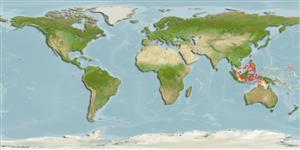
Western Pacific: Palau, Indonesia and the Philippines.
Tamaño / Peso / Age
Madurez: Lm ? range ? - ? cm
Max length : 1.7 cm SL macho / no sexado; (Ref. 109919); 1.9 cm SL (female)
Short description
Claves de identificación | Morfología | Morfometría
Espinas dorsales (total) : 7; Radios blandos dorsales (total) : 8; Espinas anales: 1; Radios blandos anales: 8. This species is distinguished by the following characters: possess a bony interorbital about three-quarters pupil diameter (68-85%), with a fully scaled nape, the anterior rows cycloid in adults, a second dorsal spine that usually reaches middle of the second dorsal fin; two cephalic sensory papillae in row f on the chin and in row r on the top of the snout, 2-5 (usually 4) papillae in row d? immediately behind the maxilla, usually 13 (range = 12-14) unbranched pectoral-fin rays, and an unbranched fifth pelvic-fin ray that is 34-45% the length of the fourth ray. Colour of freshly collected specimens: reddish head and anterior nape except below a line bounded by the horizontal limb of preopercle, where these are white; red opercular region and abdomen with a liberal sprinkling of large, dark brown melanophores, a pupil-diameter wide white band across peduncle anterior to the caudal spot, approximately pupil diameter dark marking on the posterior part of the peduncle and extending onto the bases of the caudal fin rays; preserved specimens with four distinct groupings of small round black melanophores situated at the 3, 4:30, 6 and 9 o’clock positions around the eye (Ref. 109919).
Body shape (shape guide): elongated; Cross section: oval.
Occurs in vertical wall with small caves, overhangs and crevices, hard corals (<>iAcropora, Montipora), hydroids, and sea fans (Ref. 109919).
Life cycle and mating behavior
Madurez | Reproducción | Puesta | Huevos | Fecundidad | Larva
Winterbottom, R., 2016. Trimma tevegae and T. caudomaculatum revisited and redescribed (Acanthopterygii, Gobiidae), with descriptions of three new similar species from the western Pacific. Zootaxa 4144(1):001-053. (Ref. 109919)
IUCN Red List Status (Ref. 130435: Version 2025-1)
Threat to humans
Harmless
Human uses
Pesquerías: sin interés
Herramientas
Special reports
Download XML
Fuentes de Internet
Estimates based on models
Phylogenetic diversity index (Referencia
82804): PD
50 = 0.5000 [Uniqueness, from 0.5 = low to 2.0 = high].
Bayesian length-weight: a=0.00724 (0.00339 - 0.01546), b=3.10 (2.92 - 3.28), in cm total length, based on LWR estimates for this (Sub)family-body shape (Ref.
93245).
Resiliencia (Referencia
120179): Alto, población duplicada en un tiempo mínimo inferior a 15 meses (Preliminary K or Fecundity.).
Fishing Vulnerability (Ref.
59153): Low vulnerability (10 of 100).
🛈