



Ossancora asterophysa Birindelli & Sabaj Pérez, 2011
Adicionar o seu Fotografias e vídeos
Imagem do Google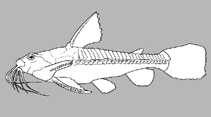 No image available for this species;
drawing shows typical species in Doradidae.
Imagem do Google
drawing shows typical species in Doradidae.
Classificação / Nomes Nomes comuns | Sinónimos | Catalog of Fishes(Género, Espécies) | ITIS | CoL | WoRMS | Cloffa
> Siluriformes (Catfishes) > Doradidae (Thorny catfishes) > Doradinae
Etymology: Ossancora: Derived from the Latin oss, meaning bone, and ancora, meaning anchor, in reference to the shape and articulation of the pectoral spine and posterior cleithral and coracoid processes which resemble the shank and flukes, respectively, of a Danforth anchor; asterophysa: Specific name is derived from the Greek aster, meaning star, and physa, meaning bladder, alluding to the proliferation of diverticula along the periphery of the gas bladder which distinguishes species from Ossancora eigenmanni. An adjective.
Etymology: Ossancora: Derived from the Latin oss, meaning bone, and ancora, meaning anchor, in reference to the shape and articulation of the pectoral spine and posterior cleithral and coracoid processes which resemble the shank and flukes, respectively, of a Danforth anchor; asterophysa: Specific name is derived from the Greek aster, meaning star, and physa, meaning bladder, alluding to the proliferation of diverticula along the periphery of the gas bladder which distinguishes species from Ossancora eigenmanni. An adjective.
Ambiente: milieu / zona climática / intervalo de profundidade / gama de distribuição Ecologia
; Água doce demersal. Tropical
Distribuição Territórios | Áreas FAO | Ecossistemas | Ocorrências | Mapa dos pontos | Introduções | Faunafri
South America: Amazonas basin in Bolivia, Brazil and Peru; Ilha do Marajó near the mouth of the rio Amazonas to laguna Yarinacocha, an oxbow lake connected to the río Ucayali; río Mamoré and upper Guaporé, Madeira drainage.
Tamanho / Peso / Idade
Maturidade: Lm ? range ? - ? cm
Max length : 16.8 cm TL macho/indeterminado; (Ref. 111518); peso máx. Publicado: 62.00 g (Ref. 111518)
Max length : 16.8 cm TL macho/indeterminado; (Ref. 111518); peso máx. Publicado: 62.00 g (Ref. 111518)
Descrição breve Chaves de identificação | Morfologia | Morfometria
Espinhos dorsais (total) : 2; Raios dorsais moles (total) : 6. Can be diagnosed from Ossancora punctata by having maxillary barbel with elongate fimbriae inserted in two distinct rows along anterior margin, one dorsally and one ventrally, mental barbels with elongate fimbriae, and anterior nuchal plate reduced, diamond shaped, not sutured to epioccipital. Can be distinguished from Ossancora eigenmanni and Ossancora fimbriata by having the unique combination of gas bladder with numerous diverticula that are thin, moderately elongate (often branched), and grouped in roughly paired, small fascicles along the periphery of anterior face, shoulder and lateral walls of anterior chamber as well as lateral walls and posterior face of posterior chambers (vs. peripheral diverticula absent or few, restricted to anterolateral shoulder and sometimes anterior face of the anterior chamber in Ossancora eigenmanni; terminal diverticula lacking or indistinguishable from other peripheral diverticula (vs. short terminal diverticula present in Ossancora fimbriata; infranuchal plate not greatly expanded ventrally (vs. greatly expanded ventrally, reaching level of posterior coracoid process in adults in Ossancora fimbriata); nuchal foramina absent (vs. usually present, except in some large adults, in Ossancora fimbriata); less than 20 teeth per ramus on premaxilla and dentary (vs. 25-50 in Ossancora fimbriata); mental barbel with elongate fimbriae in single row (vs. two rows in Ossancora fimbriata) (Ref. 92411).
Ciclo de vida e comportamento de acasalamento Maturidade | Reprodução | Desova | Ovos | Fecundidade | Larvas
Referência principal
Carregar as suas referências | Referências | Coordenador : Ferraris, Jr., Carl J. | Colaboradores
Birindelli, J.L.O., 2011. Ossancora, new genus of thorny catfish (Teleostei: Siluriformes: Doradidae) with description of one new species. Proc. Acad. Nat. Sci. Phila. 161:117-152. (Ref. 92411)
Categoria na Lista Vermelha da IUCN (Ref. 130435: Version 2025-2 (Global))
Preocupação menor (LC) ; Date assessed: 05 August 2020
CITES
Not Evaluated
Ameaça para o homem
Harmless
Utilização humana
FAO - Publication: search | FishSource |
Mais informação
Ecologia Trófica
Produtos alimentares (presas)
Composição da dieta
Consumo alimentar
Rações alimentares
Predadores
Produtos alimentares (presas)
Composição da dieta
Consumo alimentar
Rações alimentares
Predadores
Ecologia
Ecologia
Ecologia
Dinâmica das populações
Parâmetros de crescimento
Idades / tamanhos máximos
Comprimento-peso rel.
Comprimento-comprimento rel.
Frequência de comprimento
Conversão de massa
Recrutamento
Abundância
Parâmetros de crescimento
Idades / tamanhos máximos
Comprimento-peso rel.
Comprimento-comprimento rel.
Frequência de comprimento
Conversão de massa
Recrutamento
Abundância
Ciclo de vida
Reprodução
Maturidade
Maturidade/Rel. das guelras
Fecundidade
Desova
Agregações de desova
Ovos
Desenvolvimento dos ovos
Larvas
Dinâmica larvar
Reprodução
Maturidade
Maturidade/Rel. das guelras
Fecundidade
Desova
Agregações de desova
Ovos
Desenvolvimento dos ovos
Larvas
Dinâmica larvar
Anatomia
Área branquial
Cérebro
Otólitos
Área branquial
Cérebro
Otólitos
Fisiologia
Composição corporal
Nutrientes
Consumo de oxigénio
Tipo de natação
Velocidade de natação
Pigmentos visuais
Som de peixe
Doenças e Parasitas
Toxicidade (LC50s)
Composição corporal
Nutrientes
Consumo de oxigénio
Tipo de natação
Velocidade de natação
Pigmentos visuais
Som de peixe
Doenças e Parasitas
Toxicidade (LC50s)
Genética
genoma
Genética
Heterozigotia
Hereditariedade
Diversidade genética
genoma
Genética
Heterozigotia
Hereditariedade
Diversidade genética
Relacionado com o ser humano
Sistemas de aquacultura
Perfis para aquacultura
Estirpes
Casos de Ciguatera
Selos, moedas, diversos.
Sistemas de aquacultura
Perfis para aquacultura
Estirpes
Casos de Ciguatera
Selos, moedas, diversos.
Ferramentas
E-book | Guia de campo | Ferramenta auxiliar de frequências de comprimento | Ferramenta sobre a história de vida | Mapa dos pontos |
Captura-MSY |
Relatórios especiais
Descarregue XML
Fontes da internet
AFORO (otoliths) | Aquatic Commons | BHL | Cloffa | Websites from users | Consultar FishWatcher | CISTI | Catalog of Fishes: Género, Espécies | DiscoverLife | ECOTOX | FAO - Publication: search | Faunafri | Fishipedia | Fishtrace | GloBI | Google Books | Google Scholar | Google | IGFA World Record | OneZoom | Open Tree of Life | Otolith Atlas of Taiwan Fishes | PubMed | Reef Life Survey | Socotra Atlas | TreeBase | Árvore da vida | Wikipedia: ir para, procurar | World Records Freshwater Fishing | Zoobank | Registo zoológico
Estimativas baseadas em modelos
Índice de diversidade filogenética (Ref. 82804): PD50 = 0.5625 [Uniqueness, from 0.5 = low to 2.0 = high].
Bayesian length-weight: a=0.01122 (0.00659 - 0.01911), b=2.95 (2.80 - 3.10), in cm total length, based on LWR estimates for this species & (Sub)family-body (Ref. 93245).
Nível Trófico (Ref. 69278): 2.8 ±0.4 se; based on size and trophs of closest relatives
Resiliência (Ref. 120179): Elevada, tempo mínimo de duplicação da população menor que 15 meses (Preliminary K or Fecundity.).