



Ossancora asterophysa Birindelli & Sabaj Pérez, 2011
Uploaden van uw Foto's en video's
Google afbeelding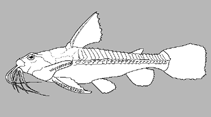 No image available for this species;
drawing shows typical species in Doradidae.
Google afbeelding
drawing shows typical species in Doradidae.
Classificatie / Namen Lokale namen | Synoniemen | Catalog of Fishes(Genus, Soort(en)) | ITIS | CoL | WoRMS | Cloffa
> Siluriformes (Catfishes) > Doradidae (Thorny catfishes) > Doradinae
Etymology: Ossancora: Derived from the Latin oss, meaning bone, and ancora, meaning anchor, in reference to the shape and articulation of the pectoral spine and posterior cleithral and coracoid processes which resemble the shank and flukes, respectively, of a Danforth anchor; asterophysa: Specific name is derived from the Greek aster, meaning star, and physa, meaning bladder, alluding to the proliferation of diverticula along the periphery of the gas bladder which distinguishes species from Ossancora eigenmanni. An adjective.
Etymology: Ossancora: Derived from the Latin oss, meaning bone, and ancora, meaning anchor, in reference to the shape and articulation of the pectoral spine and posterior cleithral and coracoid processes which resemble the shank and flukes, respectively, of a Danforth anchor; asterophysa: Specific name is derived from the Greek aster, meaning star, and physa, meaning bladder, alluding to the proliferation of diverticula along the periphery of the gas bladder which distinguishes species from Ossancora eigenmanni. An adjective.
Milieu: milieu / Klimaatzone / Diepte / verspreidingsgebied Ecologie
; zoet water demersaal. Tropical
Verspreiding Gebieden | FAO regio's | Ecosystemen | Voorkomen | Verspreidingskaart | Introducties | Faunafri
South America: Amazonas basin in Bolivia, Brazil and Peru; Ilha do Marajó near the mouth of the rio Amazonas to laguna Yarinacocha, an oxbow lake connected to the río Ucayali; río Mamoré and upper Guaporé, Madeira drainage.
Grootte / Gewicht / Leeftijd
Maturiteit: Lm ? range ? - ? cm
Max length : 16.8 cm TL mannelijk / geslacht onbekend; (Ref. 111518); max. gepubliceerd gewicht: 62.00 g (Ref. 111518)
Max length : 16.8 cm TL mannelijk / geslacht onbekend; (Ref. 111518); max. gepubliceerd gewicht: 62.00 g (Ref. 111518)
Korte beschrijving Determinatiesleutels | Morfologie | Morfometrie
Dorsale stekels (totaal) : 2; Dorsale zachte stralen (totaal) : 6. Can be diagnosed from Ossancora punctata by having maxillary barbel with elongate fimbriae inserted in two distinct rows along anterior margin, one dorsally and one ventrally, mental barbels with elongate fimbriae, and anterior nuchal plate reduced, diamond shaped, not sutured to epioccipital. Can be distinguished from Ossancora eigenmanni and Ossancora fimbriata by having the unique combination of gas bladder with numerous diverticula that are thin, moderately elongate (often branched), and grouped in roughly paired, small fascicles along the periphery of anterior face, shoulder and lateral walls of anterior chamber as well as lateral walls and posterior face of posterior chambers (vs. peripheral diverticula absent or few, restricted to anterolateral shoulder and sometimes anterior face of the anterior chamber in Ossancora eigenmanni; terminal diverticula lacking or indistinguishable from other peripheral diverticula (vs. short terminal diverticula present in Ossancora fimbriata; infranuchal plate not greatly expanded ventrally (vs. greatly expanded ventrally, reaching level of posterior coracoid process in adults in Ossancora fimbriata); nuchal foramina absent (vs. usually present, except in some large adults, in Ossancora fimbriata); less than 20 teeth per ramus on premaxilla and dentary (vs. 25-50 in Ossancora fimbriata); mental barbel with elongate fimbriae in single row (vs. two rows in Ossancora fimbriata) (Ref. 92411).
Levenscyclus en paargedrag Maturiteit | Voortplanting | Paaien | Eieren | Fecunditeit | Larven
Hoofdreferentie
Upload uw referenties | Referenties | Coördinator : Ferraris, Jr., Carl J. | Medewerkers
Birindelli, J.L.O., 2011. Ossancora, new genus of thorny catfish (Teleostei: Siluriformes: Doradidae) with description of one new species. Proc. Acad. Nat. Sci. Phila. 161:117-152. (Ref. 92411)
Status op de Rode Lijst van het IUCN (Ref. 130435: Version 2025-2 (Global))
Niet bedreigd (LC) ; Date assessed: 05 August 2020
CITES
Not Evaluated
Gevaar voor de mens
Harmless
Gebruik door de mens
FAO - Publication: search | FishSource |
Meer informatie
Trofische ecologie
Voedsel (prooien)
Dieetsamenstelling
Voedselconsumptie
Voedselrantsoenen
Predatoren
Voedsel (prooien)
Dieetsamenstelling
Voedselconsumptie
Voedselrantsoenen
Predatoren
Ecologie
Ecologie
Ecologie
Populatiedynamica
Groeiparameters
Max. leeftijden / maten
Lengte-gewicht rel.
Lengte-lengte rel.
Lengtefrequenties
Massaconversie
Rekrutering
Abundantie
Groeiparameters
Max. leeftijden / maten
Lengte-gewicht rel.
Lengte-lengte rel.
Lengtefrequenties
Massaconversie
Rekrutering
Abundantie
Levenscyclus
Voortplanting
Maturiteit
Rijpheid/kieuwen rel.
Fecunditeit
Paaien
Paaibestanden
Eieren
Ontwikkeling van de eieren
Larven
Larvale populatiedynamiek
Voortplanting
Maturiteit
Rijpheid/kieuwen rel.
Fecunditeit
Paaien
Paaibestanden
Eieren
Ontwikkeling van de eieren
Larven
Larvale populatiedynamiek
Anatomie
Kieuwoppervlak
Hersenen
Otoliet
Kieuwoppervlak
Hersenen
Otoliet
Fysiologie
Lichaamssamenstelling
Voedingsstoffen
Zuurstofverbruik
Type zwemmen
Zwemsnelheid
Visuele pigmenten
Vis geluid
Ziekten en parasieten
Toxiciteit (LC50)
Lichaamssamenstelling
Voedingsstoffen
Zuurstofverbruik
Type zwemmen
Zwemsnelheid
Visuele pigmenten
Vis geluid
Ziekten en parasieten
Toxiciteit (LC50)
Genetica
genoom
Genetica
Heterozygositeit
Erfelijkheid
Genetische diversiteit
genoom
Genetica
Heterozygositeit
Erfelijkheid
Genetische diversiteit
Menselijk gerelateerd
Aquacultuursystemen
Aquacultuurprofielen
Kweeklijnen
Ciguatera gevallen
Postzegels, munten, diversen.
Aquacultuursystemen
Aquacultuurprofielen
Kweeklijnen
Ciguatera gevallen
Postzegels, munten, diversen.
Tools
Speciale rapporten
Bekijk gegevens voor het houden in een aquarium | Bekijk Fact Sheets voor de soort | Bekijk Aquacultuur Fact Sheets
Download XML
Internetbronnen
AFORO (otoliths) | Aquatic Commons | BHL | Cloffa | Websites from users | Bekijk FishWatcher | CISTI | Catalog of Fishes: Genus, Soort(en) | DiscoverLife | ECOTOX | FAO - Publication: search | Faunafri | Fishipedia | Fishtrace | GloBI | Google Books | Google Scholar | Google | IGFA World Record | OneZoom | Open Tree of Life | Otolith Atlas of Taiwan Fishes | PubMed | Reef Life Survey | Socotra Atlas | TreeBase | Tree of Life | Wikipedia: ga naar, zoek | World Records Freshwater Fishing | Zoobank | Zoological Record
Schattingen op basis van modellen
Fylogenetische diversiteitsindex (Ref. 82804): PD50 = 0.5625 [Uniqueness, from 0.5 = low to 2.0 = high].
Bayesian length-weight: a=0.01122 (0.00659 - 0.01911), b=2.95 (2.80 - 3.10), in cm total length, based on LWR estimates for this species & (Sub)family-body (Ref. 93245).
Trofisch niveau (Ref. 69278): 2.8 ±0.4 se; based on size and trophs of closest relatives
Weerstandsvermogen (Ref. 120179): Hoog, minimale populatieverdubbelingstijd minder dan 15 maanden (Preliminary K or Fecundity.).