



Ossancora asterophysa Birindelli & Sabaj Pérez, 2011
Hochladen Photos und videos
Google Bild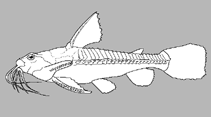 No image available for this species;
drawing shows typical species in Doradidae.
Google Bild
drawing shows typical species in Doradidae.
Klassifizierung / Names Namen | Synonyme | Catalog of Fishes(Gattung, Arten) | ITIS | CoL | WoRMS | Cloffa
> Siluriformes (Catfishes) > Doradidae (Thorny catfishes) > Doradinae
Etymology: Ossancora: Derived from the Latin oss, meaning bone, and ancora, meaning anchor, in reference to the shape and articulation of the pectoral spine and posterior cleithral and coracoid processes which resemble the shank and flukes, respectively, of a Danforth anchor; asterophysa: Specific name is derived from the Greek aster, meaning star, and physa, meaning bladder, alluding to the proliferation of diverticula along the periphery of the gas bladder which distinguishes species from Ossancora eigenmanni. An adjective.
Etymology: Ossancora: Derived from the Latin oss, meaning bone, and ancora, meaning anchor, in reference to the shape and articulation of the pectoral spine and posterior cleithral and coracoid processes which resemble the shank and flukes, respectively, of a Danforth anchor; asterophysa: Specific name is derived from the Greek aster, meaning star, and physa, meaning bladder, alluding to the proliferation of diverticula along the periphery of the gas bladder which distinguishes species from Ossancora eigenmanni. An adjective.
Umwelt: Milieu / Klimazone / Tiefenbereich / Verbreitungsgebiet Ökologie
; süßwasser demersal. Tropical
Verbreitung Territorien | FAO Gebiete | Ökosysteme | Vorkommen | Punkt Karte | Einführungen | Faunafri
South America: Amazonas basin in Bolivia, Brazil and Peru; Ilha do Marajó near the mouth of the rio Amazonas to laguna Yarinacocha, an oxbow lake connected to the río Ucayali; río Mamoré and upper Guaporé, Madeira drainage.
Größe / Gewicht / Alter
Geschlechtsreife: Lm ? range ? - ? cm
Max length : 16.8 cm TL Männchen/unbestimmt; (Ref. 111518); max. veröff. Gewicht: 62.00 g (Ref. 111518)
Max length : 16.8 cm TL Männchen/unbestimmt; (Ref. 111518); max. veröff. Gewicht: 62.00 g (Ref. 111518)
Kurzbeschreibung Bestimmungsschlüssel | Morphologie | Morphometrie
Rückenflossenstacheln (insgesamt) : 2; Rückenflossenweichstrahlen (insgesamt) : 6. Can be diagnosed from Ossancora punctata by having maxillary barbel with elongate fimbriae inserted in two distinct rows along anterior margin, one dorsally and one ventrally, mental barbels with elongate fimbriae, and anterior nuchal plate reduced, diamond shaped, not sutured to epioccipital. Can be distinguished from Ossancora eigenmanni and Ossancora fimbriata by having the unique combination of gas bladder with numerous diverticula that are thin, moderately elongate (often branched), and grouped in roughly paired, small fascicles along the periphery of anterior face, shoulder and lateral walls of anterior chamber as well as lateral walls and posterior face of posterior chambers (vs. peripheral diverticula absent or few, restricted to anterolateral shoulder and sometimes anterior face of the anterior chamber in Ossancora eigenmanni; terminal diverticula lacking or indistinguishable from other peripheral diverticula (vs. short terminal diverticula present in Ossancora fimbriata; infranuchal plate not greatly expanded ventrally (vs. greatly expanded ventrally, reaching level of posterior coracoid process in adults in Ossancora fimbriata); nuchal foramina absent (vs. usually present, except in some large adults, in Ossancora fimbriata); less than 20 teeth per ramus on premaxilla and dentary (vs. 25-50 in Ossancora fimbriata); mental barbel with elongate fimbriae in single row (vs. two rows in Ossancora fimbriata) (Ref. 92411).
Lebenszyklus und Paarungsverhalten Geschlechtsreife | Fortpflanzung | Ablaichen | Eier | Fruchtbarkeit | Larven
Hauptreferenz
Laden Sie Ihre Referenzen hoch | Referenzen | Koordinator : Ferraris, Jr., Carl J. | Partner
Birindelli, J.L.O., 2011. Ossancora, new genus of thorny catfish (Teleostei: Siluriformes: Doradidae) with description of one new species. Proc. Acad. Nat. Sci. Phila. 161:117-152. (Ref. 92411)
IUCN Rote Liste Status (Ref. 130435: Version 2025-2 (Global))
nicht bedroht (LC) ; Date assessed: 05 August 2020
CITES
Not Evaluated
Bedrohung für Menschen
Harmless
Nutzung durch Menschen
FAO - Publication: search | FishSource |
Mehr Information
Trophische Ökologie
Lebensmittel (Beutetiere)
Nahrungszusammensetzung
Nahrungsaufnahme
Lebensmittelrationen
Räuber
Lebensmittel (Beutetiere)
Nahrungszusammensetzung
Nahrungsaufnahme
Lebensmittelrationen
Räuber
Ökologie
Ökologie
Ökologie
Populationsdynamik
Wachstumsparameter
Max. Alter/Größen
Länge-Gewicht-Rel.
Länge-Länge-Verhältnis.
Längenhäufigkeiten
Massenkonvertierung
Rekrutierung
Dichte
Wachstumsparameter
Max. Alter/Größen
Länge-Gewicht-Rel.
Länge-Länge-Verhältnis.
Längenhäufigkeiten
Massenkonvertierung
Rekrutierung
Dichte
Lebenszyklus
Fortpflanzung
Geschlechtsreife
Reifung/Kiemen rel.
Fruchtbarkeit
Ablaichen
Laichaggregationen
Eier
Eientwicklung
Larven
Larven Pop.Dyn.
Fortpflanzung
Geschlechtsreife
Reifung/Kiemen rel.
Fruchtbarkeit
Ablaichen
Laichaggregationen
Eier
Eientwicklung
Larven
Larven Pop.Dyn.
Anatomie
Kiemenoberfläche
Gehirn
Otolith
Kiemenoberfläche
Gehirn
Otolith
Physiologie
Körperliche Zusammensetzung
Nährstoffe
Sauerstoffverbrauch
Schwimmart
Schwimmgeschwindigkeit
Visuelle Pigmente
Fischgeräusche
Krankheiten und Parasiten
Toxizität (LC50s)
Körperliche Zusammensetzung
Nährstoffe
Sauerstoffverbrauch
Schwimmart
Schwimmgeschwindigkeit
Visuelle Pigmente
Fischgeräusche
Krankheiten und Parasiten
Toxizität (LC50s)
Genetik
Genom
Genetik
Heterozygotie
Vererbbarkeit
Genetische Vielfalt
Genom
Genetik
Heterozygotie
Vererbbarkeit
Genetische Vielfalt
Menschenbezogen
Aquakultur-Systeme
Aquakultur Profile
Zuchtlinien
Ciguatera-Fälle
Briefmarken, Münzen, Verschiedenes.
Aquakultur-Systeme
Aquakultur Profile
Zuchtlinien
Ciguatera-Fälle
Briefmarken, Münzen, Verschiedenes.
Tools
Zusatzinformationen
Download XML
Zusammenfassung | Punktdaten | Namen | Photos
Internet Quellen
AFORO (otoliths) | Aquatic Commons | BHL | Cloffa | Websites from users | FishWatcher Einträge suchen | CISTI | Catalog of Fishes: Gattung, Arten | DiscoverLife | ECOTOX | FAO - Publication: search | Faunafri | Fishipedia | Fishtrace | GloBI | Google Books | Google Scholar | Google | IGFA World Record | OneZoom | Open Tree of Life | Otolith Atlas of Taiwan Fishes | PubMed | Reef Life Survey | Socotra Atlas | TreeBase | Tree of Life | Wikipedia: Gehe zu, Suchen | World Records Freshwater Fishing | Zoobank | Zoologischer Rekord
Schätzungen auf der Grundlage von Modellen
Phylogenetischer Diversitätsindex (Ref. 82804): PD50 = 0.5625 [Uniqueness, from 0.5 = low to 2.0 = high].
Bayesian length-weight: a=0.01122 (0.00659 - 0.01911), b=2.95 (2.80 - 3.10), in cm total length, based on LWR estimates for this species & (Sub)family-body (Ref. 93245).
Trophische Ebene (Ref. 69278): 2.8 ±0.4 se; based on size and trophs of closest relatives
Widerstandsfähigkeit (Ref. 120179): hoch, Verdopplung der Population dauert weniger als 15 Monate. (Preliminary K or Fecundity.).