



Cyphocharax biocellatus Vari, Sidlauskas & Le Bail, 2012
Carregue seu(sua) Fotos e vídeos
Imagem do Google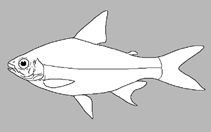 No image available for this species;
drawing shows typical species in Curimatidae.
Imagem do Google
drawing shows typical species in Curimatidae.
Classificação / Nomes Nomes comuns | Sinônimos | Catalog of Fishes(Gênero, Espécies) | ITIS | CoL | WoRMS | Cloffa
> Characiformes (Characins) > Curimatidae (Toothless characins)
Etymology: Cyphocharax: Greek, kyphos = curved, humpback + Greek, charax = a marine fish without identification (Ref. 45335); biocellatus: The specific name is derived from the Latin bi, meaning two, and ocellatus, meaning having little eyes, in reference to the two small dark spots on the lateral surface of the body in the species, one under the dorsal fin and the second on the middle of the caudal peduncle.
More on authors: Vari, Sidlauskas & LeBail.
Etymology: Cyphocharax: Greek, kyphos = curved, humpback + Greek, charax = a marine fish without identification (Ref. 45335); biocellatus: The specific name is derived from the Latin bi, meaning two, and ocellatus, meaning having little eyes, in reference to the two small dark spots on the lateral surface of the body in the species, one under the dorsal fin and the second on the middle of the caudal peduncle.
More on authors: Vari, Sidlauskas & LeBail.
Meio ambiente: milieu / Zona climática / intervalo de profundidade / faixa de distribuição Ecologia
; Água doce bentopelágico. Tropical
Distribuição Territórios | Áreas da FAO | Ecossistemas | Ocorrências | Mapa de pontos | Introduções | Faunafri
South America: Marowijne River/Maroni River system in eastern Suriname and western French Guiana, and the Mana basin in French Guiana.
Tamanho / Peso / Idade
Descrição suscinta Chaves de identificação | Morfologia | Morfometria
Raios dorsais (total) : 12; Raios anais : 10; Vértebras: 31 - 32. Can be diagnosed from all congeners by the possession in all but the smallest examined specimens of a midlateral spot of dark pigmentation in the region ventral to the dorsal fin, with the spot when present ranging in intensity from a diffuse concentration of dark chromatophores in smaller specimens to a distinct black spot in the larger examined individuals. Can be further separated from many congeners by its pigmentation features which include the presence of a dark, midlateral somewhat longitudinally-ovoid spot on the posterior portion of the caudal peduncle and scales overlying the basal portions of the middle caudal-fin rays; the absence of a series of dark stripes running between the scale rows; the lack of a patch of dark pigmentation on the dorsal fin; the hyaline or lightly speckled adipose fin. Further differs meristically from various other congeners in the number of lateral line scales 29 to 31; the number of scales above the lateral line 5; the number of scales below the lateral line 4 or 5, and the number of vertebrae 31 or 32 (Ref. 90234).
Body shape (shape guide): elongated.
Body shape (shape guide): elongated.
The type locality of the holotype is a side channel of Litani River that isolated a small, elongate, forested island. The channel dominantly consists of shallow cataracts over a bedrock substrate strewn with boulders in the upper portions and a small, shallow (less than 2 m deep) backwater over a sand substrate in the downstream portion. The channel margins are composed of shallow pockets of slackwater habitat, often with submerged vegetation and shaded by overhanging bank vegetation extending into the water. Found in shallow (0.50 m deep) tributary to the main river in an area with relatively rapid water flow (around 1m/s) and principally sandy substrate with some rocky bars and large pieces of dead wood (Ref. 90234).
Ciclo de vida ou comportamento de acasalamento Maturidade | Reprodução | Desova | Ovos | Fecundidade | Larvas
Referência principal
Carregar suas referências | Referências | Coordenador : Vari, Richard P. | Colaboradores
Vari, R.P., B.L. Sidlauskas and P.-Y. Le Bail, 2012. New species of Cyphocharax (Ostariophysi: Characiformes: Curimatidae) from Suriname and French Guiana and a discussion of curimatid diversity on the Guiana Shield. Cybium 36(1):63-69. (Ref. 90234)
Status na Lista Vermelha da UICN (Ref. 130435: Version 2025-2 (Global))
Quase ameaçada (NT) (B1b(iii,v)); Date assessed: 12 March 2023
CITES
Not Evaluated
Ameaça para os humanos
Harmless
Uso pelos humanos
Pescarias: sem interesse
FAO - Publication: search | FishSource |
Mais informação
Ecologia Trófica
Itens alimentares (presas)
Composição da dieta
Consumo alimentar
Rações alimentares
Predadores
Itens alimentares (presas)
Composição da dieta
Consumo alimentar
Rações alimentares
Predadores
Ecologia
Ecologia
Ecologia
Dinâmica populacional
Parâmetros de crescimento
Idade máxima / tamanhos
Relação comprimento-peso.
Relação comprimento-comprimento.
Frequências de comprimento
Conversão de massa
Recrutamento
Abundância
Parâmetros de crescimento
Idade máxima / tamanhos
Relação comprimento-peso.
Relação comprimento-comprimento.
Frequências de comprimento
Conversão de massa
Recrutamento
Abundância
Ciclo de vida
Reprodução
Maturidade
Maturidade/Rel. das guelras
Fecundidade
Desova
Agregações de desova
Ovos
Desenvolvimento dos ovos
Larvas
Dinâmica larval
Reprodução
Maturidade
Maturidade/Rel. das guelras
Fecundidade
Desova
Agregações de desova
Ovos
Desenvolvimento dos ovos
Larvas
Dinâmica larval
Anatomia
Área branquial
Cérebro
Otólito
Área branquial
Cérebro
Otólito
Fisiologia
Composição corporal
Nutrientes
Consumo de oxigênio
Tipo de natação
Velocidade de natação
Pigmentos visuais
Som de peixe
Doenças e Parasitas
Toxicidade (LC50s)
Composição corporal
Nutrientes
Consumo de oxigênio
Tipo de natação
Velocidade de natação
Pigmentos visuais
Som de peixe
Doenças e Parasitas
Toxicidade (LC50s)
Genética
genoma
Genética
Heterozigosidade
Hereditariedade
Diversidade genética
genoma
Genética
Heterozigosidade
Hereditariedade
Diversidade genética
Relacionado a humanos
Sistemas de aquicultura
Perfis para aquacultura
Estirpes
Casos de Ciguatera
Selos, moedas, diversos.
Sistemas de aquicultura
Perfis para aquacultura
Estirpes
Casos de Ciguatera
Selos, moedas, diversos.
Ferramentas
Livro eletrônico | Guia de campo | Ferramenta auxiliar de frequências de comprimento | Ferramenta sobre a história de vida | Mapa de pontos |
Catch-MSY |
Relatórios especiais
Checar Manutenção em Aquário | Checar Planilhas de Fatos sobre as Espécies | Checar Planilhas de Fatos sobre Aquicultura
Baixar XML
Fontes da internet
AFORO (otoliths) | Aquatic Commons | BHL | Cloffa | Websites from users | Checar Observador de Peixes (FishWatcher) | CISTI | Catalog of Fishes: Gênero, Espécies | DiscoverLife | ECOTOX | FAO - Publication: search | Faunafri | Fishipedia | Fishtrace | GloBI | Google Books | Google Scholar | Google | IGFA World Record | OneZoom | Open Tree of Life | Otolith Atlas of Taiwan Fishes | PubMed | Reef Life Survey | Socotra Atlas | TreeBase | Árvore da vida | Wikipedia: Ir para, procura | World Records Freshwater Fishing | Zoobank | Registro zoológico