



Cyphocharax biocellatus Vari, Sidlauskas & Le Bail, 2012
Carica il tuo foto e Video
Google image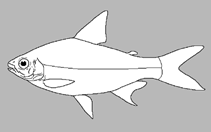 No image available for this species;
drawing shows typical species in Curimatidae.
Google image
drawing shows typical species in Curimatidae.
Classificazione / Nomi Nomi Comuni | Sinonimi | Catalog of Fishes(Genere, Specie) | ITIS | CoL | WoRMS | Cloffa
> Characiformes (Characins) > Curimatidae (Toothless characins)
Etymology: Cyphocharax: Greek, kyphos = curved, humpback + Greek, charax = a marine fish without identification (Ref. 45335); biocellatus: The specific name is derived from the Latin bi, meaning two, and ocellatus, meaning having little eyes, in reference to the two small dark spots on the lateral surface of the body in the species, one under the dorsal fin and the second on the middle of the caudal peduncle.
More on authors: Vari, Sidlauskas & LeBail.
Etymology: Cyphocharax: Greek, kyphos = curved, humpback + Greek, charax = a marine fish without identification (Ref. 45335); biocellatus: The specific name is derived from the Latin bi, meaning two, and ocellatus, meaning having little eyes, in reference to the two small dark spots on the lateral surface of the body in the species, one under the dorsal fin and the second on the middle of the caudal peduncle.
More on authors: Vari, Sidlauskas & LeBail.
Ambiente: milieu / zona climatica / distribuzione batimetrica / gamma di distribuzione Ecologia
; acqua dolce benthopelagico. Tropical
Distribuzione Territories | Aree FAO | Ecosistemi | Presenze | Mappa dei ritrovamenti | Introduzioni | Faunafri
South America: Marowijne River/Maroni River system in eastern Suriname and western French Guiana, and the Mana basin in French Guiana.
Dimensione / Peso / Età
Breve descrizione Chiavi di identificazione | Morfologia | Morfometria
Raggi dorsali molli (totale) : 12; Raggi anali molli: 10; Vertebre: 31 - 32. Can be diagnosed from all congeners by the possession in all but the smallest examined specimens of a midlateral spot of dark pigmentation in the region ventral to the dorsal fin, with the spot when present ranging in intensity from a diffuse concentration of dark chromatophores in smaller specimens to a distinct black spot in the larger examined individuals. Can be further separated from many congeners by its pigmentation features which include the presence of a dark, midlateral somewhat longitudinally-ovoid spot on the posterior portion of the caudal peduncle and scales overlying the basal portions of the middle caudal-fin rays; the absence of a series of dark stripes running between the scale rows; the lack of a patch of dark pigmentation on the dorsal fin; the hyaline or lightly speckled adipose fin. Further differs meristically from various other congeners in the number of lateral line scales 29 to 31; the number of scales above the lateral line 5; the number of scales below the lateral line 4 or 5, and the number of vertebrae 31 or 32 (Ref. 90234).
Body shape (shape guide): elongated.
Body shape (shape guide): elongated.
The type locality of the holotype is a side channel of Litani River that isolated a small, elongate, forested island. The channel dominantly consists of shallow cataracts over a bedrock substrate strewn with boulders in the upper portions and a small, shallow (less than 2 m deep) backwater over a sand substrate in the downstream portion. The channel margins are composed of shallow pockets of slackwater habitat, often with submerged vegetation and shaded by overhanging bank vegetation extending into the water. Found in shallow (0.50 m deep) tributary to the main river in an area with relatively rapid water flow (around 1m/s) and principally sandy substrate with some rocky bars and large pieces of dead wood (Ref. 90234).
Ciclo vitale e comportamento di accoppiamento Maturità | Riproduzione | Deposizione | Uova | Fecondità | Larve
Riferimento principale
Caricare le referenze | Bibliografia | Coordinatore : Vari, Richard P. | Collaboratori
Vari, R.P., B.L. Sidlauskas and P.-Y. Le Bail, 2012. New species of Cyphocharax (Ostariophysi: Characiformes: Curimatidae) from Suriname and French Guiana and a discussion of curimatid diversity on the Guiana Shield. Cybium 36(1):63-69. (Ref. 90234)
Stato della Lista Rossa IUCN (Ref. 130435: Version 2025-2 (Global))
Near Threatened (NT) (B1b(iii,v)); Date assessed: 12 March 2023
CITES
Not Evaluated
Minaccia per l'uomo
Harmless
Usi umani
Pesca: di nessun interesse
FAO - Publication: search | FishSource |
Informazioni ulteriori
Ecologia trofica
Articoli alimentari (prede)
Alimentazione
Consumo di cibo
Razioni alimentari
Predatori
Articoli alimentari (prede)
Alimentazione
Consumo di cibo
Razioni alimentari
Predatori
Ecologia
Ecologia
Ecologia
Dinamica della popolazione
Parametri di crescita
Età massima / dimensioni massime
Rapporto lunghezza-peso.
Lunghezza-lunghezza rel.
Lunghezza-frequenze
Conversione di massa
Reclutamento
Abbondanza
Parametri di crescita
Età massima / dimensioni massime
Rapporto lunghezza-peso.
Lunghezza-lunghezza rel.
Lunghezza-frequenze
Conversione di massa
Reclutamento
Abbondanza
Ciclo di vita
Riproduzione
Maturità
Maturità/Gli occhielli sono relativi.
Fecondità
Deposizione
Aggregazioni riproduttive
Uova
Sviluppo delle uova
Larve
Dinamica popolazioni larvali
Riproduzione
Maturità
Maturità/Gli occhielli sono relativi.
Fecondità
Deposizione
Aggregazioni riproduttive
Uova
Sviluppo delle uova
Larve
Dinamica popolazioni larvali
Anatomia
Area branchiale
Cervello
Otolite
Area branchiale
Cervello
Otolite
Fisiologia
Composizione corporea
Nutrienti
Consumo di ossigeno
Tipo di nuoto
Velocità di nuoto
Pigmenti visivi
Suono del pesce
Malattie e parassiti
Tossicità (LC50)
Composizione corporea
Nutrienti
Consumo di ossigeno
Tipo di nuoto
Velocità di nuoto
Pigmenti visivi
Suono del pesce
Malattie e parassiti
Tossicità (LC50)
Genetica
Genome
Genetica
Eterozigosi
Ereditarietà
Diversità genetica
Genome
Genetica
Eterozigosi
Ereditarietà
Diversità genetica
Legato all'uomo
Sistemi di acquacoltura
Profili di acquacoltura
Varietà
Casi di Ciguatera
Francobolli, monete, materiale vario.
Sistemi di acquacoltura
Profili di acquacoltura
Varietà
Casi di Ciguatera
Francobolli, monete, materiale vario.
Strumenti
Libro elettronico | Giuda pratica | Generatore frequenze di lunghezza | Strumento Parametri Biologici | Mappa dei ritrovamenti |
Cattura-MSY |
Rapporti speciali
Controllo della manutenzione dell'acquario | Verificare la presenza di schede informative sulle specie | Verifica delle schede informative sull'acquacoltura
Scarica XML
Fonti Internet
AFORO (otoliths) | Aquatic Commons | BHL | Cloffa | Websites from users | Check FishWatcher | CISTI | Catalog of Fishes: Genere, Specie | DiscoverLife | ECOTOX | FAO - Publication: search | Faunafri | Fishipedia | Fishtrace | GloBI | Google Books | Google Scholar | Google | IGFA World Record | OneZoom | Open Tree of Life | Otolith Atlas of Taiwan Fishes | PubMed | Reef Life Survey | Socotra Atlas | TreeBase | Tree of Life | Wikipedia: Go, ricerca | World Records Freshwater Fishing | Zoobank | Record zoologico