



Maculabatis randalli (Last, Manjaji-Matsumoto & Moore, 2012)
Arabian banded whipray
Ladda upp din foton och Videor
Bilder | Google image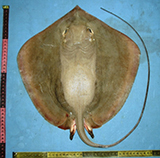 Maculabatis randalli
Bild av Osmany, H.B.
Bilder | Google image
Bild av Osmany, H.B.
Klassificering / Namn Populärnamn | synonymer | Catalog of Fishes(Släkte, Arter) | ITIS | CoL | WoRMS | Cloffa
Elasmobranchii (hajar och rockor) (sharks and rays) > Myliobatiformes (Stingrays) > Dasyatidae (Stingrays) > Urogymninae
Etymology: randalli: Named for J.E. Randall, Bishop Museum; whose work on the taxonomy of Indo-Pacific fishes is legendary, and who was amongst the first authors to publish a photographic image of this species (as H. gerrardi) in his guide to the fishes of Oman (Randall, 1995).
Eponymy: Dr John ‘Jack’ Ernest Randall Jr. [...] (Ref. 128868), visit book page.
More on authors: Last, Manjaji-Matsumoto & Moore.
Etymology: randalli: Named for J.E. Randall, Bishop Museum; whose work on the taxonomy of Indo-Pacific fishes is legendary, and who was amongst the first authors to publish a photographic image of this species (as H. gerrardi) in his guide to the fishes of Oman (Randall, 1995).
Eponymy: Dr John ‘Jack’ Ernest Randall Jr. [...] (Ref. 128868), visit book page.
More on authors: Last, Manjaji-Matsumoto & Moore.
Miljö: miljö / Klimatzon / djupintervall / distributionsområde Ekologi
marina bottenlevande; djupintervall 1 - 40 m (Ref. 90168). Tropical
Utbredning Territorier | FAO områden | Ekosystem | Förekomster | Prickkarta | Utplanteringar | Faunafri
Western Indian Ocean: off Kuwait, Bahrain, Qatar and Iran. known from the Persian Gulf from where it is possibly endemic (Ref. 90168).
Storlek / Vikt / Ålder
Kort beskrivning Bestämningsnycklar | Morfologi | Morfometri
This medium-sized species (to at least 62 cm DW) is distinguished by the following set of characters: disc weakly rhomboidal; preorbital snout moderately elongate with weak apical lobe, snout angle 113-119°; rounded pectoral-fin apices, angle 96-98°; small, protrusible orbits; relatively broad mouth, its width 0.9-1.2 in internasal width; distance between first gill slits 2.5-2.6 times internasal distance; distance between fifth gill slits times 1.5-1.7 times internasal distance, 27-29% of ventral head length; broad pelvic-fin base, 13-17% DW; in juveniles, the tail behind sting is subcircular with deep longitudinal ventral groove and prominent mid-lateral ridge, in adults, it is weakly depressed; 1-2 (usually 1) small, broadly heart-shaped to seed shaped suprascapular denticles, primary denticle band and thorns absent; secondary denticle band irregularly sub-oval, relatively narrow (its maximum width across scapulocoracoid barely exceeding its width at spiracles), with well-defined lateral margins, narrowly tapering near tail base; fully developed band and covering entire dorsal surface of tail by 33 cm DW; dorsal surface mainly uniformly coloured (occasionally with dark flecks in specimens smaller than 25 cm DW), disc margin sometimes paler dorsally; ventral disc uniformly whitish, not black edged; in adults, darker dorsal surface of tail sharply demarcated from paler ventral surface; in neonates and juveniles, dark tail with conspicuous white saddles, its distal portion usually almost uniformly dark; pectoral-fin radials 124-129; 108-111 total vertebral count (excluding 1st synarcual centra), 43-44 monospondylous centra, 65-68 pre-sting diplospondylous centra (Ref. 90168).
Body shape (shape guide): other; Cross section: flattened.
Body shape (shape guide): other; Cross section: flattened.
Known from the Persian Gulf which is mostly shallower than 40 m and with depths rarely exceeding 60 m; soft substrates, mostly sand and mud (Ref. 90168).
Livscykel och parningsbeteende Könsmognad | Reproduktion | Lek | Ägg | Fekunditet | Larver
Huvudreferens
Ladda upp dina referenser | referenser | Koordinator : McEachran, John | Medarbetare
Last, P.R., B.M. Manjaji-Matsumoto and A.B.M. Moore, 2012. Himantura randalli sp. nov., a new whipray (Myliobatoidea: Dasyatidae) from the Persian Gulf. Zootaxa 3327:20-32. (Ref. 90168)
Status på IUCN:s rödlista (Ref. 130435: Version 2025-2 (Global))
Least Concern (LC) ; Date assessed: 08 February 2017
CITES
Not Evaluated
Hot mot människor
Harmless
Mänskliga användningsområden
FAO - Publication: search | FishSource |
Ytterligare information
Trofisk ekologi
Livsmedelsartiklar (preys)
Födosammansättning
Födointag
Matransoner
Predatorer
Livsmedelsartiklar (preys)
Födosammansättning
Födointag
Matransoner
Predatorer
Ekologi
Ekologi
Ekologi
Populationsdynamik
Tillväxtparametrar
Max. åldrar / storlekar
Längd-vikt rel.
Längd-längd rel.
Längd-frekvenser
Massakonvertering
Rekrytering
Abundans
Tillväxtparametrar
Max. åldrar / storlekar
Längd-vikt rel.
Längd-längd rel.
Längd-frekvenser
Massakonvertering
Rekrytering
Abundans
Livscykel
Reproduktion
Könsmognad
Mognad/Gills rel.
Fekunditet
Lek
Lekande aggregat
Ägg
Utveckling av ägg
Larver
Larvdynamik
Reproduktion
Könsmognad
Mognad/Gills rel.
Fekunditet
Lek
Lekande aggregat
Ägg
Utveckling av ägg
Larver
Larvdynamik
Anatomi
Gälyta
Hjärna
Otolit
Gälyta
Hjärna
Otolit
Fysiologi
Kroppssammansättning
Näringsämnen
Syreförbrukning
Typ av simning
Simhastighet
Visuella pigment
Ljud från fisk
Sjukdomar & Parasiter
Toxicitet (LC50)
Kroppssammansättning
Näringsämnen
Syreförbrukning
Typ av simning
Simhastighet
Visuella pigment
Ljud från fisk
Sjukdomar & Parasiter
Toxicitet (LC50)
Genetik
Genom
Genetik
Heterozygositet
Ärftlighet
Genetisk mångfald
Genom
Genetik
Heterozygositet
Ärftlighet
Genetisk mångfald
Människorelaterad
Vattenbrukssystem
Vattenbruksprofiler
Avelslinjer
Ciguatera-fall
Frimärken, mynt, diverse.
Vattenbrukssystem
Vattenbruksprofiler
Avelslinjer
Ciguatera-fall
Frimärken, mynt, diverse.
Verktyg
Särskilda rapporter
Kontrollera för underhåll av akvarium | Kontrollera om det finns faktablad om arter | Kontrollera om det finns faktablad om vattenbruk
Ladda ner XML
Internet-källor
AFORO (otoliths) | Aquatic Commons | BHL | Cloffa | Websites from users | Check FishWatcher | CISTI | Catalog of Fishes: Släkte, Arter | DiscoverLife | ECOTOX | FAO - Publication: search | Faunafri | Fishipedia | Fishtrace | GloBI | Google Books | Google Scholar | Google | IGFA World Record | OneZoom | Open Tree of Life | Otolith Atlas of Taiwan Fishes | PubMed | Reef Life Survey | Socotra Atlas | TreeBase | Tree of Life | Wikipedia: Go, sök | World Records Freshwater Fishing | Zoologiskt register
Uppskattningar baserade på modeller
Önskad temperatur (Ref. 123201): 24.4 - 29.3, mean 26.9 °C (based on 128 cells).
Index för fylogenetisk mångfald (Ref. 82804): PD50 = 0.5020 [Uniqueness, from 0.5 = low to 2.0 = high].
Bayesian length-weight: a=0.01023 (0.00482 - 0.02174), b=3.06 (2.86 - 3.26), in cm total length, based on LWR estimates for this (Sub)family-body shape (Ref. 93245).
Trofisk nivå (Ref. 69278): 3.7 ±0.4 se; based on size and trophs of closest relatives