



Maculabatis randalli (Last, Manjaji-Matsumoto & Moore, 2012)
Arabian banded whipray
Carregue seu(sua) Fotos e vídeos
Fotos | Imagem do Google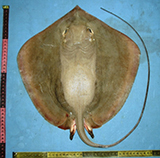 Maculabatis randalli
Foto de Osmany, H.B.
Fotos | Imagem do Google
Foto de Osmany, H.B.
Classificação / Nomes Nomes comuns | Sinônimos | Catalog of Fishes(Gênero, Espécies) | ITIS | CoL | WoRMS | Cloffa
Elasmobranchii (tubarões e raias) (sharks and rays) > Myliobatiformes (Stingrays) > Dasyatidae (Stingrays) > Urogymninae
Etymology: randalli: Named for J.E. Randall, Bishop Museum; whose work on the taxonomy of Indo-Pacific fishes is legendary, and who was amongst the first authors to publish a photographic image of this species (as H. gerrardi) in his guide to the fishes of Oman (Randall, 1995).
Eponymy: Dr John ‘Jack’ Ernest Randall Jr. [...] (Ref. 128868), visit book page.
More on authors: Last, Manjaji-Matsumoto & Moore.
Etymology: randalli: Named for J.E. Randall, Bishop Museum; whose work on the taxonomy of Indo-Pacific fishes is legendary, and who was amongst the first authors to publish a photographic image of this species (as H. gerrardi) in his guide to the fishes of Oman (Randall, 1995).
Eponymy: Dr John ‘Jack’ Ernest Randall Jr. [...] (Ref. 128868), visit book page.
More on authors: Last, Manjaji-Matsumoto & Moore.
Meio ambiente: milieu / Zona climática / intervalo de profundidade / faixa de distribuição Ecologia
marinhas demersal; intervalo de profundidade 1 - 40 m (Ref. 90168). Tropical
Distribuição Territórios | Áreas da FAO | Ecossistemas | Ocorrências | Mapa de pontos | Introduções | Faunafri
Western Indian Ocean: off Kuwait, Bahrain, Qatar and Iran. known from the Persian Gulf from where it is possibly endemic (Ref. 90168).
Tamanho / Peso / Idade
Descrição suscinta Chaves de identificação | Morfologia | Morfometria
This medium-sized species (to at least 62 cm DW) is distinguished by the following set of characters: disc weakly rhomboidal; preorbital snout moderately elongate with weak apical lobe, snout angle 113-119°; rounded pectoral-fin apices, angle 96-98°; small, protrusible orbits; relatively broad mouth, its width 0.9-1.2 in internasal width; distance between first gill slits 2.5-2.6 times internasal distance; distance between fifth gill slits times 1.5-1.7 times internasal distance, 27-29% of ventral head length; broad pelvic-fin base, 13-17% DW; in juveniles, the tail behind sting is subcircular with deep longitudinal ventral groove and prominent mid-lateral ridge, in adults, it is weakly depressed; 1-2 (usually 1) small, broadly heart-shaped to seed shaped suprascapular denticles, primary denticle band and thorns absent; secondary denticle band irregularly sub-oval, relatively narrow (its maximum width across scapulocoracoid barely exceeding its width at spiracles), with well-defined lateral margins, narrowly tapering near tail base; fully developed band and covering entire dorsal surface of tail by 33 cm DW; dorsal surface mainly uniformly coloured (occasionally with dark flecks in specimens smaller than 25 cm DW), disc margin sometimes paler dorsally; ventral disc uniformly whitish, not black edged; in adults, darker dorsal surface of tail sharply demarcated from paler ventral surface; in neonates and juveniles, dark tail with conspicuous white saddles, its distal portion usually almost uniformly dark; pectoral-fin radials 124-129; 108-111 total vertebral count (excluding 1st synarcual centra), 43-44 monospondylous centra, 65-68 pre-sting diplospondylous centra (Ref. 90168).
Body shape (shape guide): other; Cross section: flattened.
Body shape (shape guide): other; Cross section: flattened.
Known from the Persian Gulf which is mostly shallower than 40 m and with depths rarely exceeding 60 m; soft substrates, mostly sand and mud (Ref. 90168).
Ciclo de vida ou comportamento de acasalamento Maturidade | Reprodução | Desova | Ovos | Fecundidade | Larvas
Referência principal
Carregar suas referências | Referências | Coordenador : McEachran, John | Colaboradores
Last, P.R., B.M. Manjaji-Matsumoto and A.B.M. Moore, 2012. Himantura randalli sp. nov., a new whipray (Myliobatoidea: Dasyatidae) from the Persian Gulf. Zootaxa 3327:20-32. (Ref. 90168)
Status na Lista Vermelha da UICN (Ref. 130435: Version 2025-2 (Global))
Segura ou pouco preocupante (LC) ; Date assessed: 08 February 2017
CITES
Not Evaluated
Ameaça para os humanos
Harmless
Uso pelos humanos
FAO - Publication: search | FishSource |
Mais informação
Ecologia Trófica
Itens alimentares (presas)
Composição da dieta
Consumo alimentar
Rações alimentares
Predadores
Itens alimentares (presas)
Composição da dieta
Consumo alimentar
Rações alimentares
Predadores
Ecologia
Ecologia
Ecologia
Dinâmica populacional
Parâmetros de crescimento
Idade máxima / tamanhos
Relação comprimento-peso.
Relação comprimento-comprimento.
Frequências de comprimento
Conversão de massa
Recrutamento
Abundância
Parâmetros de crescimento
Idade máxima / tamanhos
Relação comprimento-peso.
Relação comprimento-comprimento.
Frequências de comprimento
Conversão de massa
Recrutamento
Abundância
Ciclo de vida
Reprodução
Maturidade
Maturidade/Rel. das guelras
Fecundidade
Desova
Agregações de desova
Ovos
Desenvolvimento dos ovos
Larvas
Dinâmica larval
Reprodução
Maturidade
Maturidade/Rel. das guelras
Fecundidade
Desova
Agregações de desova
Ovos
Desenvolvimento dos ovos
Larvas
Dinâmica larval
Anatomia
Área branquial
Cérebro
Otólito
Área branquial
Cérebro
Otólito
Fisiologia
Composição corporal
Nutrientes
Consumo de oxigênio
Tipo de natação
Velocidade de natação
Pigmentos visuais
Som de peixe
Doenças e Parasitas
Toxicidade (LC50s)
Composição corporal
Nutrientes
Consumo de oxigênio
Tipo de natação
Velocidade de natação
Pigmentos visuais
Som de peixe
Doenças e Parasitas
Toxicidade (LC50s)
Genética
genoma
Genética
Heterozigosidade
Hereditariedade
Diversidade genética
genoma
Genética
Heterozigosidade
Hereditariedade
Diversidade genética
Relacionado a humanos
Sistemas de aquicultura
Perfis para aquacultura
Estirpes
Casos de Ciguatera
Selos, moedas, diversos.
Sistemas de aquicultura
Perfis para aquacultura
Estirpes
Casos de Ciguatera
Selos, moedas, diversos.
Ferramentas
Livro eletrônico | Guia de campo | Ferramenta auxiliar de frequências de comprimento | Ferramenta sobre a história de vida | Mapa de pontos |
Catch-MSY |
Relatórios especiais
Checar Manutenção em Aquário | Checar Planilhas de Fatos sobre as Espécies | Checar Planilhas de Fatos sobre Aquicultura
Baixar XML
Fontes da internet
AFORO (otoliths) | Aquatic Commons | BHL | Cloffa | Websites from users | Checar Observador de Peixes (FishWatcher) | CISTI | Catalog of Fishes: Gênero, Espécies | DiscoverLife | ECOTOX | FAO - Publication: search | Faunafri | Fishipedia | Fishtrace | GloBI | Google Books | Google Scholar | Google | IGFA World Record | OneZoom | Open Tree of Life | Otolith Atlas of Taiwan Fishes | PubMed | Reef Life Survey | Socotra Atlas | TreeBase | Árvore da vida | Wikipedia: Ir para, procura | World Records Freshwater Fishing | Registro zoológico
Estimativas baseadas em modelos
Temperatura preferida (Ref. 123201): 24.4 - 29.3, mean 26.9 °C (based on 128 cells).
Índice de diversidade filogenética (Ref. 82804): PD50 = 0.5020 [Uniqueness, from 0.5 = low to 2.0 = high].
Bayesian length-weight: a=0.01023 (0.00482 - 0.02174), b=3.06 (2.86 - 3.26), in cm total length, based on LWR estimates for this (Sub)family-body shape (Ref. 93245).
Nível Trófico (Ref. 69278): 3.7 ±0.4 se; based on size and trophs of closest relatives