



Maculabatis randalli (Last, Manjaji-Matsumoto & Moore, 2012)
Arabian banded whipray
Carica il tuo foto e Video
Immagini | Google image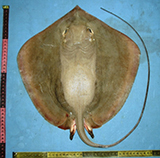 Maculabatis randalli
Immagine di Osmany, H.B.
Immagini | Google image
Immagine di Osmany, H.B.
Classificazione / Nomi Nomi Comuni | Sinonimi | Catalog of Fishes(Genere, Specie) | ITIS | CoL | WoRMS | Cloffa
Elasmobranchi (squali e razze) (sharks and rays) > Myliobatiformes (Stingrays) > Dasyatidae (Stingrays) > Urogymninae
Etymology: randalli: Named for J.E. Randall, Bishop Museum; whose work on the taxonomy of Indo-Pacific fishes is legendary, and who was amongst the first authors to publish a photographic image of this species (as H. gerrardi) in his guide to the fishes of Oman (Randall, 1995).
Eponymy: Dr John ‘Jack’ Ernest Randall Jr. [...] (Ref. 128868), visit book page.
More on authors: Last, Manjaji-Matsumoto & Moore.
Etymology: randalli: Named for J.E. Randall, Bishop Museum; whose work on the taxonomy of Indo-Pacific fishes is legendary, and who was amongst the first authors to publish a photographic image of this species (as H. gerrardi) in his guide to the fishes of Oman (Randall, 1995).
Eponymy: Dr John ‘Jack’ Ernest Randall Jr. [...] (Ref. 128868), visit book page.
More on authors: Last, Manjaji-Matsumoto & Moore.
Ambiente: milieu / zona climatica / distribuzione batimetrica / gamma di distribuzione Ecologia
marino demersale; distribuzione batimetrica 1 - 40 m (Ref. 90168). Tropical
Distribuzione Territories | Aree FAO | Ecosistemi | Presenze | Mappa dei ritrovamenti | Introduzioni | Faunafri
Western Indian Ocean: off Kuwait, Bahrain, Qatar and Iran. known from the Persian Gulf from where it is possibly endemic (Ref. 90168).
Dimensione / Peso / Età
Breve descrizione Chiavi di identificazione | Morfologia | Morfometria
This medium-sized species (to at least 62 cm DW) is distinguished by the following set of characters: disc weakly rhomboidal; preorbital snout moderately elongate with weak apical lobe, snout angle 113-119°; rounded pectoral-fin apices, angle 96-98°; small, protrusible orbits; relatively broad mouth, its width 0.9-1.2 in internasal width; distance between first gill slits 2.5-2.6 times internasal distance; distance between fifth gill slits times 1.5-1.7 times internasal distance, 27-29% of ventral head length; broad pelvic-fin base, 13-17% DW; in juveniles, the tail behind sting is subcircular with deep longitudinal ventral groove and prominent mid-lateral ridge, in adults, it is weakly depressed; 1-2 (usually 1) small, broadly heart-shaped to seed shaped suprascapular denticles, primary denticle band and thorns absent; secondary denticle band irregularly sub-oval, relatively narrow (its maximum width across scapulocoracoid barely exceeding its width at spiracles), with well-defined lateral margins, narrowly tapering near tail base; fully developed band and covering entire dorsal surface of tail by 33 cm DW; dorsal surface mainly uniformly coloured (occasionally with dark flecks in specimens smaller than 25 cm DW), disc margin sometimes paler dorsally; ventral disc uniformly whitish, not black edged; in adults, darker dorsal surface of tail sharply demarcated from paler ventral surface; in neonates and juveniles, dark tail with conspicuous white saddles, its distal portion usually almost uniformly dark; pectoral-fin radials 124-129; 108-111 total vertebral count (excluding 1st synarcual centra), 43-44 monospondylous centra, 65-68 pre-sting diplospondylous centra (Ref. 90168).
Body shape (shape guide): other; Cross section: flattened.
Body shape (shape guide): other; Cross section: flattened.
Known from the Persian Gulf which is mostly shallower than 40 m and with depths rarely exceeding 60 m; soft substrates, mostly sand and mud (Ref. 90168).
Ciclo vitale e comportamento di accoppiamento Maturità | Riproduzione | Deposizione | Uova | Fecondità | Larve
Riferimento principale
Caricare le referenze | Bibliografia | Coordinatore : McEachran, John | Collaboratori
Last, P.R., B.M. Manjaji-Matsumoto and A.B.M. Moore, 2012. Himantura randalli sp. nov., a new whipray (Myliobatoidea: Dasyatidae) from the Persian Gulf. Zootaxa 3327:20-32. (Ref. 90168)
Stato della Lista Rossa IUCN (Ref. 130435: Version 2025-2 (Global))
Least Concern (LC) ; Date assessed: 08 February 2017
CITES
Not Evaluated
Minaccia per l'uomo
Harmless
Usi umani
FAO - Publication: search | FishSource |
Informazioni ulteriori
Ecologia trofica
Articoli alimentari (prede)
Alimentazione
Consumo di cibo
Razioni alimentari
Predatori
Articoli alimentari (prede)
Alimentazione
Consumo di cibo
Razioni alimentari
Predatori
Ecologia
Ecologia
Ecologia
Dinamica della popolazione
Parametri di crescita
Età massima / dimensioni massime
Rapporto lunghezza-peso.
Lunghezza-lunghezza rel.
Lunghezza-frequenze
Conversione di massa
Reclutamento
Abbondanza
Parametri di crescita
Età massima / dimensioni massime
Rapporto lunghezza-peso.
Lunghezza-lunghezza rel.
Lunghezza-frequenze
Conversione di massa
Reclutamento
Abbondanza
Ciclo di vita
Riproduzione
Maturità
Maturità/Gli occhielli sono relativi.
Fecondità
Deposizione
Aggregazioni riproduttive
Uova
Sviluppo delle uova
Larve
Dinamica popolazioni larvali
Riproduzione
Maturità
Maturità/Gli occhielli sono relativi.
Fecondità
Deposizione
Aggregazioni riproduttive
Uova
Sviluppo delle uova
Larve
Dinamica popolazioni larvali
Anatomia
Area branchiale
Cervello
Otolite
Area branchiale
Cervello
Otolite
Fisiologia
Composizione corporea
Nutrienti
Consumo di ossigeno
Tipo di nuoto
Velocità di nuoto
Pigmenti visivi
Suono del pesce
Malattie e parassiti
Tossicità (LC50)
Composizione corporea
Nutrienti
Consumo di ossigeno
Tipo di nuoto
Velocità di nuoto
Pigmenti visivi
Suono del pesce
Malattie e parassiti
Tossicità (LC50)
Genetica
Genome
Genetica
Eterozigosi
Ereditarietà
Diversità genetica
Genome
Genetica
Eterozigosi
Ereditarietà
Diversità genetica
Legato all'uomo
Sistemi di acquacoltura
Profili di acquacoltura
Varietà
Casi di Ciguatera
Francobolli, monete, materiale vario.
Sistemi di acquacoltura
Profili di acquacoltura
Varietà
Casi di Ciguatera
Francobolli, monete, materiale vario.
Strumenti
Libro elettronico | Giuda pratica | Generatore frequenze di lunghezza | Strumento Parametri Biologici | Mappa dei ritrovamenti |
Cattura-MSY |
Rapporti speciali
Controllo della manutenzione dell'acquario | Verificare la presenza di schede informative sulle specie | Verifica delle schede informative sull'acquacoltura
Scarica XML
Fonti Internet
AFORO (otoliths) | Aquatic Commons | BHL | Cloffa | Websites from users | Check FishWatcher | CISTI | Catalog of Fishes: Genere, Specie | DiscoverLife | ECOTOX | FAO - Publication: search | Faunafri | Fishipedia | Fishtrace | GloBI | Google Books | Google Scholar | Google | IGFA World Record | OneZoom | Open Tree of Life | Otolith Atlas of Taiwan Fishes | PubMed | Reef Life Survey | Socotra Atlas | TreeBase | Tree of Life | Wikipedia: Go, ricerca | World Records Freshwater Fishing | Record zoologico
Stime basate su modelli
Temperatura preferita (Fonte Biblio. 123201): 24.4 - 29.3, mean 26.9 °C (based on 128 cells).
Indice di diversità filogenetica (Fonte Biblio. 82804): PD50 = 0.5020 [Uniqueness, from 0.5 = low to 2.0 = high].
Bayesian length-weight: a=0.01023 (0.00482 - 0.02174), b=3.06 (2.86 - 3.26), in cm total length, based on LWR estimates for this (Sub)family-body shape (Ref. 93245).
Livello trofico (Fonte Biblio. 69278): 3.7 ±0.4 se; based on size and trophs of closest relatives