



Pastinachus gracilicaudus Last & Manjaji-Matsumoto, 2010
Narrowtail stingray
Ladda upp din foton och Videor
Google image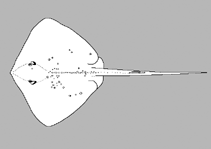 No image available for this species;
drawing shows typical species in Dasyatidae.
Google image
drawing shows typical species in Dasyatidae.
Klassificering / Namn Populärnamn | synonymer | Catalog of Fishes(Släkte, Arter) | ITIS | CoL | WoRMS | Cloffa
Elasmobranchii (hajar och rockor) (sharks and rays) > Myliobatiformes (Stingrays) > Dasyatidae (Stingrays) > Hypolophinae
Etymology: Pastinachus: Latin, pastinaca = a sting ray (Ref. 45335); gracilicaudus: Name from Latin 'gracilis' meaning slender, thin and 'cauda' for tail, appendage; referring to the slender appearance of the tail and narrow ventral cutaneous fold, as compared to other members of the genus Pastinachus.
More on authors: Last & Manjaji-Matsumoto.
Etymology: Pastinachus: Latin, pastinaca = a sting ray (Ref. 45335); gracilicaudus: Name from Latin 'gracilis' meaning slender, thin and 'cauda' for tail, appendage; referring to the slender appearance of the tail and narrow ventral cutaneous fold, as compared to other members of the genus Pastinachus.
More on authors: Last & Manjaji-Matsumoto.
Miljö: miljö / Klimatzon / djupintervall / distributionsområde Ekologi
marina bentopelagisk; djupintervall ? - 60 m (Ref. 90102). Tropical
Utbredning Territorier | FAO områden | Ekosystem | Förekomster | Prickkarta | Utplanteringar | Faunafri
Western Pacific: This species is reasonably common but patchily distributed in both Malaysian and Indonesian Borneo, including Sabah, Sarawak, and western and northeastern Kalimantan. Possibly more widespread in the Indo-Malay Archipelago, east to at least the Wallace Line and the the identity of a specimen collected off Beruwala (Sri Lanka) needs confirmation.
Storlek / Vikt / Ålder
Könsmognad: Lm ? range ? - ? cm
Max length : 74.7 cm WD hane/ej könsbestämd; (Ref. 84288); 83.0 cm WD (female)
Max length : 74.7 cm WD hane/ej könsbestämd; (Ref. 84288); 83.0 cm WD (female)
Kort beskrivning Bestämningsnycklar | Morfologi | Morfometri
This medium-sized species (attaining about 75 cm DW) is distinguished by the following set of characters: snout rounded, not produced, angle more than 115°, apex largely naked and lacking enlarged denticles; disc length 83-89% DW; head length 38-41% DW; preoral length 15-17% DW; distance between nostrils 7-8% DW; distance between first gill slits 18-20% DW; tail compressed above mid-base of ventral cutaneous fold, its width 0.5-0.8 times its height; ventral fold low and slender, length 0.7-1.0 times DW, 17-22 times its depth below its mid-base, depth 2.0-3.6 times tail height at its mid-base; distance from anterior cloaca to sting 0.8-1 in precloacal length; two large, midscapular pearl thorns, usually preceded by a smaller irregular thorn; 120-122 pectoral-fin radials; monospondylous vertebral centra (exc. synarcual) 37-40 (Ref. 84288).
Body shape (shape guide): other.
Body shape (shape guide): other.
The depth occupied by this species is unknown as most material were collected in fish markets, but probably mainly coastal. A 69.5 cm DW adult male weighed ca 12 kg. Size at birth apparently variable; 83.0 cm DW female delivered a full term embryo with small umbilical scar; however, other retained specimens, 26.1 cm DW still had a substantial yolk sac, while in another 19.3 cm DW specimen the umbilical scar was barely visible. All these young specimens have large mid-scapular tubercles and well-developed denticles over most of the dorsal disc; a small embryo with yolk sac (16.5 cm DW) had prominent mid-scapular tubercles, but other denticles are just starting to form on the disc (Ref. 84288).
Livscykel och parningsbeteende Könsmognad | Reproduktion | Lek | Ägg | Fekunditet | Larver
Huvudreferens
Ladda upp dina referenser | referenser | Koordinator : McEachran, John | Medarbetare
Last, P.R. and B.M. Manjaji-Matsumoto, 2010. Description of a new stingray, Pastinachus gracilicaudus sp. nov. (Elasmobranchii: Myliobatiformes), based on material from the Indo-Malay Archipelago. pp. 115-128. In Last, P.R., White, W.T. & Pogonoski, J.J. (eds.): Descriptions of new sharks and rays from Borneo. CSIRO Marine and Atmospheric Research Paper no. 32. (Ref. 84288)
Status på IUCN:s rödlista (Ref. 130435: Version 2025-2 (Global))
Endangered (EN) (A2d); Date assessed: 19 May 2020
CITES
Not Evaluated
Hot mot människor
Harmless
Mänskliga användningsområden
FAO - Publication: search | FishSource |
Ytterligare information
Trofisk ekologi
Livsmedelsartiklar (preys)
Födosammansättning
Födointag
Matransoner
Predatorer
Livsmedelsartiklar (preys)
Födosammansättning
Födointag
Matransoner
Predatorer
Ekologi
Ekologi
Ekologi
Populationsdynamik
Tillväxtparametrar
Max. åldrar / storlekar
Längd-vikt rel.
Längd-längd rel.
Längd-frekvenser
Massakonvertering
Rekrytering
Abundans
Tillväxtparametrar
Max. åldrar / storlekar
Längd-vikt rel.
Längd-längd rel.
Längd-frekvenser
Massakonvertering
Rekrytering
Abundans
Livscykel
Reproduktion
Könsmognad
Mognad/Gills rel.
Fekunditet
Lek
Lekande aggregat
Ägg
Utveckling av ägg
Larver
Larvdynamik
Reproduktion
Könsmognad
Mognad/Gills rel.
Fekunditet
Lek
Lekande aggregat
Ägg
Utveckling av ägg
Larver
Larvdynamik
Anatomi
Gälyta
Hjärna
Otolit
Gälyta
Hjärna
Otolit
Fysiologi
Kroppssammansättning
Näringsämnen
Syreförbrukning
Typ av simning
Simhastighet
Visuella pigment
Ljud från fisk
Sjukdomar & Parasiter
Toxicitet (LC50)
Kroppssammansättning
Näringsämnen
Syreförbrukning
Typ av simning
Simhastighet
Visuella pigment
Ljud från fisk
Sjukdomar & Parasiter
Toxicitet (LC50)
Människorelaterad
Vattenbrukssystem
Vattenbruksprofiler
Avelslinjer
Ciguatera-fall
Frimärken, mynt, diverse.
Vattenbrukssystem
Vattenbruksprofiler
Avelslinjer
Ciguatera-fall
Frimärken, mynt, diverse.
Verktyg
Särskilda rapporter
Kontrollera för underhåll av akvarium | Kontrollera om det finns faktablad om arter | Kontrollera om det finns faktablad om vattenbruk
Ladda ner XML
Internet-källor
AFORO (otoliths) | Aquatic Commons | BHL | Cloffa | Websites from users | Check FishWatcher | CISTI | Catalog of Fishes: Släkte, Arter | DiscoverLife | ECOTOX | FAO - Publication: search | Faunafri | Fishipedia | Fishtrace | GloBI | Google Books | Google Scholar | Google | IGFA World Record | OneZoom | Open Tree of Life | Otolith Atlas of Taiwan Fishes | PubMed | Reef Life Survey | Socotra Atlas | TreeBase | Tree of Life | Wikipedia: Go, sök | World Records Freshwater Fishing | Zoobank | Zoologiskt register
Uppskattningar baserade på modeller
Index för fylogenetisk mångfald (Ref. 82804): PD50 = 0.5312 [Uniqueness, from 0.5 = low to 2.0 = high].
Bayesian length-weight: a=0.01000 (0.00244 - 0.04107), b=3.04 (2.81 - 3.27), in cm total length, based on all LWR estimates for this body shape (Ref. 93245).
Trofisk nivå (Ref. 69278): 3.7 ±0.6 se; based on size and trophs of closest relatives