



Pastinachus gracilicaudus Last & Manjaji-Matsumoto, 2010
Narrowtail stingray
Adicionar o seu Fotografias e vídeos
Imagem do Google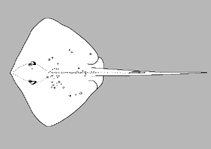 No image available for this species;
drawing shows typical species in Dasyatidae.
Imagem do Google
drawing shows typical species in Dasyatidae.
Classificação / Nomes Nomes comuns | Sinónimos | Catalog of Fishes(Género, Espécies) | ITIS | CoL | WoRMS | Cloffa
Elasmobranchii (tubarões e raias) (sharks and rays) > Myliobatiformes (Stingrays) > Dasyatidae (Stingrays) > Hypolophinae
Etymology: Pastinachus: Latin, pastinaca = a sting ray (Ref. 45335); gracilicaudus: Name from Latin 'gracilis' meaning slender, thin and 'cauda' for tail, appendage; referring to the slender appearance of the tail and narrow ventral cutaneous fold, as compared to other members of the genus Pastinachus.
More on authors: Last & Manjaji-Matsumoto.
Etymology: Pastinachus: Latin, pastinaca = a sting ray (Ref. 45335); gracilicaudus: Name from Latin 'gracilis' meaning slender, thin and 'cauda' for tail, appendage; referring to the slender appearance of the tail and narrow ventral cutaneous fold, as compared to other members of the genus Pastinachus.
More on authors: Last & Manjaji-Matsumoto.
Ambiente: milieu / zona climática / intervalo de profundidade / gama de distribuição Ecologia
marinhas bentopelágico; intervalo de profundidade ? - 60 m (Ref. 90102). Tropical
Distribuição Territórios | Áreas FAO | Ecossistemas | Ocorrências | Mapa dos pontos | Introduções | Faunafri
Western Pacific: This species is reasonably common but patchily distributed in both Malaysian and Indonesian Borneo, including Sabah, Sarawak, and western and northeastern Kalimantan. Possibly more widespread in the Indo-Malay Archipelago, east to at least the Wallace Line and the the identity of a specimen collected off Beruwala (Sri Lanka) needs confirmation.
Tamanho / Peso / Idade
Maturidade: Lm ? range ? - ? cm
Max length : 74.7 cm WD macho/indeterminado; (Ref. 84288); 83.0 cm WD (female)
Max length : 74.7 cm WD macho/indeterminado; (Ref. 84288); 83.0 cm WD (female)
Descrição breve Chaves de identificação | Morfologia | Morfometria
This medium-sized species (attaining about 75 cm DW) is distinguished by the following set of characters: snout rounded, not produced, angle more than 115°, apex largely naked and lacking enlarged denticles; disc length 83-89% DW; head length 38-41% DW; preoral length 15-17% DW; distance between nostrils 7-8% DW; distance between first gill slits 18-20% DW; tail compressed above mid-base of ventral cutaneous fold, its width 0.5-0.8 times its height; ventral fold low and slender, length 0.7-1.0 times DW, 17-22 times its depth below its mid-base, depth 2.0-3.6 times tail height at its mid-base; distance from anterior cloaca to sting 0.8-1 in precloacal length; two large, midscapular pearl thorns, usually preceded by a smaller irregular thorn; 120-122 pectoral-fin radials; monospondylous vertebral centra (exc. synarcual) 37-40 (Ref. 84288).
Body shape (shape guide): other.
Body shape (shape guide): other.
The depth occupied by this species is unknown as most material were collected in fish markets, but probably mainly coastal. A 69.5 cm DW adult male weighed ca 12 kg. Size at birth apparently variable; 83.0 cm DW female delivered a full term embryo with small umbilical scar; however, other retained specimens, 26.1 cm DW still had a substantial yolk sac, while in another 19.3 cm DW specimen the umbilical scar was barely visible. All these young specimens have large mid-scapular tubercles and well-developed denticles over most of the dorsal disc; a small embryo with yolk sac (16.5 cm DW) had prominent mid-scapular tubercles, but other denticles are just starting to form on the disc (Ref. 84288).
Ciclo de vida e comportamento de acasalamento Maturidade | Reprodução | Desova | Ovos | Fecundidade | Larvas
Referência principal
Carregar as suas referências | Referências | Coordenador : McEachran, John | Colaboradores
Last, P.R. and B.M. Manjaji-Matsumoto, 2010. Description of a new stingray, Pastinachus gracilicaudus sp. nov. (Elasmobranchii: Myliobatiformes), based on material from the Indo-Malay Archipelago. pp. 115-128. In Last, P.R., White, W.T. & Pogonoski, J.J. (eds.): Descriptions of new sharks and rays from Borneo. CSIRO Marine and Atmospheric Research Paper no. 32. (Ref. 84288)
Categoria na Lista Vermelha da IUCN (Ref. 130435: Version 2025-2 (Global))
Ameaçada (EN) (A2d); Date assessed: 19 May 2020
CITES
Not Evaluated
Ameaça para o homem
Harmless
Utilização humana
FAO - Publication: search | FishSource |
Mais informação
Ecologia Trófica
Produtos alimentares (presas)
Composição da dieta
Consumo alimentar
Rações alimentares
Predadores
Produtos alimentares (presas)
Composição da dieta
Consumo alimentar
Rações alimentares
Predadores
Ecologia
Ecologia
Ecologia
Dinâmica das populações
Parâmetros de crescimento
Idades / tamanhos máximos
Comprimento-peso rel.
Comprimento-comprimento rel.
Frequência de comprimento
Conversão de massa
Recrutamento
Abundância
Parâmetros de crescimento
Idades / tamanhos máximos
Comprimento-peso rel.
Comprimento-comprimento rel.
Frequência de comprimento
Conversão de massa
Recrutamento
Abundância
Ciclo de vida
Reprodução
Maturidade
Maturidade/Rel. das guelras
Fecundidade
Desova
Agregações de desova
Ovos
Desenvolvimento dos ovos
Larvas
Dinâmica larvar
Reprodução
Maturidade
Maturidade/Rel. das guelras
Fecundidade
Desova
Agregações de desova
Ovos
Desenvolvimento dos ovos
Larvas
Dinâmica larvar
Anatomia
Área branquial
Cérebro
Otólitos
Área branquial
Cérebro
Otólitos
Fisiologia
Composição corporal
Nutrientes
Consumo de oxigénio
Tipo de natação
Velocidade de natação
Pigmentos visuais
Som de peixe
Doenças e Parasitas
Toxicidade (LC50s)
Composição corporal
Nutrientes
Consumo de oxigénio
Tipo de natação
Velocidade de natação
Pigmentos visuais
Som de peixe
Doenças e Parasitas
Toxicidade (LC50s)
Relacionado com o ser humano
Sistemas de aquacultura
Perfis para aquacultura
Estirpes
Casos de Ciguatera
Selos, moedas, diversos.
Sistemas de aquacultura
Perfis para aquacultura
Estirpes
Casos de Ciguatera
Selos, moedas, diversos.
Ferramentas
E-book | Guia de campo | Ferramenta auxiliar de frequências de comprimento | Ferramenta sobre a história de vida | Mapa dos pontos |
Captura-MSY |
Relatórios especiais
Descarregue XML
Fontes da internet
AFORO (otoliths) | Aquatic Commons | BHL | Cloffa | Websites from users | Consultar FishWatcher | CISTI | Catalog of Fishes: Género, Espécies | DiscoverLife | ECOTOX | FAO - Publication: search | Faunafri | Fishipedia | Fishtrace | GloBI | Google Books | Google Scholar | Google | IGFA World Record | OneZoom | Open Tree of Life | Otolith Atlas of Taiwan Fishes | PubMed | Reef Life Survey | Socotra Atlas | TreeBase | Árvore da vida | Wikipedia: ir para, procurar | World Records Freshwater Fishing | Zoobank | Registo zoológico
Estimativas baseadas em modelos
Índice de diversidade filogenética (Ref. 82804): PD50 = 0.5312 [Uniqueness, from 0.5 = low to 2.0 = high].
Bayesian length-weight: a=0.01000 (0.00244 - 0.04107), b=3.04 (2.81 - 3.27), in cm total length, based on all LWR estimates for this body shape (Ref. 93245).
Nível Trófico (Ref. 69278): 3.7 ±0.6 se; based on size and trophs of closest relatives