



Pastinachus gracilicaudus Last & Manjaji-Matsumoto, 2010
Narrowtail stingray
Carica il tuo foto e Video
Google image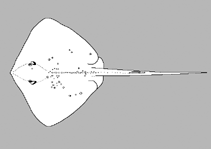 No image available for this species;
drawing shows typical species in Dasyatidae.
Google image
drawing shows typical species in Dasyatidae.
Classificazione / Nomi Nomi Comuni | Sinonimi | Catalog of Fishes(Genere, Specie) | ITIS | CoL | WoRMS | Cloffa
Elasmobranchi (squali e razze) (sharks and rays) > Myliobatiformes (Stingrays) > Dasyatidae (Stingrays) > Hypolophinae
Etymology: Pastinachus: Latin, pastinaca = a sting ray (Ref. 45335); gracilicaudus: Name from Latin 'gracilis' meaning slender, thin and 'cauda' for tail, appendage; referring to the slender appearance of the tail and narrow ventral cutaneous fold, as compared to other members of the genus Pastinachus.
More on authors: Last & Manjaji-Matsumoto.
Etymology: Pastinachus: Latin, pastinaca = a sting ray (Ref. 45335); gracilicaudus: Name from Latin 'gracilis' meaning slender, thin and 'cauda' for tail, appendage; referring to the slender appearance of the tail and narrow ventral cutaneous fold, as compared to other members of the genus Pastinachus.
More on authors: Last & Manjaji-Matsumoto.
Ambiente: milieu / zona climatica / distribuzione batimetrica / gamma di distribuzione Ecologia
marino benthopelagico; distribuzione batimetrica ? - 60 m (Ref. 90102). Tropical
Distribuzione Territories | Aree FAO | Ecosistemi | Presenze | Mappa dei ritrovamenti | Introduzioni | Faunafri
Western Pacific: This species is reasonably common but patchily distributed in both Malaysian and Indonesian Borneo, including Sabah, Sarawak, and western and northeastern Kalimantan. Possibly more widespread in the Indo-Malay Archipelago, east to at least the Wallace Line and the the identity of a specimen collected off Beruwala (Sri Lanka) needs confirmation.
Dimensione / Peso / Età
Maturità: Lm ? range ? - ? cm
Max length : 74.7 cm WD maschio/sesso non determinato; (Ref. 84288); 83.0 cm WD (female)
Max length : 74.7 cm WD maschio/sesso non determinato; (Ref. 84288); 83.0 cm WD (female)
Breve descrizione Chiavi di identificazione | Morfologia | Morfometria
This medium-sized species (attaining about 75 cm DW) is distinguished by the following set of characters: snout rounded, not produced, angle more than 115°, apex largely naked and lacking enlarged denticles; disc length 83-89% DW; head length 38-41% DW; preoral length 15-17% DW; distance between nostrils 7-8% DW; distance between first gill slits 18-20% DW; tail compressed above mid-base of ventral cutaneous fold, its width 0.5-0.8 times its height; ventral fold low and slender, length 0.7-1.0 times DW, 17-22 times its depth below its mid-base, depth 2.0-3.6 times tail height at its mid-base; distance from anterior cloaca to sting 0.8-1 in precloacal length; two large, midscapular pearl thorns, usually preceded by a smaller irregular thorn; 120-122 pectoral-fin radials; monospondylous vertebral centra (exc. synarcual) 37-40 (Ref. 84288).
Body shape (shape guide): other.
Body shape (shape guide): other.
The depth occupied by this species is unknown as most material were collected in fish markets, but probably mainly coastal. A 69.5 cm DW adult male weighed ca 12 kg. Size at birth apparently variable; 83.0 cm DW female delivered a full term embryo with small umbilical scar; however, other retained specimens, 26.1 cm DW still had a substantial yolk sac, while in another 19.3 cm DW specimen the umbilical scar was barely visible. All these young specimens have large mid-scapular tubercles and well-developed denticles over most of the dorsal disc; a small embryo with yolk sac (16.5 cm DW) had prominent mid-scapular tubercles, but other denticles are just starting to form on the disc (Ref. 84288).
Ciclo vitale e comportamento di accoppiamento Maturità | Riproduzione | Deposizione | Uova | Fecondità | Larve
Riferimento principale
Caricare le referenze | Bibliografia | Coordinatore : McEachran, John | Collaboratori
Last, P.R. and B.M. Manjaji-Matsumoto, 2010. Description of a new stingray, Pastinachus gracilicaudus sp. nov. (Elasmobranchii: Myliobatiformes), based on material from the Indo-Malay Archipelago. pp. 115-128. In Last, P.R., White, W.T. & Pogonoski, J.J. (eds.): Descriptions of new sharks and rays from Borneo. CSIRO Marine and Atmospheric Research Paper no. 32. (Ref. 84288)
Stato della Lista Rossa IUCN (Ref. 130435: Version 2025-2 (Global))
Endangered (EN) (A2d); Date assessed: 19 May 2020
CITES
Not Evaluated
Minaccia per l'uomo
Harmless
Usi umani
FAO - Publication: search | FishSource |
Informazioni ulteriori
Ecologia trofica
Articoli alimentari (prede)
Alimentazione
Consumo di cibo
Razioni alimentari
Predatori
Articoli alimentari (prede)
Alimentazione
Consumo di cibo
Razioni alimentari
Predatori
Ecologia
Ecologia
Ecologia
Dinamica della popolazione
Parametri di crescita
Età massima / dimensioni massime
Rapporto lunghezza-peso.
Lunghezza-lunghezza rel.
Lunghezza-frequenze
Conversione di massa
Reclutamento
Abbondanza
Parametri di crescita
Età massima / dimensioni massime
Rapporto lunghezza-peso.
Lunghezza-lunghezza rel.
Lunghezza-frequenze
Conversione di massa
Reclutamento
Abbondanza
Ciclo di vita
Riproduzione
Maturità
Maturità/Gli occhielli sono relativi.
Fecondità
Deposizione
Aggregazioni riproduttive
Uova
Sviluppo delle uova
Larve
Dinamica popolazioni larvali
Riproduzione
Maturità
Maturità/Gli occhielli sono relativi.
Fecondità
Deposizione
Aggregazioni riproduttive
Uova
Sviluppo delle uova
Larve
Dinamica popolazioni larvali
Anatomia
Area branchiale
Cervello
Otolite
Area branchiale
Cervello
Otolite
Fisiologia
Composizione corporea
Nutrienti
Consumo di ossigeno
Tipo di nuoto
Velocità di nuoto
Pigmenti visivi
Suono del pesce
Malattie e parassiti
Tossicità (LC50)
Composizione corporea
Nutrienti
Consumo di ossigeno
Tipo di nuoto
Velocità di nuoto
Pigmenti visivi
Suono del pesce
Malattie e parassiti
Tossicità (LC50)
Legato all'uomo
Sistemi di acquacoltura
Profili di acquacoltura
Varietà
Casi di Ciguatera
Francobolli, monete, materiale vario.
Sistemi di acquacoltura
Profili di acquacoltura
Varietà
Casi di Ciguatera
Francobolli, monete, materiale vario.
Strumenti
Libro elettronico | Giuda pratica | Generatore frequenze di lunghezza | Strumento Parametri Biologici | Mappa dei ritrovamenti |
Cattura-MSY |
Rapporti speciali
Controllo della manutenzione dell'acquario | Verificare la presenza di schede informative sulle specie | Verifica delle schede informative sull'acquacoltura
Scarica XML
Fonti Internet
AFORO (otoliths) | Aquatic Commons | BHL | Cloffa | Websites from users | Check FishWatcher | CISTI | Catalog of Fishes: Genere, Specie | DiscoverLife | ECOTOX | FAO - Publication: search | Faunafri | Fishipedia | Fishtrace | GloBI | Google Books | Google Scholar | Google | IGFA World Record | OneZoom | Open Tree of Life | Otolith Atlas of Taiwan Fishes | PubMed | Reef Life Survey | Socotra Atlas | TreeBase | Tree of Life | Wikipedia: Go, ricerca | World Records Freshwater Fishing | Zoobank | Record zoologico
Stime basate su modelli
Indice di diversità filogenetica (Fonte Biblio. 82804): PD50 = 0.5312 [Uniqueness, from 0.5 = low to 2.0 = high].
Bayesian length-weight: a=0.01000 (0.00244 - 0.04107), b=3.04 (2.81 - 3.27), in cm total length, based on all LWR estimates for this body shape (Ref. 93245).
Livello trofico (Fonte Biblio. 69278): 3.7 ±0.6 se; based on size and trophs of closest relatives