



Adicionar as suas observações no Fish Watcher
| Native range | All suitable habitat | Point map | Year 2050 |

|
| This map was computer-generated and has not yet been reviewed. |
| Lophiodes endoi AquaMaps Data sources: GBIF OBIS |
Adicionar o seu Fotografias e vídeos
Fotografias | Imagem do Google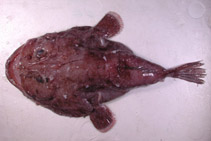 Lophiodes endoi
Fotografia de Shao, K.T.
Fotografias | Imagem do Google
Fotografia de Shao, K.T.
Classificação / Nomes Nomes comuns | Sinónimos | Catalog of Fishes(Género, Espécies) | ITIS | CoL | WoRMS | Cloffa
> Lophiiformes (Anglerfishes) > Lophiidae (Goosefishes)
Etymology: Lophiodes: Greek, lophos = crest + Greek, suffix oides = similar to (Ref. 45335); endoi: Lophiodes endoi is named in honor of Dr. Hiromitsu Endo, Associate Professor of Faculty of Science, Kochi University, in recognition of his excellent work in ichthyology, his friendship, and for supplying specimens for this study.
Eponymy: Dr Hiromitsu Endo (d: 1964) of the Laboratory of Marine Biology is a Professor (since 1996) in the Faculty of Science, Kochi University, and Curator there. [...] (Ref. 128868), visit book page.
Etymology: Lophiodes: Greek, lophos = crest + Greek, suffix oides = similar to (Ref. 45335); endoi: Lophiodes endoi is named in honor of Dr. Hiromitsu Endo, Associate Professor of Faculty of Science, Kochi University, in recognition of his excellent work in ichthyology, his friendship, and for supplying specimens for this study.
Eponymy: Dr Hiromitsu Endo (d: 1964) of the Laboratory of Marine Biology is a Professor (since 1996) in the Faculty of Science, Kochi University, and Curator there. [...] (Ref. 128868), visit book page.
Ambiente: milieu / zona climática / intervalo de profundidade / gama de distribuição Ecologia
marinhas bentopelágico; intervalo de profundidade 261 - 750 m (Ref. 79601). Temperate
Distribuição Territórios | Áreas FAO | Ecossistemas | Ocorrências | Mapa dos pontos | Introduções | Faunafri
Western Pacific: off Japan, Taiwan and Australia. Collected from southeastern Japan (Okinawa trough, Tosa Bay, and Kyushu–Palau Ridge) at depth range 261–600 m. In Taiwanese waters this species is usually captured together with Lophiodes mutilus at depths of about 280–310 m, and some may range deeper. Specimens were collected from the Tasman Sea of southeastern Australia at depths of 300–750 m, and a series of photographs were taken of a specimen at a depth of 288 m at Greenwell Point, New South Wales, Australia, by an underwater vehicle (K. Aitken, personal communication, 20 March 2005). Two specimens were collected from the northwest shelf off Australia at depths of 492–520 m (Ref. 79601).
Tamanho / Peso / Idade
Descrição breve Chaves de identificação | Morfologia | Morfometria
A species of the Lophiodes mutilus group differing from congeners by the following characters: a rounded esca with paler tip; third dorsal spine bearing a pair of black tendrils located at two-thirds of illicial length; 18–22 (mainly 20–21) pectoral fin rays; a relatively short head (33.4–39.6% SL); a relatively short illicium (16.5–26.7% SL); a relatively short third dorsal spine (30.0–42.3% SL); fifth dorsal spine relatively long, when folded back reaching base of third dorsal fin ray, and anterior frontal spine enlarged (Ref. 79601).
Tail cylindrical, somewhat depressed, tapering posteriorly; eye large; gill openings extending in front of pectoral fins; both maxilla and frontal ridge smooth, without knobs; frontal divided into three spines, anterior one enlarged, directed forward, sometimes divided into two sub-spines; sphenotic with two spines, inner spine well developed, straight and directed upward; inner frontal spine present in specimens smaller than 300 mm and reduced in specimens larger than 300 mm; single interopercular spine; parietal spine present at either side of third dorsal spine base, reduced in larger specimens; hyomandibula with two spines, anterior spine smaller, becoming blunt with three knobs in larger specimens; humeral spine well developed with three to four spines. All dorsal fin spines, except for the third, devoid of tendrils; second to sixth dorsal spines bearing a tiny dark bulb at tip in most specimens; illicium lightly pigmented, relatively short (16.5–26.7% SL), when folded back reaching third dorsal spine base, reaching sphenotic spines in larger specimens; esca a rounded bulb, slightly darker than illicium, tip pale; second dorsal spine slightly longer than illicium, when folded back reaching between third dorsal spine base and end of neurocranium; third dorsal spine relatively short (30.0–42.3% SL), bearing one pair of darkly pigmented tendrils at about two-thirds its length, when folded back reaches third dorsal fin ray base, reaching origin of soft dorsal fin in larger specimens; fourth dorsal spine absent; fifth dorsal spine relatively long, when folded back reaching base of third dorsal fin ray, reaching origin of soft dorsal fin in larger specimens; sixth dorsal spine very short, when folded back not reaching origin of dorsal fin, embedded under skin in larger specimens. Anal fin extending beyond caudal fin base in smaller specimens, reaching caudal fin base in larger specimens (Ref. 79601).
Coloration in life: based on a series of underwater photographs of a male specimen taken from Greenwell Point, New South Wales, Australia: dorsal surface pale brown with numerous medium-sized, diffuse light blue or gray patches; illicium paler; esca darker at base and paler at tip; some darker patches associated with head spines and upper jaw; pectoral fin margin pale, dorsal surface with some diffuse pale blue spots (Ref. 79601).
Body shape (shape guide): short and / or deep.
Body shape (shape guide): short and / or deep.
Ciclo de vida e comportamento de acasalamento Maturidade | Reprodução | Desova | Ovos | Fecundidade | Larvas
Referência principal
Carregar as suas referências | Referências | Coordenador : Ho, Hsuan-Ching | Colaboradores
Ho, H.-C. and K.-T. Shao, 2008. A new species of anglerfish (Lophiidae: Lophiodes) from the western Pacific. Ichthyol. Res. 55(4):367-373. (Ref. 79601)
Categoria na Lista Vermelha da IUCN (Ref. 130435: Version 2025-2 (Global))
Preocupação menor (LC) ; Date assessed: 12 August 2019
CITES
Not Evaluated
Ameaça para o homem
Harmless
Utilização humana
FAO - Publication: search | FishSource |
Mais informação
Ecologia Trófica
Produtos alimentares (presas)
Composição da dieta
Consumo alimentar
Rações alimentares
Predadores
Produtos alimentares (presas)
Composição da dieta
Consumo alimentar
Rações alimentares
Predadores
Ecologia
Ecologia
Ecologia
Dinâmica das populações
Parâmetros de crescimento
Idades / tamanhos máximos
Comprimento-peso rel.
Comprimento-comprimento rel.
Frequência de comprimento
Conversão de massa
Recrutamento
Abundância
Parâmetros de crescimento
Idades / tamanhos máximos
Comprimento-peso rel.
Comprimento-comprimento rel.
Frequência de comprimento
Conversão de massa
Recrutamento
Abundância
Ciclo de vida
Reprodução
Maturidade
Maturidade/Rel. das guelras
Fecundidade
Desova
Agregações de desova
Ovos
Desenvolvimento dos ovos
Larvas
Dinâmica larvar
Reprodução
Maturidade
Maturidade/Rel. das guelras
Fecundidade
Desova
Agregações de desova
Ovos
Desenvolvimento dos ovos
Larvas
Dinâmica larvar
Anatomia
Área branquial
Cérebro
Otólitos
Área branquial
Cérebro
Otólitos
Fisiologia
Composição corporal
Nutrientes
Consumo de oxigénio
Tipo de natação
Velocidade de natação
Pigmentos visuais
Som de peixe
Doenças e Parasitas
Toxicidade (LC50s)
Composição corporal
Nutrientes
Consumo de oxigénio
Tipo de natação
Velocidade de natação
Pigmentos visuais
Som de peixe
Doenças e Parasitas
Toxicidade (LC50s)
Genética
genoma
Genética
Heterozigotia
Hereditariedade
Diversidade genética
genoma
Genética
Heterozigotia
Hereditariedade
Diversidade genética
Relacionado com o ser humano
Sistemas de aquacultura
Perfis para aquacultura
Estirpes
Casos de Ciguatera
Selos, moedas, diversos.
Sistemas de aquacultura
Perfis para aquacultura
Estirpes
Casos de Ciguatera
Selos, moedas, diversos.
Ferramentas
E-book | Guia de campo | Ferramenta auxiliar de frequências de comprimento | Ferramenta sobre a história de vida | Mapa dos pontos |
Captura-MSY |
Relatórios especiais
Descarregue XML
Fontes da internet
AFORO (otoliths) | Aquatic Commons | BHL | Cloffa | Websites from users | Consultar FishWatcher | CISTI | Catalog of Fishes: Género, Espécies | DiscoverLife | ECOTOX | FAO - Publication: search | Faunafri | Fishipedia | Fishtrace | GloBI | Google Books | Google Scholar | Google | IGFA World Record | Bases de dados nacionais | OneZoom | Open Tree of Life | Otolith Atlas of Taiwan Fishes | PubMed | Reef Life Survey | Socotra Atlas | TreeBase | Árvore da vida | Wikipedia: ir para, procurar | World Records Freshwater Fishing | Zoobank | Registo zoológico
Estimativas baseadas em modelos
Temperatura preferida (Ref. 123201): 7 - 12.7, mean 9.3 °C (based on 150 cells).
Índice de diversidade filogenética (Ref. 82804): PD50 = 0.5000 [Uniqueness, from 0.5 = low to 2.0 = high].
Bayesian length-weight: a=0.01905 (0.00877 - 0.04141), b=3.01 (2.82 - 3.20), in cm total length, based on LWR estimates for this (Sub)family-body shape (Ref. 93245).
Nível Trófico (Ref. 69278): 4.5 ±0.8 se; based on size and trophs of closest relatives
Resiliência (Ref. 120179): Médio, tempo mínimo de duplicação da população 1,4 - 4,4 anos (Preliminary K or Fecundity.).