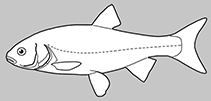
Classification / Names
Noms communs | Synonymes | Catalog of Fishes(Genre, Espèce) | ITIS | CoL | WoRMS | Cloffa
>
Cypriniformes (Carps) >
Leuciscidae (Minnows) > Leuciscinae
Etymology: Alburnus: From the city of Al Bura, where the fish was known (Ref. 45335); leobergi: Named after Leo S. Bergi who first realized that there are different shemayas in the Black and Azov Sea basin.
Eponymy: Lev (Leo) Semionovitch (Semenovich) Berg (1876–1950). (See Berg) (Ref. 128868), visit book page.
More on authors: Freyhof & Kottelat.
Environment: milieu / climate zone / profondeur / distribution range
Écologie
; eau douce; saumâtre benthopélagique. Temperate
Europe: Sea of Azov basin in Russia and Ukraine. Landlocked population in Tsimlyansk Reservoir (Don drainage).
Taille / Poids / Âge
Maturité: Lm ? range ? - ? cm
Max length : 40.3 cm TL mâle / non sexé; (Ref. 75106)
Description synthétique
Clés d'identification | Morphologie | Morphométrie
Differs from other species of shemayas by the combination of the following characters: origin of anal fin about 1½ -2½ scales behind dorsal-fin base; anal fin with 15-17½ branched rays; gill rakers 24-28; length of gill raker at angle between upper and lower limbs of first gill arch 30-50% of opposite inner gill filament; lateral line scales 54-64 + 4-5; ventral keel exposed for 4-6 scales in front of anus; head length 21-23% SL; predorsal length 55-57% SL; caudal peduncle depth 9-11% SL,1.7-2.0 times in its length; eye diameter 4.7-5.5% SL, 1.4-1.5 times in interorbital distance; absence of faint grey midlateral stripe; in adult spawners, base of paired fins grey; and presence of numerous small tubercles in nuptial males (Ref. 75106).
Body shape (shape guide): fusiform / normal.
Inhabit lower reaches of rivers, coastal lakes, estuaries, and open sea. Occur close to surface and tolerate salinities up to 12 ppt at the sea. Adults predominantly prey on planktonic crustaceans, terrestrial insects, and small fish. Larvae and young juveniles feed on zooplankton, algae, and insect larvae. Undertake migration for long distances, up to upper reaches of streams in piedmont and montane zones. Spawns in rivers or streams with heavy current on gravel bottom. Landlocked population breeds in reservoir tributaries. Adults migrate back to the sea soon after spawning to forage while young juveniles move downriver in autumn of same year or next spring. Commonly hybridizes with Squalius cephalus. Populations sharply declined in the early and middle 20th century due to the constructed dams that hindered in reaching the spawning grounds. Remaining populations spawn below these dams (Ref. 59043).
Life cycle and mating behavior
Maturité | Reproduction | Frai | Œufs | Fécondité | Larves
Anadromous populations begin to enter rivers during autumn (September in Kuban) and move upstream during winter and/or in spring. Males assemble and wait at the spawning grounds for ripe females, which arrive later. Lay sticky eggs which adhere on pebbles or stones. Adults migrate back to the sea soon after spawning to forage while young juveniles move downriver in autumn of same year or next spring (Ref. 59043).
Freyhof, J. and M. Kottelat, 2007. Review of the Alburnus mento species group with description of two new species (Teleostei: Cyprinidae). Ichthyol. Explor. Freshwat. 18(3):213-225. (Ref. 75106)
Statut dans la liste rouge de l'IUCN (Ref. 130435: Version 2025-1)
Menace pour l'homme
Harmless
Utilisations par l'homme
Outils
Articles particuliers
Télécharger en XML
Sources Internet
Estimates based on models
Phylogenetic diversity index (Réf.
82804): PD
50 = 0.5000 [Uniqueness, from 0.5 = low to 2.0 = high].
Bayesian length-weight: a=0.00661 (0.00311 - 0.01404), b=3.12 (2.95 - 3.29), in cm total length, based on LWR estimates for this Genus-body shape (Ref.
93245).
Niveau trophique (Réf.
69278): 2.7 ±0.3 se; based on size and trophs of closest relatives
Résilience (Réf.
120179): Milieu, temps minimum de doublement de population : 1,4 à 4,4 années (Assuming Fec < 10,000).
Fishing Vulnerability (Ref.
59153): Low to moderate vulnerability (30 of 100).
🛈