



Envoyez vos Photos et vidéos
Images | Images Google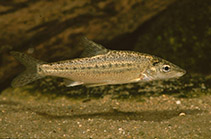 Aulopyge huegelii
Photo de Hartl, A.
Images | Images Google
Photo de Hartl, A.
Classification / Noms Noms communs | Synonymes | Catalog of Fishes(Genre, Espèce) | ITIS | CoL | WoRMS | Cloffa
> Cypriniformes (Carps) > Cyprinidae (Minnows or carps) > Barbinae
Etymology: Aulopyge: Greek, aulos = flute + Greek, pyge = tail (Ref. 45335).
Eponymy: Karl Alexander Anselm Freiherr von Hügel (Baron Charles von Hügel) (1795–1870) was an Austrian army officer, diplomat, botanist and explorer primarily remembered for his travels in northern India (1830s). [...] (Ref. 128868), visit book page.
More on author: Heckel.
Etymology: Aulopyge: Greek, aulos = flute + Greek, pyge = tail (Ref. 45335).
Eponymy: Karl Alexander Anselm Freiherr von Hügel (Baron Charles von Hügel) (1795–1870) was an Austrian army officer, diplomat, botanist and explorer primarily remembered for his travels in northern India (1830s). [...] (Ref. 128868), visit book page.
More on author: Heckel.
Taxonomic Remarks
The genus is placed here in Barbinae tentatively following Gaubert et al. (2009) and other molecular studies (pers. comm., J. Freyhof, Oct. 2013).
Environnement : milieu / zone climatique / profondeur / gamme de distribution Écologie
; eau douce benthopélagique. Temperate; 46°N - 42°N, 14°E - 19°E
Distribution Territoires | Zones FAO | Écosystèmes | Occurrences | Carte par point | Introductions | Faunafri
Europe: Croatia (Cetina, Krka and Zrmanja drainages) and Bosnia-Herzegovina (Karstic streams in Glamocko, Livanjsko and Duvanjsko poljes, Lakes Busko and Blidinje).
Taille / Poids / Âge
Description synthétique Clés d'identification | Morphologie | Morphométrie
The only species of the genus and can be diagnosed from other cyprinid species in Europe by having the following characters: prolonged urogenital papilla fused with anterior edge of anal in female; 2 pairs of barbels; last simple dorsal ray serrated; scales almost or completely absent (Ref. 59043).
Body shape (shape guide): elongated.
Body shape (shape guide): elongated.
Adults inhabit streams with swift water, still waters and lakes and enter subterranean waters during winter or dry seasons. Larvae and juveniles live on the bottom and are solitary. Omnivorous. Spawn in shallow areas of rivers and lakes. Attain up to about 20 cm SL. Threatened due to small range, water abstraction and pollution. The sharp decline of its population during 20th century had been caused by habitat loss and pollution (Ref. 59043).
Cycle de vie et comportement reproducteur Maturité | Reproduction | Frai | Œufs | Fécondité | Larves
Référence principale
Téléchargez vos références | Références | Coordinateur | Collaborateurs
Kottelat, M. and J. Freyhof, 2007. Handbook of European freshwater fishes. Publications Kottelat, Cornol and Freyhof, Berlin. 646 pp. (Ref. 59043)
Statut dans la liste rouge de l'IUCN (Ref. 130435: Version 2025-2 (Global))
Menacé (EN) (B2ab(iii)); Date assessed: 02 November 2023
CITES
Not Evaluated
Menace pour l'homme
Harmless
Utilisations par l'homme
Pêcheries: commercial
FAO - Publication: search | FishSource |
Plus d'informations
Écologie trophique
Aliments (proies)
Composition du régime alimentaire
Consommation alimentaire
Rations alimentaires
Prédateurs
Aliments (proies)
Composition du régime alimentaire
Consommation alimentaire
Rations alimentaires
Prédateurs
Dynamique des populations
Paramètres de croissance
Âges / tailles maximales
Longueur-poids rel.
Rel. longueur-longueur.
Fréquences de longueurs
Conversion de masse
Recrutement
Abondance
Paramètres de croissance
Âges / tailles maximales
Longueur-poids rel.
Rel. longueur-longueur.
Fréquences de longueurs
Conversion de masse
Recrutement
Abondance
Anatomie
Surface branchiale
Cerveau
Otolithe
Surface branchiale
Cerveau
Otolithe
Physiologie
Composition corporelle
Nutriments
Consommation d'oxygène
Type de natation
Vitesse de nage
Pigments visuels
Son de poisson
Maladies et parasites
Toxicité (CL50)
Composition corporelle
Nutriments
Consommation d'oxygène
Type de natation
Vitesse de nage
Pigments visuels
Son de poisson
Maladies et parasites
Toxicité (CL50)
Liées à l'homme
Systèmes d'aquaculture
Profils d'aquaculture
Souches
Cas de ciguatera
Timbres, pièces de monnaie, divers
Systèmes d'aquaculture
Profils d'aquaculture
Souches
Cas de ciguatera
Timbres, pièces de monnaie, divers
Outils
E-book | Guide de terrain | Générateur de fréquences de longueur | Outil de dynamique de population | Carte par point |
Capture-MSY |
Articles particuliers
Télécharger en XML
Sources Internet
AFORO (otoliths) | Aquatic Commons | BHL | Cloffa | Websites from users | FishWatcher | CISTI | Catalog of Fishes: Genre, Espèce | DiscoverLife | ECOTOX | FAO - Publication: search | Faunafri | Fishipedia | Fishtrace | GloBI | Google Books | Google Scholar | Google | IGFA World Record | OneZoom | Open Tree of Life | Otolith Atlas of Taiwan Fishes | PubMed | Reef Life Survey | Socotra Atlas | TreeBase | Arbre de Vie | Wikipedia: aller à, chercher | World Records Freshwater Fishing | Zoobank | Zoological Record
Estimations basées sur des modèles
Indice de diversité phylogénétique (Réf. 82804): PD50 = 1.0000 [Uniqueness, from 0.5 = low to 2.0 = high].
Bayesian length-weight: a=0.00759 (0.00451 - 0.01275), b=3.13 (2.98 - 3.28), in cm total length, based on LWR estimates for this species & (Sub)family-body (Ref. 93245).
Niveau trophique (Réf. 69278): 2.0 ±0.00 se; based on food items.
Résilience (Réf. 120179): Milieu, temps minimum de doublement de population : 1,4 à 4,4 années (tm = 2).