



Uploaden van uw Foto's en video's
Afbeeldingen | Google afbeelding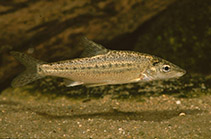 Aulopyge huegelii
Afbeelding van Hartl, A.
Afbeeldingen | Google afbeelding
Afbeelding van Hartl, A.
Classificatie / Namen Lokale namen | Synoniemen | Catalog of Fishes(Genus, Soort(en)) | ITIS | CoL | WoRMS | Cloffa
> Cypriniformes (Carps) > Cyprinidae (Minnows or carps) > Barbinae
Etymology: Aulopyge: Greek, aulos = flute + Greek, pyge = tail (Ref. 45335).
Eponymy: Karl Alexander Anselm Freiherr von Hügel (Baron Charles von Hügel) (1795–1870) was an Austrian army officer, diplomat, botanist and explorer primarily remembered for his travels in northern India (1830s). [...] (Ref. 128868), visit book page.
More on author: Heckel.
Etymology: Aulopyge: Greek, aulos = flute + Greek, pyge = tail (Ref. 45335).
Eponymy: Karl Alexander Anselm Freiherr von Hügel (Baron Charles von Hügel) (1795–1870) was an Austrian army officer, diplomat, botanist and explorer primarily remembered for his travels in northern India (1830s). [...] (Ref. 128868), visit book page.
More on author: Heckel.
Taxonomic Remarks
The genus is placed here in Barbinae tentatively following Gaubert et al. (2009) and other molecular studies (pers. comm., J. Freyhof, Oct. 2013).
Milieu: milieu / Klimaatzone / Diepte / verspreidingsgebied Ecologie
; zoet water benthopelagisch. Temperate; 46°N - 42°N, 14°E - 19°E
Verspreiding Gebieden | FAO regio's | Ecosystemen | Voorkomen | Verspreidingskaart | Introducties | Faunafri
Europe: Croatia (Cetina, Krka and Zrmanja drainages) and Bosnia-Herzegovina (Karstic streams in Glamocko, Livanjsko and Duvanjsko poljes, Lakes Busko and Blidinje).
Grootte / Gewicht / Leeftijd
Korte beschrijving Determinatiesleutels | Morfologie | Morfometrie
The only species of the genus and can be diagnosed from other cyprinid species in Europe by having the following characters: prolonged urogenital papilla fused with anterior edge of anal in female; 2 pairs of barbels; last simple dorsal ray serrated; scales almost or completely absent (Ref. 59043).
Body shape (shape guide): elongated.
Body shape (shape guide): elongated.
Adults inhabit streams with swift water, still waters and lakes and enter subterranean waters during winter or dry seasons. Larvae and juveniles live on the bottom and are solitary. Omnivorous. Spawn in shallow areas of rivers and lakes. Attain up to about 20 cm SL. Threatened due to small range, water abstraction and pollution. The sharp decline of its population during 20th century had been caused by habitat loss and pollution (Ref. 59043).
Levenscyclus en paargedrag Maturiteit | Voortplanting | Paaien | Eieren | Fecunditeit | Larven
Hoofdreferentie
Upload uw referenties | Referenties | Coördinator | Medewerkers
Kottelat, M. and J. Freyhof, 2007. Handbook of European freshwater fishes. Publications Kottelat, Cornol and Freyhof, Berlin. 646 pp. (Ref. 59043)
Status op de Rode Lijst van het IUCN (Ref. 130435: Version 2025-2 (Global))
Bedreigd (EN) (B2ab(iii)); Date assessed: 02 November 2023
CITES
Not Evaluated
Gevaar voor de mens
Harmless
Gebruik door de mens
Visserij: commercieel
FAO - Publication: search | FishSource |
Meer informatie
Trofische ecologie
Voedsel (prooien)
Dieetsamenstelling
Voedselconsumptie
Voedselrantsoenen
Predatoren
Voedsel (prooien)
Dieetsamenstelling
Voedselconsumptie
Voedselrantsoenen
Predatoren
Populatiedynamica
Groeiparameters
Max. leeftijden / maten
Lengte-gewicht rel.
Lengte-lengte rel.
Lengtefrequenties
Massaconversie
Rekrutering
Abundantie
Groeiparameters
Max. leeftijden / maten
Lengte-gewicht rel.
Lengte-lengte rel.
Lengtefrequenties
Massaconversie
Rekrutering
Abundantie
Levenscyclus
Voortplanting
Maturiteit
Rijpheid/kieuwen rel.
Fecunditeit
Paaien
Paaibestanden
Eieren
Ontwikkeling van de eieren
Larven
Larvale populatiedynamiek
Voortplanting
Maturiteit
Rijpheid/kieuwen rel.
Fecunditeit
Paaien
Paaibestanden
Eieren
Ontwikkeling van de eieren
Larven
Larvale populatiedynamiek
Anatomie
Kieuwoppervlak
Hersenen
Otoliet
Kieuwoppervlak
Hersenen
Otoliet
Fysiologie
Lichaamssamenstelling
Voedingsstoffen
Zuurstofverbruik
Type zwemmen
Zwemsnelheid
Visuele pigmenten
Vis geluid
Ziekten en parasieten
Toxiciteit (LC50)
Lichaamssamenstelling
Voedingsstoffen
Zuurstofverbruik
Type zwemmen
Zwemsnelheid
Visuele pigmenten
Vis geluid
Ziekten en parasieten
Toxiciteit (LC50)
Menselijk gerelateerd
Aquacultuursystemen
Aquacultuurprofielen
Kweeklijnen
Ciguatera gevallen
Postzegels, munten, diversen.
Aquacultuursystemen
Aquacultuurprofielen
Kweeklijnen
Ciguatera gevallen
Postzegels, munten, diversen.
Tools
Speciale rapporten
Bekijk gegevens voor het houden in een aquarium | Bekijk Fact Sheets voor de soort | Bekijk Aquacultuur Fact Sheets
Download XML
Internetbronnen
AFORO (otoliths) | Aquatic Commons | BHL | Cloffa | Websites from users | Bekijk FishWatcher | CISTI | Catalog of Fishes: Genus, Soort(en) | DiscoverLife | ECOTOX | FAO - Publication: search | Faunafri | Fishipedia | Fishtrace | GloBI | Google Books | Google Scholar | Google | IGFA World Record | OneZoom | Open Tree of Life | Otolith Atlas of Taiwan Fishes | PubMed | Reef Life Survey | Socotra Atlas | TreeBase | Tree of Life | Wikipedia: ga naar, zoek | World Records Freshwater Fishing | Zoobank | Zoological Record
Schattingen op basis van modellen
Fylogenetische diversiteitsindex (Ref. 82804): PD50 = 1.0000 [Uniqueness, from 0.5 = low to 2.0 = high].
Bayesian length-weight: a=0.00759 (0.00451 - 0.01275), b=3.13 (2.98 - 3.28), in cm total length, based on LWR estimates for this species & (Sub)family-body (Ref. 93245).
Trofisch niveau (Ref. 69278): 2.0 ±0.00 se; based on food items.
Weerstandsvermogen (Ref. 120179): Gemiddeld, minimale populatieverdubbelingstijd 1,4-4,4 jaar (tm = 2).