



Epinephelus merra Bloch, 1793
Honeycomb grouper
Adicionar as suas observações no Fish Watcher
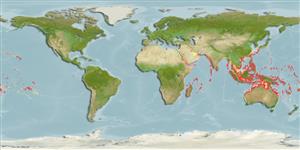
| Native range | All suitable habitat | Point map | Year 2050 |
|
| This map was computer-generated and has not yet been reviewed. |
| Epinephelus merra AquaMaps Data sources: GBIF OBIS |
Adicionar o seu Fotografias e vídeos
Fotografias | vídeos | Selos, moedas, diversos. | Imagem do Google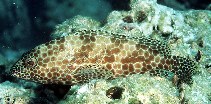 Epinephelus merra
Fotografia de Randall, J.E.
Fotografias | vídeos | Selos, moedas, diversos. | Imagem do Google
Fotografia de Randall, J.E.
Classificação / Nomes Nomes comuns | Sinónimos | Catalog of Fishes(Género, Espécies) | ITIS | CoL | WoRMS | Cloffa
> Perciformes/Serranoidei (Groupers) > Epinephelidae (Groupers)
Etymology: Epinephelus: Greek, epinephelos = cloudy (Ref. 45335).
More on author: Bloch.
Etymology: Epinephelus: Greek, epinephelos = cloudy (Ref. 45335).
More on author: Bloch.
Ambiente: milieu / zona climática / intervalo de profundidade / gama de distribuição Ecologia
marinhas associadas(os) a recifes; intervalo de profundidade 0 - 50 m (Ref. 9710), usually ? - 20 m (Ref. 5222). Tropical; 35°N - 35°S, 28°E - 129°W (Ref. 5222)
Distribuição Territórios | Áreas FAO | Ecossistemas | Ocorrências | Mapa dos pontos | Introduções | Faunafri
Indo-Pacific: South Africa to French Polynesia. Not known from the Red Sea, Persian Gulf, nor Asian mainland.
Comprimento na primeira maturidade / Tamanho / Peso / Idade
Maturidade: Lm 11.0, range 19 - ? cm
Max length : 36.5 cm TL macho/indeterminado; (Ref. 125599); peso máx. Publicado: 1.0 kg (Ref. 125599)
Max length : 36.5 cm TL macho/indeterminado; (Ref. 125599); peso máx. Publicado: 1.0 kg (Ref. 125599)
Descrição breve Chaves de identificação | Morfologia | Morfometria
Espinhos dorsais (total) : 11; Raios dorsais moles (total) : 15 - 17; Espinhos anais: 3; Raios anais moles: 8. This species is distinguished by the following characters: greatest body depth 2.8-3.3 in SL; head length 2.3-2.6 in SL; preopercle rounded or subangular, the serrae at angle enlarged; upper edge of operculum almost straight; midlateral part of lower jaw with 2-4 rows of teeth, the inner teeth about twice length of outer ones; gill rakers of first gill arch 6-9 + 14-17; dorsal fin spines third to last subequal, the longest 2.4-3.2 in HL; anal fin spines second and third subequal, 2.1-3.0 in HL and longer than depth of peduncle; caudal fin rounded, peduncle depth 3.2-4.1 in HL; pectoral-fin rays 16-18; lateral-line scales 48-54, in series 98-114. Head, body, and fins pale, are covered with close-set (sometimes coalesced), dark brown or reddish brown spots, the interspaces forming an irregular pale reticulum; pectoral fins are covered with distinct small black spots, largely confined to the rays (the best diagnostic colour character of this species) (Ref. 39231, 89707, 90102).
Body shape (shape guide): fusiform / normal; Cross section: compressed.
Body shape (shape guide): fusiform / normal; Cross section: compressed.
A solitary fish, in coastal and offshore reefs usually in less than 20 m depth (Ref. 90102); also very common in shallow lagoon and semi-protected seaward reefs. Juveniles are common in thickets of staghorn Acropora corals. Feed on crustaceans and fishes. Increase of piscivory with age is observed in this species. Neither opercular spine nor anterolateral glandular grooves with venom gland is present (Ref. 57406). Current information in the table (dangerous fish) do not match; needs verification. Cultured under experimental conditions in the Philippines (Ref. 4757). In the Hong Kong live fish markets (Ref. 27253). It is important to artisanal fisheries because of its abundance in shallow water and caught with handlines, fish traps, and spear (Ref. 39231).
Ciclo de vida e comportamento de acasalamento Maturidade | Reprodução | Desova | Ovos | Fecundidade | Larvas
Referência principal
Carregar as suas referências | Referências | Coordenador | Colaboradores
Heemstra, P.C. and J.E. Randall, 1993. FAO Species Catalogue. Vol. 16. Groupers of the world (family Serranidae, subfamily Epinephelinae). An annotated and illustrated catalogue of the grouper, rockcod, hind, coral grouper and lyretail species known to date. Rome: FAO. FAO Fish. Synop. 125(16):382 p. (Ref. 5222)
Categoria na Lista Vermelha da IUCN (Ref. 130435: Version 2025-2 (Global))
Preocupação menor (LC) ; Date assessed: 17 January 2017
CITES
Not Evaluated
Ameaça para o homem
Reports of ciguatera poisoning (Ref. 30298)
Utilização humana
Pescarias: espécies comerciais; Aquacultura: espécies comerciais; peixe desportivo: sim; Aquário: Aquários públicos
FAO - pescarias: desembarques; Publication: search | FishSource | Sea Around Us
Mais informação
Ecologia Trófica
Produtos alimentares (presas)
Composição da dieta
Consumo alimentar
Rações alimentares
Predadores
Produtos alimentares (presas)
Composição da dieta
Consumo alimentar
Rações alimentares
Predadores
Dinâmica das populações
Parâmetros de crescimento
Idades / tamanhos máximos
Comprimento-peso rel.
Comprimento-comprimento rel.
Frequência de comprimento
Conversão de massa
Recrutamento
Abundância
Parâmetros de crescimento
Idades / tamanhos máximos
Comprimento-peso rel.
Comprimento-comprimento rel.
Frequência de comprimento
Conversão de massa
Recrutamento
Abundância
Ciclo de vida
Reprodução
Maturidade
Maturidade/Rel. das guelras
Fecundidade
Desova
Agregações de desova
Ovos
Desenvolvimento dos ovos
Larvas
Dinâmica larvar
Reprodução
Maturidade
Maturidade/Rel. das guelras
Fecundidade
Desova
Agregações de desova
Ovos
Desenvolvimento dos ovos
Larvas
Dinâmica larvar
Fisiologia
Composição corporal
Nutrientes
Consumo de oxigénio
Tipo de natação
Velocidade de natação
Pigmentos visuais
Som de peixe
Doenças e Parasitas
Toxicidade (LC50s)
Composição corporal
Nutrientes
Consumo de oxigénio
Tipo de natação
Velocidade de natação
Pigmentos visuais
Som de peixe
Doenças e Parasitas
Toxicidade (LC50s)
Relacionado com o ser humano
Sistemas de aquacultura
Perfis para aquacultura
Estirpes
Casos de Ciguatera
Selos, moedas, diversos.
Sistemas de aquacultura
Perfis para aquacultura
Estirpes
Casos de Ciguatera
Selos, moedas, diversos.
Ferramentas
Questionário orgânico | E-book | Guia de campo | Chaves de identificação | Ferramenta auxiliar de frequências de comprimento | Ferramenta sobre a história de vida | Mapa dos pontos |
Captura-MSY |
Relatórios especiais
Descarregue XML
Fontes da internet
AFORO (otoliths) | Alien/Invasive Species database | Aquatic Commons | BHL | Cloffa | Websites from users | Consultar FishWatcher | CISTI | Catalog of Fishes: Género, Espécies | DiscoverLife | ECOTOX | FAO - pescarias: desembarques; Publication: search | Faunafri | Fishipedia | Fishtrace | GloBI | Google Books | Google Scholar | Google | IGFA World Record | Bases de dados nacionais | OneZoom | Open Tree of Life | Otolith Atlas of Taiwan Fishes | PubMed | Reef Life Survey | Socotra Atlas | TreeBase | Árvore da vida | Wikipedia: ir para, procurar | World Records Freshwater Fishing | Zoobank | Registo zoológico
Estimativas baseadas em modelos
Temperatura preferida (Ref. 123201): 24.6 - 29, mean 27.8 °C (based on 760 cells).
Índice de diversidade filogenética (Ref. 82804): PD50 = 0.5000 [Uniqueness, from 0.5 = low to 2.0 = high].
Bayesian length-weight: a=0.01175 (0.01040 - 0.01327), b=3.05 (3.03 - 3.07), in cm total length, based on LWR estimates for this species (Ref. 93245).
Nível Trófico (Ref. 69278): 3.8 ±0.0 se; based on diet studies.
Resiliência (Ref. 120179): Elevada, tempo mínimo de duplicação da população menor que 15 meses (K=0.3-0.6).
Nutrientes (Ref. 124155): Calcium = 48.4 [23.5, 101.6] mg/100g; Iron = 0.721 [0.369, 1.518] mg/100g; Protein = 18.4 [16.9, 19.8] %; Omega3 = 0.132 [0.080, 0.213] g/100g; Selenium = 32.9 [17.0, 64.7] μg/100g; VitaminA = 254 [64, 968] μg/100g; Zinc = 1.37 [0.91, 2.01] mg/100g (wet weight); based on nutrient studies.