



Epinephelus merra Bloch, 1793
Honeycomb grouper
Masukkan pemerhatian anda di Fish Watcher
| Native range | All suitable habitat | Point map | Year 2050 |
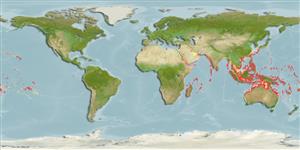
|
| This map was computer-generated and has not yet been reviewed. |
| Epinephelus merra AquaMaps Data sources: GBIF OBIS |
muatnaik fotos/gambar dan video
Gambar | video | Perangko, koin, dll. | imej Google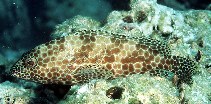 Epinephelus merra
foto/gambar oleh Randall, J.E.
Gambar | video | Perangko, koin, dll. | imej Google
foto/gambar oleh Randall, J.E.
klasifikasi / Nama Nama-nama umum | Sinonim (persamaan) | Catalog of Fishes(Marga, Jenis) | ITIS | CoL | WoRMS | Cloffa
> Perciformes/Serranoidei (Groupers) > Epinephelidae (Groupers)
Etymology: Epinephelus: Greek, epinephelos = cloudy (Ref. 45335).
More on author: Bloch.
Etymology: Epinephelus: Greek, epinephelos = cloudy (Ref. 45335).
More on author: Bloch.
Lingkungan: lingkungan / zona iklim / kisaran kedalaman / jangkauan distribusi Ekologi
laut berasosiasi dengan karang; kisaran kedalaman 0 - 50 m (Ref. 9710), usually ? - 20 m (Ref. 5222). Tropical; 35°N - 35°S, 28°E - 129°W (Ref. 5222)
Penyebaran Wilayah | Daerah-daerah FAO | Ekosistem | Kemunculan | peta titik | Introduksi | Faunafri
Indo-Pacific: South Africa to French Polynesia. Not known from the Red Sea, Persian Gulf, nor Asian mainland.
Panjang pada saat jatuh tempo pertama / Ukuran / Berat / umur
Kematangan: Lm 11.0, range 19 - ? cm
Max length : 36.5 cm TL jantan/; (Ref. 125599); Berat maksimum terpublikasi: 1.0 kg (Ref. 125599)
Max length : 36.5 cm TL jantan/; (Ref. 125599); Berat maksimum terpublikasi: 1.0 kg (Ref. 125599)
deskripsi pendek Kunci identifiaksi (pengenalan) | Morfologi | Morfometrik
Duri punggung (Keseluruhan (total)) : 11; duri punggung lunak (Keseluruhan (total)) : 15 - 17; Duri dubur: 3; Sirip dubur lunak: 8. This species is distinguished by the following characters: greatest body depth 2.8-3.3 in SL; head length 2.3-2.6 in SL; preopercle rounded or subangular, the serrae at angle enlarged; upper edge of operculum almost straight; midlateral part of lower jaw with 2-4 rows of teeth, the inner teeth about twice length of outer ones; gill rakers of first gill arch 6-9 + 14-17; dorsal fin spines third to last subequal, the longest 2.4-3.2 in HL; anal fin spines second and third subequal, 2.1-3.0 in HL and longer than depth of peduncle; caudal fin rounded, peduncle depth 3.2-4.1 in HL; pectoral-fin rays 16-18; lateral-line scales 48-54, in series 98-114. Head, body, and fins pale, are covered with close-set (sometimes coalesced), dark brown or reddish brown spots, the interspaces forming an irregular pale reticulum; pectoral fins are covered with distinct small black spots, largely confined to the rays (the best diagnostic colour character of this species) (Ref. 39231, 89707, 90102).
Body shape (shape guide): fusiform / normal; Cross section: compressed.
Body shape (shape guide): fusiform / normal; Cross section: compressed.
A solitary fish, in coastal and offshore reefs usually in less than 20 m depth (Ref. 90102); also very common in shallow lagoon and semi-protected seaward reefs. Juveniles are common in thickets of staghorn Acropora corals. Feed on crustaceans and fishes. Increase of piscivory with age is observed in this species. Neither opercular spine nor anterolateral glandular grooves with venom gland is present (Ref. 57406). Current information in the table (dangerous fish) do not match; needs verification. Cultured under experimental conditions in the Philippines (Ref. 4757). In the Hong Kong live fish markets (Ref. 27253). It is important to artisanal fisheries because of its abundance in shallow water and caught with handlines, fish traps, and spear (Ref. 39231).
Siklus hidup dan perilaku kawin Kematangan | Reproduksi, perkembang biakan | Pemijahan | telur-telur | Fekunditas | Larva
rujukan utama
Unggah referensi Anda | Acuan | Koordinator | mitra
Heemstra, P.C. and J.E. Randall, 1993. FAO Species Catalogue. Vol. 16. Groupers of the world (family Serranidae, subfamily Epinephelinae). An annotated and illustrated catalogue of the grouper, rockcod, hind, coral grouper and lyretail species known to date. Rome: FAO. FAO Fish. Synop. 125(16):382 p. (Ref. 5222)
Status IUCN Red List (Ref. 130435: Version 2025-2 (Global))
kurang bimbang (LC) ; Date assessed: 17 January 2017
CITES
Not Evaluated
ancaman kepada manusia
Reports of ciguatera poisoning (Ref. 30298)
penggunaan manusia
Perikanan: komersial; Budidaya air: komersial; Ikan buruan: ya; Akuarium: Akuarium publik
FAO - Perikanan: pendaratan; Publication: search | FishSource | Laut di Sekitar Kita
informasi lanjut
Dinamika populasi
Parameter pertumbuhan
Maks. usia / ukuran
Panjang-berat rel.
Panjang-panjang rel.
ukuran frekuensi
Konversi massa
pemulihan
Kelimpahan
Parameter pertumbuhan
Maks. usia / ukuran
Panjang-berat rel.
Panjang-panjang rel.
ukuran frekuensi
Konversi massa
pemulihan
Kelimpahan
Siklus hidup
Reproduksi, perkembang biakan
Kematangan
Kedewasaan / insang rel.
Fekunditas
Pemijahan
Agregasi pemijahan
telur-telur
pekembangan telor
Larva
Dinamika larva
Reproduksi, perkembang biakan
Kematangan
Kedewasaan / insang rel.
Fekunditas
Pemijahan
Agregasi pemijahan
telur-telur
pekembangan telor
Larva
Dinamika larva
Fisiologi
Komposisi tubuh
Nutrisi
Konsumsi oksigen
Jenis renang
Kecepatan berenang
Pigmen visual
Suara ikan
Penyakit & Parasit
Toksisitas (LC50)
Komposisi tubuh
Nutrisi
Konsumsi oksigen
Jenis renang
Kecepatan berenang
Pigmen visual
Suara ikan
Penyakit & Parasit
Toksisitas (LC50)
Yang berhubungan dengan manusia
Sistem akuakultur
profil budidaya air
Strain
Kasus Ciguatera
Perangko, koin, dll.
Sistem akuakultur
profil budidaya air
Strain
Kasus Ciguatera
Perangko, koin, dll.
Alat, peralatan
Kuis organik | E-book | Penuntun lapangan | Kunci identifiaksi (pengenalan) | tanda freqkuenci panjang | peringkat sejarah hidup | peta titik |
Tangkap-MSY |
laporan khas
muat turun XML
Sumber internet
AFORO (otoliths) | Alien/Invasive Species database | Aquatic Commons | BHL | Cloffa | Websites from users | semak peneliti ikan | CISTI | Catalog of Fishes: Marga, Jenis | DiscoverLife | ECOTOX | FAO - Perikanan: pendaratan; Publication: search | Faunafri | Fishipedia | Fishtrace | GloBI | Google Books | Google Scholar | Google | IGFA World Record | Pangkalan data nasional | OneZoom | Open Tree of Life | Otolith Atlas of Taiwan Fishes | PubMed | Reef Life Survey | Socotra Atlas | TreeBase | Tree of Life | Wikipedia: pergi, Cari | World Records Freshwater Fishing | Zoobank | Catatan Zoologi
Estimasi berdasarkan model
Suhu yang disukai (Acuan 123201): 24.6 - 29, mean 27.8 °C (based on 760 cells).
Indeks keanekaragaman filogenetik (Acuan 82804): PD50 = 0.5000 [Uniqueness, from 0.5 = low to 2.0 = high].
Bayesian length-weight: a=0.01175 (0.01040 - 0.01327), b=3.05 (3.03 - 3.07), in cm total length, based on LWR estimates for this species (Ref. 93245).
Tingkat Trofik (Acuan 69278): 3.8 ±0.0 se; based on diet studies.
Daya lenting (Acuan 120179): Tinggi, Waktu penggandaan populasi minimum kurang dari 15 bulan (K=0.3-0.6).
Nutrisi (Ref. 124155): Calcium = 48.4 [23.5, 101.6] mg/100g; Iron = 0.721 [0.369, 1.518] mg/100g; Protein = 18.4 [16.9, 19.8] %; Omega3 = 0.132 [0.080, 0.213] g/100g; Selenium = 32.9 [17.0, 64.7] μg/100g; VitaminA = 254 [64, 968] μg/100g; Zinc = 1.37 [0.91, 2.01] mg/100g (wet weight); based on nutrient studies.