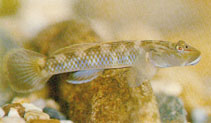
Environment: milieu / climate zone / rango de profundidad / distribution range
Ecología
marino; agua dulce; salobre demersal; pH range: 7.0 - ? ; dH range: 20 - ?; anfidromo (Ref. 51243). Subtropical; 16°C - 20°C (Ref. 2060); 54°N - 7°N, 106°E - 145°E
Asia: river basin of the seas of Japan, Okhotsk, the Pacific coasts of Japan,Hokkaido, Ryukyu, Taiwan, rivers of Korea, continental China and the Philippines (Ref. 26334); Viet Nam (Ref. 89724). Introduced to the USA (Washington, Columbia and Portland, Oregon) (Ref. 92840).
Tamaño / Peso / Age
Madurez: Lm ? range ? - ? cm
Max length : 5.8 cm TL macho / no sexado; (Ref. 116937); common length : 4.5 cm TL macho / no sexado; (Ref. 50519)
Short description
Claves de identificación | Morfología | Morfometría
Espinas dorsales (total) : 7; Radios blandos dorsales (total) : 8; Espinas anales: 1; Radios blandos anales: 8; Vértebra: 26. This species is distinguished from its congeners by the following set of characters: D2 I,8; A I,8; pectoral-fin rays fin rays 36-40 (modally 19); longitudinal scale rows 32-35; transverse scale rows 9-10; predorsal scales 11-13 with a trifurcate anterior margin of which point 3 lies above the upper gill opening; vertebrae 10 + 16 = 26; gill opening extending ventrally to the vertical midline of the opercle. Coloration of males and females: males' basal region of body scale pockets with a bright orange spot, somewhat indistinct in females; the lateral side of females with a middle longitudinal row of discontinuous brownish black spots or bars and their dorsal lateral region with 3-4 longitudinal rows of black spots and the caudal fin base with 2 separate, vertical black bars; males with second dorsal fin with 4 longitudinal rows of reddish brown bars or spots and caudal fin with 8-10 waving vertical orange to brown stripes; pectoral fin base with a basal distinct, oblique deep brown stripe; cheek scattered with 16-25 small, orange red spots, brighter in males; the pectoral fin base of the species with a basal distinct, oblique deep brown stripe, followed by a parallel shorter, lighter stripe or waving mark (Ref. 104792).
Body shape (shape guide): elongated.
Adults inhabit lakes and rivers. Juveniles move into the sea and return to rivers after several months. This species has several types differentiated according to shape, coloration, and life history. Each type is isolated by habitat in the same stream.
Life cycle and mating behavior
Madurez | Reproducción | Puesta | Huevos | Fecundidad | Larva
Masuda, H., K. Amaoka, C. Araga, T. Uyeno and T. Yoshino, 1984. The fishes of the Japanese Archipelago. Vol. 1. Tokai University Press, Tokyo, Japan. 437 p. (text). (Ref. 559)
IUCN Red List Status (Ref. 130435: Version 2025-1)
Threat to humans
Harmless
Human uses
Pesquerías: sin interés
Herramientas
Special reports
Download XML
Fuentes de Internet
Estimates based on models
Preferred temperature (Referencia
123201): 12.2 - 20.9, mean 16.9 °C (based on 144 cells).
Phylogenetic diversity index (Referencia
82804): PD
50 = 0.5000 [Uniqueness, from 0.5 = low to 2.0 = high].
Bayesian length-weight: a=0.00759 (0.00466 - 0.01235), b=3.13 (2.99 - 3.27), in cm total length, based on LWR estimates for this species & (Sub)family-body (Ref.
93245).
Nivel trófico (Referencia
69278): 3.2 ±0.4 se; based on size and trophs of closest relatives
Resiliencia (Referencia
120179): Alto, población duplicada en un tiempo mínimo inferior a 15 meses (Preliminary K or Fecundity.).
Fishing Vulnerability (Ref.
59153): Low vulnerability (10 of 100).
🛈