分类 / Names
俗名 | 同种异名 | Catalog of Fishes(属, 种) | ITIS | CoL | WoRMS | Cloffa
Environment: milieu / climate zone / 深度上下限 / distribution range
生态学
海洋; 淡水; 半咸淡水 居于水底的; pH range: 7.0 - ? ; dH range: 20 - ?; 非产卵性溯降河的 (Ref. 51243). 亚热带的; 16°C - 20°C (Ref. 2060); 54°N - 7°N, 106°E - 145°E
Asia: river basin of the seas of Japan, Okhotsk, the Pacific coasts of Japan,Hokkaido, Ryukyu, Taiwan, rivers of Korea, continental China and the Philippines (Ref. 26334); Viet Nam (Ref. 89724). Introduced to the USA (Washington, Columbia and Portland, Oregon) (Ref. 92840).
亚洲: 日本的河川流域 (参考文献 559) ,俄国远东 (参考文献 56557) ,日本的太平洋海岸,琉球,台湾,韩国的河川,中国大陆与菲律宾。
大小 / 重量 / 年龄
成熟度: Lm ? range ? - ? cm
Max length : 5.8 cm TL 雄鱼/尚未辨别雌雄; (Ref. 116937); common length : 4.5 cm TL 雄鱼/尚未辨别雌雄; (Ref. 50519)
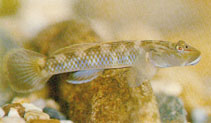
背棘 (总数) : 7; 背的软条 (总数) : 8; 臀棘: 1; 臀鳍软条: 8; 脊椎骨: 26. This species is distinguished from its congeners by the following set of characters: D2 I,8; A I,8; pectoral-fin rays fin rays 36-40 (modally 19); longitudinal scale rows 32-35; transverse scale rows 9-10; predorsal scales 11-13 with a trifurcate anterior margin of which point 3 lies above the upper gill opening; vertebrae 10 + 16 = 26; gill opening extending ventrally to the vertical midline of the opercle. Coloration of males and females: males' basal region of body scale pockets with a bright orange spot, somewhat indistinct in females; the lateral side of females with a middle longitudinal row of discontinuous brownish black spots or bars and their dorsal lateral region with 3-4 longitudinal rows of black spots and the caudal fin base with 2 separate, vertical black bars; males with second dorsal fin with 4 longitudinal rows of reddish brown bars or spots and caudal fin with 8-10 waving vertical orange to brown stripes; pectoral fin base with a basal distinct, oblique deep brown stripe; cheek scattered with 16-25 small, orange red spots, brighter in males; the pectoral fin base of the species with a basal distinct, oblique deep brown stripe, followed by a parallel shorter, lighter stripe or waving mark (Ref. 104792).
Body shape (shape guide): elongated.
Adults inhabit lakes and rivers. Juveniles move into the sea and return to rivers after several months. This species has several types differentiated according to shape, coloration, and life history. Each type is isolated by habitat in the same stream.
栖息于湖与河。 稚鱼移进海洋中而且好几个月之后回到河川。 这种有好几个类型依据区别形状,颜色与生活历史。 每个类型被在同一条溪流中的栖息地隔离。
Life cycle and mating behavior
成熟度 | 繁殖 | 产卵场 | 卵 | 孕卵数 | 仔鱼
亚洲: 日本的河川流域 (参考文献 559) ,俄国远东 (参考文献 56557) ,日本的太平洋海岸,琉球,台湾,韩国的河川,中国大陆与菲律宾。
Masuda, H., K. Amaoka, C. Araga, T. Uyeno and T. Yoshino, 1984. The fishes of the Japanese Archipelago. Vol. 1. Tokai University Press, Tokyo, Japan. 437 p. (text). (Ref. 559)
世界自然保护联盟红皮书 (Ref. 130435: Version 2025-1)
人类利用
渔业: 没有兴趣
工具
特别资料
下载 XML
网络资源
Estimates based on models
Preferred temperature (参考文献
123201): 12.2 - 20.9, mean 16.9 °C (based on 144 cells).
Phylogenetic diversity index (参考文献
82804): PD
50 = 0.5000 [Uniqueness, from 0.5 = low to 2.0 = high].
Bayesian length-weight: a=0.00759 (0.00466 - 0.01235), b=3.13 (2.99 - 3.27), in cm total length, based on LWR estimates for this species & (Sub)family-body (Ref.
93245).
营养阶层 (参考文献
69278): 3.2 ±0.4 se; based on size and trophs of closest relatives
回复力 (参考文献
120179): 高度, 族群倍增时间少于 15个月 (Preliminary K or Fecundity.).
Fishing Vulnerability (Ref.
59153): Low vulnerability (10 of 100).
🛈