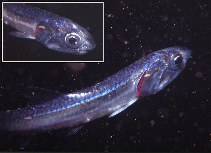
Environment: milieu / climate zone / пределы глубины / distribution range
экология
морской pelagic-neritic; мигрирует в океане (Ref. 51243); пределы глубины 0 - 400 m (Ref. 50550). Temperate; 8°C - 30°C (Ref. 56557); 49°N - 2°N, 105°E - 155°E (Ref. 54432)
Western Pacific: southern Sakhalin Islands, Sea of Japan and Pacific coasts of Japan, and south to almost Canton/Taiwan; rare records (seems to represent stray fishes) off the coasts of Luzon and Western Mindanao, Philippines and from Manado and Ujung Pandang, Sulawesi, Indonesia (Ref. 189).
Length at first maturity / Size / Вес / Возраст
половая зрелость: Lm 10.5, range 10 - 11 cm
Max length : 18.0 cm TL самец/пол неопределен; (Ref. 56527); common length : 14.0 cm TL самец/пол неопределен; (Ref. 56527); наибольший вес (опубликованные данные): 45.00 g (Ref. 56527); наибольший возраст (опубликованны данные): 4 годы (Ref. 56527)
колючие лучи спинного плавника (общее число) : 0; членистые (мягкие) лучи спинного плавника (общее число) : 12 - 14; колючие лучи анального плавника: 0; членистые (мягкие) лучи анального плавника: 13 - 18. Differs very little from the European anchovy (see E. encrasicolus) and can be identified from that description. Of other anchovies found in the southern part of its distribution, only species of Encrasicholina and Stolephorus are of similar appearance, but all have small spine-like pre-pelvic scutes (usually 2 to 7 scutes). Thryssa have compressed bodies and a keel of scutes along belly.
Body shape (shape guide): elongated; Cross section: oval.
Occurs in large schools near the surface, mainly in coastal waters but as far out as over 1,000 km from the shore. Tends to move more northward and inshore in spring and summer. Juveniles associate with drifting seaweed (Ref. 12114, 12115). Feeds on copepods, but also on other small crustaceans, molluscan larvae, fish eggs and larvae and diatoms. Marketed fresh and salted, processed into fishmeal and oil (Ref. 12484).
Whitehead, P.J.P., G.J. Nelson and T. Wongratana, 1988. FAO Species Catalogue. Vol. 7. Clupeoid fishes of the world (Suborder Clupeoidei). An annotated and illustrated catalogue of the herrings, sardines, pilchards, sprats, shads, anchovies and wolf-herrings. FAO Fish. Synop. 125(7/2):305-579. Rome: FAO. (Ref. 189)
Статус Красного Списка МСОП (Ref. 130435: Version 2025-1)
Угроза для людей
Reports of ciguatera poisoning (Ref. 4690)
Использование человеком
рыболовство: важный объект промысла; аквакультура (рыбоводство): коммерческий; наживка: usually
дополнительная информация
инструменты
Специальные отчеты
Скачать в формате XML
ресурсы в Интернет
Estimates based on models
Preferred temperature (ссылка
123201): 8.1 - 23.3, mean 18.4 °C (based on 139 cells).
Phylogenetic diversity index (ссылка
82804): PD
50 = 0.5020 [Uniqueness, from 0.5 = low to 2.0 = high].
Bayesian length-weight: a=0.00398 (0.00272 - 0.00583), b=3.10 (2.98 - 3.22), in cm total length, based on LWR estimates for this species & Genus-body shape (Ref.
93245).
Trophic level (ссылка
69278): 3.1 ±0.1 se; based on diet studies.
Generation time: 1.1 (1.0 - 1.8) years. Estimated as median ln(3)/K based on 16
growth studies.
устойчивость к внешним воздействиям (ссылка
120179): высокий, минимальное время удвоения популяции до 15 месяцев (K=1.05; tm=1-2; tmax=3).
Prior r = 0.90, 95% CL = 0.60 - 1.36, Based on 3 full stock assessments.
Fishing Vulnerability (Ref.
59153): Low vulnerability (23 of 100).
🛈
Nutrients (Ref.
124155): Calcium = 148 [56, 380] mg/100g; Iron = 0.698 [0.304, 1.783] mg/100g; Protein = 18.3 [16.8, 19.7] %; Omega3 = 1.57 [0.74, 3.39] g/100g; Selenium = 14.9 [5.6, 40.7] μg/100g; VitaminA = 7.51 [1.30, 42.67] μg/100g; Zinc = 0.939 [0.527, 1.630] mg/100g (wet weight);