Environment: milieu / climate zone / пределы глубины / distribution range
экология
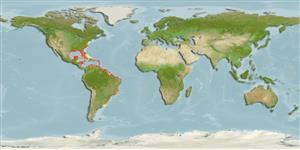
морской ассоциированный с рифами; пределы глубины 1 - 50 m (Ref. 93252), usually 5 - ? m (Ref. 9710). Tropical; 41°N - 37°S, 98°W - 33°W (Ref. 188)
Western Atlantic: Gulf of Maine (USA), Bermuda, throughout the Gulf of Mexico, Caribbean and West Indies southward to Santa Catarina, Brazil. Also found in Uruguay (Ref. 54736) and Argentina (Ref. 2806).
Length at first maturity / Size / Вес / Возраст
половая зрелость: Lm 11.5, range 11 - ? cm
Max length : 38.0 cm TL самец/пол неопределен; (Ref. 5217); common length : 20.0 cm SL самец/пол неопределен; (Ref. 188); наибольший вес (опубликованные данные): 375.00 g (Ref. 5217)
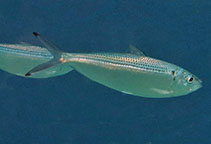
колючие лучи спинного плавника (общее число) : 0; членистые (мягкие) лучи спинного плавника (общее число) : 19 - 21; колючие лучи анального плавника: 0; членистые (мягкие) лучи анального плавника: 23 - 24. The filamentous last dorsal fin ray distinguishes this species from all other western Atlantic clupeoids except Dorosoma, which has an inferior mouth (Ref. 188). Otherwise, superficially resembles species of Sardinella (but i 8 pelvic fin rays in western Atlantic species, cf. i 7 in Opisthonema) and Harengula (but small toothed hypomaxilla in upper jaw) (Ref. 188). Lower gill rakers stable at 28 to 46 after 8 cm (Ref. 188). Silvery, with a bluish or greenish back, 6-7 lengthwise dark streaks on side. Dark spot above opercle, larger dark spot behind opercle, usually with a row of dark spots behind it. Lower profile deeply curved. Head pointed (Ref. 7251).
Body shape (shape guide): fusiform / normal; Cross section: compressed.
Inhabit harbors and shallow coastal areas (Ref. 9710). Pelagic (Ref. 27549). Form schools (but solitary individuals reported), probably not entering water of low salinity. Feed by filtering plankton (copepods), but also take small fishes, crabs and shrimps. Marketed fresh, frozen and salted; also used in the fishmeal industry. Occur in freshwater in St. Johns River, Florida (Ref. 26938).
Possibly breeds in March-July off Venezuela.
Whitehead, P.J.P., 1985. FAO Species Catalogue. Vol. 7. Clupeoid fishes of the world (suborder Clupeoidei). An annotated and illustrated catalogue of the herrings, sardines, pilchards, sprats, shads, anchovies and wolf-herrings. FAO Fish. Synop. 125(7/1):1-303. Rome: FAO. (Ref. 188)
Статус Красного Списка МСОП (Ref. 130435: Version 2025-1)
Угроза для людей
Reports of ciguatera poisoning (Ref. 30911)
Использование человеком
рыболовство: коммерческий; наживка: usually
дополнительная информация
инструменты
Специальные отчеты
Скачать в формате XML
ресурсы в Интернет
Estimates based on models
Preferred temperature (ссылка
123201): 22.7 - 28, mean 25.5 °C (based on 480 cells).
Phylogenetic diversity index (ссылка
82804): PD
50 = 0.5312 [Uniqueness, from 0.5 = low to 2.0 = high].
Bayesian length-weight: a=0.00871 (0.00776 - 0.00977), b=3.06 (3.03 - 3.09), in cm total length, based on LWR estimates for this species (Ref.
93245).
Trophic level (ссылка
69278): 4.5 ±0.0 se; based on diet studies.
устойчивость к внешним воздействиям (ссылка
120179): средний (среднего размера), минимальное время удвоения популяции 1.4-4.4 года (tm=1-3; tmax=8).
Prior r = 1.18, 95% CL = 0.78 - 1.77, Based on 4 data-limited stock assessments.
Fishing Vulnerability (Ref.
59153): Low vulnerability (24 of 100).
🛈
Climate Vulnerability (Ref.
125649): Moderate to high vulnerability (54 of 100).
🛈
Nutrients (Ref.
124155): Calcium = 59.1 [28.2, 107.6] mg/100g; Iron = 0.805 [0.394, 1.446] mg/100g; Protein = 19.9 [18.5, 21.2] %; Omega3 = 0.242 [0.132, 0.455] g/100g; Selenium = 34.8 [18.7, 79.4] μg/100g; VitaminA = 95.7 [28.7, 303.9] μg/100g; Zinc = 0.856 [0.565, 1.280] mg/100g (wet weight);