



Chaetodipterus faber (Broussonet, 1782)
Atlantic spadefish
Lägg till din observation i Fish Watcher
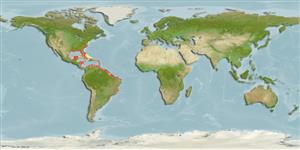
| Native range | All suitable habitat | Point map | Year 2050 |
|
| This map was computer-generated and has not yet been reviewed. |
| Chaetodipterus faber AquaMaps Data sources: GBIF OBIS |
Ladda upp din foton och Videor
Bilder | Videor | Google image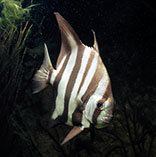 Chaetodipterus faber
Bild av Muséum-Aquarium de Nancy/D. Terver
Bilder | Videor | Google image
Bild av Muséum-Aquarium de Nancy/D. Terver
Klassificering / Namn Populärnamn | synonymer | Catalog of Fishes(Släkte, Arter) | ITIS | CoL | WoRMS | Cloffa
> Acanthuriformes (Surgeonfishes) > Ephippidae (Spadefishes, batfishes and scats)
Etymology: Chaetodipterus: Greek, chaite = hair + Greek, dipteros = with two fins (Ref. 45335).
Etymology: Chaetodipterus: Greek, chaite = hair + Greek, dipteros = with two fins (Ref. 45335).
Miljö: miljö / Klimatzon / djupintervall / distributionsområde Ekologi
marina; brackvatten revassocierade; havsvandrande (Ref. 51243); djupintervall 3 - 35 m (Ref. 26912). Subtropical; 43°N - 34°S, 98°W - 34°W
Utbredning Territorier | FAO områden | Ekosystem | Förekomster | Prickkarta | Utplanteringar | Faunafri
Western Atlantic: Massachusetts, USA and northern Gulf of Mexico to Rio Grande do Sul, Brazil (Ref. 47377).
Längd vid första mognad / Storlek / Vikt / Ålder
Könsmognad: Lm ?, range 12 - ? cm
Max length : 91.0 cm TL hane/ej könsbestämd; (Ref. 7251); common length : 50.4 cm TL hane/ej könsbestämd; (Ref. 26466); publicerad maxvikt: 9.0 kg (Ref. 7251)
Max length : 91.0 cm TL hane/ej könsbestämd; (Ref. 7251); common length : 50.4 cm TL hane/ej könsbestämd; (Ref. 26466); publicerad maxvikt: 9.0 kg (Ref. 7251)
Kort beskrivning Bestämningsnycklar | Morfologi | Morfometri
Taggstrålar i ryggfenan (totalt) : 9; Mjukstrålar i ryggfenan (totalt) : 21 - 24; Taggstrålar i analfenan: 3; Mjukstrålar i analfenan: 17 - 18. Very deep-bodied, compressed, disk-shaped fish with a very blunt snout. Irregular, bold, blackish, vertical bands that fade with age. Second dorsal and anal fins have high anterior lobes (Ref. 26938). Mouth small, the maxilla of adults ending beneath nostrils; no teeth on roof of mouth; scales ctenoid; head and fins scaled; opercle ends in an obtuse point (Ref. 13442).
Body shape (shape guide): short and / or deep.
Body shape (shape guide): short and / or deep.
Abundant in shallow coastal waters, from mangroves and sandy beaches to wrecks and harbors. Juveniles (black phase) are common in estuaries and often found in very shallow water swimming at an angle resembling dead leaves or as infertile red mangrove pods and other debris. Adults often occur in very large schools of up to 500 individuals (Ref. 9710). Feed on benthic invertebrates like crustaceans, mollusks, annelids, cnidarians as well as on plankton (Ref. 35237). Good food fish (Ref. 5521); marketed fresh (Ref. 5217). Often circles divers (Ref. 9710). Minimum depth from Ref. 9710. In southeastern Brazil found between 23 and 45 m (Ref. 47377). Has been reared in captivity (Ref. 35425).
Livscykel och parningsbeteende Könsmognad | Reproduktion | Lek | Ägg | Fekunditet | Larver
Huvudreferens
Ladda upp dina referenser | referenser | Koordinator | Medarbetare
Robins, C.R. and G.C. Ray, 1986. A field guide to Atlantic coast fishes of North America. Houghton Mifflin Company, Boston, U.S.A. 354 p. (Ref. 7251)
Status på IUCN:s rödlista (Ref. 130435: Version 2025-2 (Global))
Least Concern (LC) ; Date assessed: 29 January 2013
CITES
Not Evaluated
Hot mot människor
Reports of ciguatera poisoning (Ref. 30303)
Mänskliga användningsområden
Fiskeri: mindre kommeriell; Vattenbruk: kommersiell; sportfisk: ja; Akvarium: Offentliga akvarier
FAO - Publication: search | FishSource | Havet omkring oss
Ytterligare information
Populationsdynamik
Tillväxtparametrar
Max. åldrar / storlekar
Längd-vikt rel.
Längd-längd rel.
Längd-frekvenser
Massakonvertering
Rekrytering
Abundans
Tillväxtparametrar
Max. åldrar / storlekar
Längd-vikt rel.
Längd-längd rel.
Längd-frekvenser
Massakonvertering
Rekrytering
Abundans
Livscykel
Reproduktion
Könsmognad
Mognad/Gills rel.
Fekunditet
Lek
Lekande aggregat
Ägg
Utveckling av ägg
Larver
Larvdynamik
Reproduktion
Könsmognad
Mognad/Gills rel.
Fekunditet
Lek
Lekande aggregat
Ägg
Utveckling av ägg
Larver
Larvdynamik
Anatomi
Gälyta
Hjärna
Otolit
Gälyta
Hjärna
Otolit
Fysiologi
Kroppssammansättning
Näringsämnen
Syreförbrukning
Typ av simning
Simhastighet
Visuella pigment
Ljud från fisk
Sjukdomar & Parasiter
Toxicitet (LC50)
Kroppssammansättning
Näringsämnen
Syreförbrukning
Typ av simning
Simhastighet
Visuella pigment
Ljud från fisk
Sjukdomar & Parasiter
Toxicitet (LC50)
Människorelaterad
Vattenbrukssystem
Vattenbruksprofiler
Avelslinjer
Ciguatera-fall
Frimärken, mynt, diverse.
Vattenbrukssystem
Vattenbruksprofiler
Avelslinjer
Ciguatera-fall
Frimärken, mynt, diverse.
Verktyg
Organisk frågesport | E-bok | Fälthandbok | Längdfördelnings-verktyg | Livshistorie-verktyg | Prickkarta |
Fångst-MSY |
Särskilda rapporter
Kontrollera för underhåll av akvarium | Kontrollera om det finns faktablad om arter | Kontrollera om det finns faktablad om vattenbruk
Ladda ner XML
Internet-källor
AFORO (otoliths) | Alien/Invasive Species database | Aquatic Commons | BHL | Cloffa | Websites from users | Check FishWatcher | CISTI | Catalog of Fishes: Släkte, Arter | DiscoverLife | DORIS | ECOTOX | FAO - Publication: search | Faunafri | Fishipedia | Fishtrace | GloBI | GoMexSI (interaction data) | Google Books | Google Scholar | Google | IGFA World Record | Nationella databaser | OceanAdapt | OneZoom | Open Tree of Life | Otolith Atlas of Taiwan Fishes | Offentliga akvarier | PubMed | Reef Life Survey | Socotra Atlas | TreeBase | Tree of Life | Wikipedia: Go, sök | World Records Freshwater Fishing | Zoologiskt register
Uppskattningar baserade på modeller
Önskad temperatur (Ref. 123201): 22.6 - 28, mean 25.4 °C (based on 380 cells).
Index för fylogenetisk mångfald (Ref. 82804): PD50 = 0.6250 [Uniqueness, from 0.5 = low to 2.0 = high].
Bayesian length-weight: a=0.03388 (0.02648 - 0.04335), b=2.95 (2.88 - 3.02), in cm total length, based on LWR estimates for this species (Ref. 93245).
Trofisk nivå (Ref. 69278): 4.5 ±0.0 se; based on diet studies.
Resiliens (Ref. 120179): Låg, lägsta populationsfördubblingstid 4,5-14 år (tmax=11; tm=1; K=0.17-0.34).
Näringsämnen (Ref. 124155): Calcium = 16 [7, 41] mg/100g; Iron = 0.412 [0.214, 0.762] mg/100g; Protein = 20.3 [19.1, 21.4] %; Omega3 = 0.165 [0.090, 0.311] g/100g; Selenium = 15.9 [6.9, 34.9] μg/100g; VitaminA = 24.7 [5.6, 116.7] μg/100g; Zinc = 0.532 [0.327, 0.832] mg/100g (wet weight);