>
Acanthuriformes (Surgeonfishes) >
Ephippidae (Spadefishes, batfishes and scats)
Etymology: Chaetodipterus: Greek, chaite = hair + Greek, dipteros = with two fins (Ref. 45335).
Environment: milieu / climate zone / depth range / distribution range
экология
морской; солоноватоводный ассоциированный с рифами; мигрирует в океане (Ref. 51243); пределы глубины 3 - 35 m (Ref. 26912). Subtropical; 43°N - 34°S, 98°W - 34°W
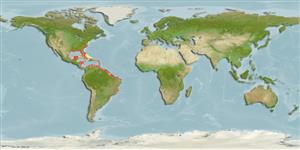
Western Atlantic: Massachusetts, USA and northern Gulf of Mexico to Rio Grande do Sul, Brazil (Ref. 47377).
Length at first maturity / Size / Вес / Возраст
Maturity: Lm ?, range 12 - ? cm
Max length : 91.0 cm TL самец/пол неопределен; (Ref. 7251); common length : 50.4 cm TL самец/пол неопределен; (Ref. 26466); наибольший вес (опубликованные данные): 9.0 kg (Ref. 7251)
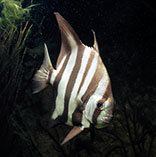
колючие лучи спинного плавника (общее число): 9; членистые (мягкие) лучи спинного плавника (общее число): 21-24; колючие лучи анального плавника 3; членистые (мягкие) лучи анального плавника: 17 - 18. Very deep-bodied, compressed, disk-shaped fish with a very blunt snout. Irregular, bold, blackish, vertical bands that fade with age. Second dorsal and anal fins have high anterior lobes (Ref. 26938). Mouth small, the maxilla of adults ending beneath nostrils; no teeth on roof of mouth; scales ctenoid; head and fins scaled; opercle ends in an obtuse point (Ref. 13442).
Abundant in shallow coastal waters, from mangroves and sandy beaches to wrecks and harbors. Juveniles (black phase) are common in estuaries and often found in very shallow water swimming at an angle resembling dead leaves or as infertile red mangrove pods and other debris. Adults often occur in very large schools of up to 500 individuals (Ref. 9710). Feed on benthic invertebrates like crustaceans, mollusks, annelids, cnidarians as well as on plankton (Ref. 35237). Good food fish (Ref. 5521); marketed fresh (Ref. 5217). Often circles divers (Ref. 9710). Minimum depth from Ref. 9710. In southeastern Brazil found between 23 and 45 m (Ref. 47377). Has been reared in captivity (Ref. 35425).
Robins, C.R. and G.C. Ray, 1986. A field guide to Atlantic coast fishes of North America. Houghton Mifflin Company, Boston, U.S.A. 354 p. (Ref. 7251)
Статус Красного Списка МСОП (Ref. 130435)
Угроза для людей
Reports of ciguatera poisoning (Ref. 30303)
Использование человеком
рыболовство: не имеет хозяйственного значения; аквакультура (рыбоводство): коммерческий; объект спортивного рыболовства: да; аквариум: общественные аквариумы
дополнительная информация
ссылкиаквакультура (рыбоводство)особенности рыбоводствастепень растяжениягенетикаElectrophoresesнаследуемостьболезниобработкаNutrientsMass conversion
инструменты
Специальные отчеты
Скачать в формате XML
ресурсы в Интернет
Estimates based on models
Preferred temperature (Ref.
123201): 22.6 - 28, mean 25.4 °C (based on 380 cells).
Phylogenetic diversity index (Ref.
82804): PD
50 = 0.6250 [Uniqueness, from 0.5 = low to 2.0 = high].
Bayesian length-weight: a=0.03311 (0.02580 - 0.04250), b=2.94 (2.87 - 3.01), in cm total length, based on LWR estimates for this species (Ref.
93245).
Trophic level (Ref.
69278): 4.5 ±0.0 se; based on diet studies.
устойчивость к внешним воздействиям (Ref.
120179): средний (среднего размера), минимальное время удвоения популяции 1.4-4.4 года (tmax=8; tm=1; K=0.34).
Fishing Vulnerability (Ref.
59153): Moderate to high vulnerability (49 of 100).
Nutrients (Ref.
124155): Calcium = 16 [7, 41] mg/100g; Iron = 0.412 [0.214, 0.762] mg/100g; Protein = 20.3 [19.1, 21.4] %; Omega3 = 0.165 [0.090, 0.311] g/100g; Selenium = 15.9 [6.9, 34.9] μg/100g; VitaminA = 24.7 [5.6, 116.7] μg/100g; Zinc = 0.532 [0.327, 0.832] mg/100g (wet weight);