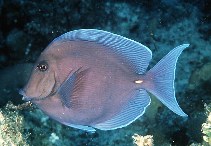
Acanthurus coeruleus, Blue tang surgeonfish : fisheries, aquarium, bait

Acanthurus coeruleus Bloch & Schneider, 1801

Blue tang surgeonfish
Beobachtung melden im Fish Watcher
Native range | All suitable habitat | Point map | Year 2050
This map was computer-generated and has not yet been reviewed.
Acanthurus coeruleus   AquaMaps   Data sources: GBIF OBIS
Hochladen Photos und videos
Bilder | videos | Briefmarken, Münzen, Verschiedenes. | Google Bild

Klassifizierung / Names Namen | Synonyme | Catalog of Fishes(Gattung, Arten) | ITIS | CoL | WoRMS | Cloffa

> Acanthuriformes (Surgeonfishes) > Acanthuridae (Surgeonfishes, tangs, unicornfishes) > Acanthurinae
Etymology: Acanthurus: Greek, akantha = thorn + Greek, oura = tail (Ref. 45335).
More on authors: Bloch & Schneider.

Umwelt: Milieu / Klimazone / Tiefenbereich / Verbreitungsgebiet Ökologie

seewasser riff-verbunden; tiefenbereich 2 - 50 m (Ref. 7345), usually 2 - 18 m (Ref. 27115). Tropical; 43°N - 27°S, 100°W - 4°W (Ref. 55165)

Verbreitung Territorien | FAO Gebiete | Ökosysteme | Vorkommen | Punkt Karte | Einführungen | Faunafri

Western Atlantic: New York, USA and Bermuda to the Gulf of Mexico and Brazil. Eastern Atlantic: Ascension Island (Ref. 7345).

Länge bei der ersten Reifung / Größe / Gewicht / Alter

Geschlechtsreife: Lm ?, range 13 - ? cm
Max length : 39.0 cm TL Männchen/unbestimmt; (Ref. 36453); common length : 25.0 cm TL Männchen/unbestimmt; (Ref. 5217)

Kurzbeschreibung Bestimmungsschlüssel | Morphologie | Morphometrie

Rückenflossenstacheln (insgesamt) : 9; Rückenflossenweichstrahlen (insgesamt) : 26 - 28; Afterflossenstacheln: 3; Afterflossenweichstrahlen: 24 - 26. A deep-bodied surgeonfish (body depth 1.7 in SL) with a conspicuous yellow caudal spine. Has the most distinctive coloration of all western Atlantic surgeonfishes (Ref. 26938).
Body shape (shape guide): short and / or deep.

Biologie     Fachlexikon (Englisch) (z.B. epibenthic)

Inhabits coral reefs, inshore grassy or rocky areas. Forms small groups (Ref. 26235). Mainly diurnal. Feeds entirely on algae (Ref. 5521). At Fernando de Noronha Archipelago in southwestern Atlantic, juveniles hold cleaning stations together with the doctorfish (Acanthurus chirurgus) and sergeant major (Abudefduf saxatilis) and graze algae as well as pick molted skin and parasites from green turtles (Chelonia mydas). This behavior is preceded by a characteristic inspection usually followed by feeding nips on the turtles’ skin (head, limbs, and tail), as well as on the carapace. The most inspected and cleaned body parts are the flippers (Ref. 51385). Diurnal species (Ref. 3194). It forms resident spawning aggregations in late afternoon after high tide (Ref. 27825, 120681, 120682). The spine on both sides of the caudal peduncle may inflict painful wounds (Ref. 5217). Marketed fresh. Maximum depth reported taken from Ref. 127989.

Lebenszyklus und Paarungsverhalten Geschlechtsreife | Fortpflanzung | Ablaichen | Eier | Fruchtbarkeit | Larven

Hauptreferenz Laden Sie Ihre Referenzen hoch | Referenzen | Koordinator : Randall, John E. | Partner

Robins, C.R. and G.C. Ray, 1986. A field guide to Atlantic coast fishes of North America. Houghton Mifflin Company, Boston, U.S.A. 354 p. (Ref. 7251)

IUCN Rote Liste Status (Ref. 130435: Version 2025-2 (Global))

  nicht bedroht (LC) ; Date assessed: 03 May 2010

CITES

Not Evaluated

CMS (Ref. 116361)

Not Evaluated

Bedrohung für Menschen

  Traumatogenic (Ref. 4690)


Nutzung durch Menschen

Fischereien: weniger kommerziell; Aquarium: Kommerziell; Köder: occasionally
FAO - Publication: search | FishSource |

Mehr Information

Trophische Ökologie
Lebensmittel (Beutetiere)
Nahrungszusammensetzung
Nahrungsaufnahme
Lebensmittelrationen
Räuber
Ökologie
Ökologie
Populationsdynamik
Wachstumsparameter
Max. Alter/Größen
Länge-Gewicht-Rel.
Länge-Länge-Verhältnis.
Längenhäufigkeiten
Massenkonvertierung
Rekrutierung
Dichte
Lebenszyklus
Fortpflanzung
Geschlechtsreife
Reifung/Kiemen rel.
Fruchtbarkeit
Ablaichen
Laichaggregationen
Eier
Eientwicklung
Larven
Larven Pop.Dyn.
Verbreitung
Territorien
FAO Gebiete
Ökosysteme
Vorkommen
Einführungen
BRUVS - Videos
Anatomie
Kiemenoberfläche
Gehirn
Otolith
Physiologie
Körperliche Zusammensetzung
Nährstoffe
Sauerstoffverbrauch
Schwimmart
Schwimmgeschwindigkeit
Visuelle Pigmente
Fischgeräusche
Krankheiten und Parasiten
Toxizität (LC50s)
Genetik
Genom
Genetik
Heterozygotie
Vererbbarkeit
Genetische Vielfalt
Menschenbezogen
Aquakultur-Systeme
Aquakultur Profile
Zuchtlinien
Ciguatera-Fälle
Briefmarken, Münzen, Verschiedenes.
Aufsuchen
Partner
Referenzen
Referenzen

Tools

Zusatzinformationen

Download XML

Internet Quellen

Schätzungen auf der Grundlage von Modellen

Bevorzugte Temperatur (Ref. 123201): 23.7 - 28.1, mean 27.4 °C (based on 783 cells).
Phylogenetischer Diversitätsindex (Ref. 82804):  PD50 = 0.5000   [Uniqueness, from 0.5 = low to 2.0 = high].
Bayesian length-weight: a=0.02570 (0.01565 - 0.04223), b=2.96 (2.82 - 3.10), in cm total length, based on LWR estimates for this species & Genus-body shape (Ref. 93245).
Trophische Ebene (Ref. 69278):  2.2   ±0.00 se; based on food items.
Generation time: 9.8 ( na - na) years. Estimated as median ln(3)/K based on 2 growth studies.
Widerstandsfähigkeit (Ref. 120179):  mittel, Verdopplung der Population dauert 1,4 - 4,4 Jahre. (K=0.11-0.50).
Anfälligkeit der Fischerei (Ref. 59153):  High vulnerability (59 of 100). 🛈
Preiskategorie (Ref. 80766):   Medium.
Nährstoffe (Ref. 124155):  Calcium = 53.4 [22.4, 151.6] mg/100g; Iron = 0.729 [0.281, 1.754] mg/100g; Protein = 18.3 [17.0, 19.5] %; Omega3 = 0.102 [0.047, 0.213] g/100g; Selenium = 19.2 [6.8, 55.4] μg/100g; VitaminA = 36.2 [8.8, 136.0] μg/100g; Zinc = 2.59 [0.82, 4.74] mg/100g (wet weight);