Élasmobranches (requins et raies) (sharks and rays) >
Rajiformes (Skates and rays) >
Rajidae (Skates)
Etymology: Leucoraja: Greek, leykos = white + Latin, raja = a fish, Raja sp. (Ref. 45335).
Environment: milieu / climate zone / profondeur / distribution range
Écologie
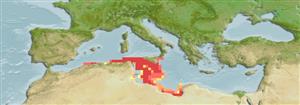
marin bathydémersal; profondeur 60 - 800 m (Ref. 106604). Deep-water; 42°N - 36°N, 2°W - 16°E
Mediterranean Sea: endemic to the coasts of Tunisia, Malta and a single record from Italy; rare off Algeria.
Taille / Poids / Âge
Maturité: Lm ? range ? - ? cm
Max length : 52.0 cm TL mâle / non sexé; (Ref. 125195); 45.0 cm TL (female)
Feed on crustaceans mainly amphipods (Ref. 3167). Oviparous. Distinct pairing with embrace. Young may tend to follow large objects, such as their mother (Ref. 205). Eggs are oblong capsules with stiff pointed horns at the corners deposited in sandy or muddy flats (Ref. 205). About 10-56 eggs are laid per individual annually (Ref. 41305, 41314).
Life cycle and mating behavior
Maturité | Reproduction | Frai | Œufs | Fécondité | Larves
Oviparous, paired eggs are laid. Embryos feed solely on yolk (Ref. 50449). Breeds throughout the year, but ripe females observed mainly in spring and autumn (Ref. 3167). Distinct pairing with embrace. Young may tend to follow large objects, such as their mother (Ref. 205).
McEachran, J.D. and K.A. Dunn, 1998. Phylogenetic analysis of skates, a morphologically conservative clade of elasmobranchs (Chondrichthyes: Rajidae). Copeia 1998(2):271-290. (Ref. 27314)
Statut dans la liste rouge de l'IUCN (Ref. 130435: Version 2025-1)
Menace pour l'homme
Harmless
Utilisations par l'homme
Pêcheries: intérêt commercial mineur
Outils
Articles particuliers
Télécharger en XML
Sources Internet
Estimates based on models
Preferred temperature (Réf.
123201): 13.1 - 14.6, mean 14 °C (based on 23 cells).
Phylogenetic diversity index (Réf.
82804): PD
50 = 0.5000 [Uniqueness, from 0.5 = low to 2.0 = high].
Bayesian length-weight: a=0.00229 (0.00142 - 0.00370), b=3.21 (3.07 - 3.35), in cm total length, based on LWR estimates for this species & Genus-body shape (Ref.
93245).
Niveau trophique (Réf.
69278): 3.3 ±0.53 se; based on food items.
Résilience (Réf.
120179): Faible, temps minimum de doublement de population : 4,5 à 14 années (Fec=10).
Fishing Vulnerability (Ref.
59153): Moderate vulnerability (41 of 100).
🛈
Nutrients (Ref.
124155): Calcium = 6.32 [0.98, 122.77] mg/100g; Iron = 0.346 [0.033, 4.702] mg/100g; Protein = 15.1 [13.0, 17.2] %; Omega3 = 0.455 [0.180, 1.150] g/100g; Selenium = 14.5 [2.5, 68.7] μg/100g; VitaminA = 5.07 [0.37, 64.27] μg/100g; Zinc = 0.329 [0.023, 3.815] mg/100g (wet weight);