



Tylochromis aristoma Stiassny, 1989
Carregue seu(sua) Fotos e vídeos
Imagem do Google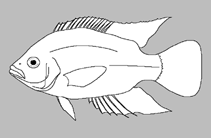 No image available for this species;
drawing shows typical species in Cichlidae.
Imagem do Google
drawing shows typical species in Cichlidae.
Classificação / Nomes Nomes comuns | Sinônimos | Catalog of Fishes(Gênero, Espécies) | ITIS | CoL | WoRMS | Cloffa
> Cichliformes (Cichlids, convict blennies) > Cichlidae (Cichlids) > Pseudocrenilabrinae
Etymology: Tylochromis: Greek, tylos = callus + Greek, chromis = a fish, perhaps a perch (Ref. 45335); aristoma: ari = Greek for well-developed, stoma = Greek for mouth (Ref. 52307). Named in reference to the prominent lower jaw and large-mouthed appearance of the adult (Ref. 52346).
Etymology: Tylochromis: Greek, tylos = callus + Greek, chromis = a fish, perhaps a perch (Ref. 45335); aristoma: ari = Greek for well-developed, stoma = Greek for mouth (Ref. 52307). Named in reference to the prominent lower jaw and large-mouthed appearance of the adult (Ref. 52346).
Meio ambiente: milieu / Zona climática / intervalo de profundidade / faixa de distribuição Ecologia
; Água doce bentopelágico. Tropical
Distribuição Territórios | Áreas da FAO | Ecossistemas | Ocorrências | Mapa de pontos | Introduções | Faunafri
Africa: restricted to the Ruki River drainage (middle Congo River basin), in Democratic Republic of the Congo (Ref. 52346, 93897).
Tamanho / Peso / Idade
Descrição suscinta Chaves de identificação | Morfologia | Morfometria
Espinhos dorsais (total) : 13 - 16; Raios dorsais (total) : 12 - 14; Raios anais : 7; Vértebras: 28 - 29. Diagnosis: deep bodied, robust species with a relatively large mouth (compared to its congeners), but juveniles slender (Ref. 52307). Slender gracile lower jaw and narrow elongate keel (Ref. 52346). Dorsum strongly curved from nape to caudal peduncle but ventrum more or less flattened; long snout with a straight and steep predorsal profile passing uninterrupted to origin of dorsal fin, where body depth is largest; lower jaw extremely prominent; lips well-formed but not overly thickened or fleshy; entire premaxillary oral flap present; buccal teeth capped with brown or black enameloid; in juveniles all teeth small and fine with little differentiation in tooth size between inner and outer rows; in adult (male) teeth coarse and enlarged; upper branch of lateral line terminates in advance of end of dorsal fin; dorsal, ventral and medial lateral line branches on caudal fin well developed and almost reach to periphery; dorsal fin spines increase in length to 4th-5th and are then more or less of equal length; anal fin rounded; caudal fin roundly emarginate and densely scaled; pectoral fin relatively elongate and usually reaches level of first soft anal ray; first branched pelvic ray produced and filamentous (Ref. 52346).
Coloration: adult male: upper lip and front of head black (Ref. 52307, 52346). Just anterior to a short black nape stripe a patch of red/gold is present (Ref. 52346). Cheeks, operculum and breast silvery-white with greenish iridescent parts (Ref. 52307). Just behind nape band a broad pale blue/green band extends obliquely down to base of pelvic fins (Ref. 52346). Behind this oblique band body dark (golden) bronze which becomes more greenish towards caudal peduncle (Ref. 52307, 52346). Darker pigmentation on flank scales; dorsal, pelvic and anal fins dark reddish brown, with numerous rows of small greenish dots (Ref. 52307). Caudal fin light brown centrally, with more reddish parts in distal (outer) regions and many small black lines (Ref. 52307, 52346). (Preserved) juveniles: ground coloration light brown with dark smokey grey upper lip and front of head; nape band strongly marked but not reaching down onto operculum; diffuse opercular blotch present on lower portion of operculum; 6 vertical stripes extend down well below midline and onto belly and ventrum (especially in the smallest specimens) (Ref. 52346).
Seems to feed primarily upon plants and insect larvae; maternal mouthbrooder that does not pair-bond (Ref. 52307).
Ciclo de vida ou comportamento de acasalamento Maturidade | Reprodução | Desova | Ovos | Fecundidade | Larvas
Referência principal
Carregar suas referências | Referências | Coordenador : Kullander, Sven O. | Colaboradores
Stiassny, M.L.J., 1991. Tylochromis. p. 526-533. In J. Daget, J.-P. Gosse, G.G. Teugels and D.F.E. Thys van den Audenaerde (eds.) Check-list of the freshwater fishes of Africa (CLOFFA). ISNB, Brussels; MRAC, Tervuren; and ORSTOM, Paris. Vol. 4. (Ref. 5714)
Status na Lista Vermelha da UICN (Ref. 130435: Version 2025-2 (Global))
Segura ou pouco preocupante (LC) ; Date assessed: 16 February 2009
CITES
Not Evaluated
Ameaça para os humanos
Harmless
Uso pelos humanos
FAO - Publication: search | FishSource |
Mais informação
Ecologia Trófica
Itens alimentares (presas)
Composição da dieta
Consumo alimentar
Rações alimentares
Predadores
Itens alimentares (presas)
Composição da dieta
Consumo alimentar
Rações alimentares
Predadores
Dinâmica populacional
Parâmetros de crescimento
Idade máxima / tamanhos
Relação comprimento-peso.
Relação comprimento-comprimento.
Frequências de comprimento
Conversão de massa
Recrutamento
Abundância
Parâmetros de crescimento
Idade máxima / tamanhos
Relação comprimento-peso.
Relação comprimento-comprimento.
Frequências de comprimento
Conversão de massa
Recrutamento
Abundância
Ciclo de vida
Reprodução
Maturidade
Maturidade/Rel. das guelras
Fecundidade
Desova
Agregações de desova
Ovos
Desenvolvimento dos ovos
Larvas
Dinâmica larval
Reprodução
Maturidade
Maturidade/Rel. das guelras
Fecundidade
Desova
Agregações de desova
Ovos
Desenvolvimento dos ovos
Larvas
Dinâmica larval
Anatomia
Área branquial
Cérebro
Otólito
Área branquial
Cérebro
Otólito
Fisiologia
Composição corporal
Nutrientes
Consumo de oxigênio
Tipo de natação
Velocidade de natação
Pigmentos visuais
Som de peixe
Doenças e Parasitas
Toxicidade (LC50s)
Composição corporal
Nutrientes
Consumo de oxigênio
Tipo de natação
Velocidade de natação
Pigmentos visuais
Som de peixe
Doenças e Parasitas
Toxicidade (LC50s)
Genética
genoma
Genética
Heterozigosidade
Hereditariedade
Diversidade genética
genoma
Genética
Heterozigosidade
Hereditariedade
Diversidade genética
Relacionado a humanos
Sistemas de aquicultura
Perfis para aquacultura
Estirpes
Casos de Ciguatera
Selos, moedas, diversos.
Sistemas de aquicultura
Perfis para aquacultura
Estirpes
Casos de Ciguatera
Selos, moedas, diversos.
Ferramentas
Livro eletrônico | Guia de campo | Ferramenta auxiliar de frequências de comprimento | Ferramenta sobre a história de vida | Mapa de pontos |
Catch-MSY |
Relatórios especiais
Checar Manutenção em Aquário | Checar Planilhas de Fatos sobre as Espécies | Checar Planilhas de Fatos sobre Aquicultura
Baixar XML
Fontes da internet
AFORO (otoliths) | Aquatic Commons | BHL | Cloffa | Websites from users | Checar Observador de Peixes (FishWatcher) | CISTI | Catalog of Fishes: Gênero, Espécies | DiscoverLife | ECOTOX | FAO - Publication: search | Faunafri | Fishipedia | Fishtrace | GloBI | Google Books | Google Scholar | Google | IGFA World Record | OneZoom | Open Tree of Life | Otolith Atlas of Taiwan Fishes | PubMed | Reef Life Survey | Socotra Atlas | TreeBase | Árvore da vida | Wikipedia: Ir para, procura | World Records Freshwater Fishing | Zoobank | Registro zoológico
Estimativas baseadas em modelos
Índice de diversidade filogenética (Ref. 82804): PD50 = 0.5000 [Uniqueness, from 0.5 = low to 2.0 = high].
Bayesian length-weight: a=0.00389 (0.00180 - 0.00842), b=3.12 (2.94 - 3.30), in cm total length, based on all LWR estimates for this body shape (Ref. 93245).
Nível Trófico (Ref. 69278): 2.7 ±0.3 se; based on size and trophs of closest relatives
Resiliência (Ref. 120179): Elevada, tempo mínimo de duplicação da população menor que 15 meses (Preliminary K or Fecundity.).
Nutrientes (Ref. 124155): Calcium = 150 [73, 263] mg/100g; Iron = 1.45 [0.78, 2.89] mg/100g; Protein = 17.7 [16.1, 19.2] %; Omega3 = 0.367 [0.132, 1.062] g/100g; Selenium = 73 [26, 166] μg/100g; VitaminA = 36.3 [9.4, 114.1] μg/100g; Zinc = 2.14 [1.39, 3.31] mg/100g (wet weight);