



Tylochromis aristoma Stiassny, 1989
Carica il tuo foto e Video
Google image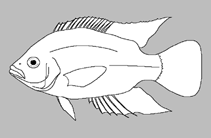 No image available for this species;
drawing shows typical species in Cichlidae.
Google image
drawing shows typical species in Cichlidae.
Classificazione / Nomi Nomi Comuni | Sinonimi | Catalog of Fishes(Genere, Specie) | ITIS | CoL | WoRMS | Cloffa
> Cichliformes (Cichlids, convict blennies) > Cichlidae (Cichlids) > Pseudocrenilabrinae
Etymology: Tylochromis: Greek, tylos = callus + Greek, chromis = a fish, perhaps a perch (Ref. 45335); aristoma: ari = Greek for well-developed, stoma = Greek for mouth (Ref. 52307). Named in reference to the prominent lower jaw and large-mouthed appearance of the adult (Ref. 52346).
Etymology: Tylochromis: Greek, tylos = callus + Greek, chromis = a fish, perhaps a perch (Ref. 45335); aristoma: ari = Greek for well-developed, stoma = Greek for mouth (Ref. 52307). Named in reference to the prominent lower jaw and large-mouthed appearance of the adult (Ref. 52346).
Ambiente: milieu / zona climatica / distribuzione batimetrica / gamma di distribuzione Ecologia
; acqua dolce benthopelagico. Tropical
Distribuzione Territories | Aree FAO | Ecosistemi | Presenze | Mappa dei ritrovamenti | Introduzioni | Faunafri
Africa: restricted to the Ruki River drainage (middle Congo River basin), in Democratic Republic of the Congo (Ref. 52346, 93897).
Dimensione / Peso / Età
Breve descrizione Chiavi di identificazione | Morfologia | Morfometria
Spine dorsali (totale) : 13 - 16; Raggi dorsali molli (totale) : 12 - 14; Raggi anali molli: 7; Vertebre: 28 - 29. Diagnosis: deep bodied, robust species with a relatively large mouth (compared to its congeners), but juveniles slender (Ref. 52307). Slender gracile lower jaw and narrow elongate keel (Ref. 52346). Dorsum strongly curved from nape to caudal peduncle but ventrum more or less flattened; long snout with a straight and steep predorsal profile passing uninterrupted to origin of dorsal fin, where body depth is largest; lower jaw extremely prominent; lips well-formed but not overly thickened or fleshy; entire premaxillary oral flap present; buccal teeth capped with brown or black enameloid; in juveniles all teeth small and fine with little differentiation in tooth size between inner and outer rows; in adult (male) teeth coarse and enlarged; upper branch of lateral line terminates in advance of end of dorsal fin; dorsal, ventral and medial lateral line branches on caudal fin well developed and almost reach to periphery; dorsal fin spines increase in length to 4th-5th and are then more or less of equal length; anal fin rounded; caudal fin roundly emarginate and densely scaled; pectoral fin relatively elongate and usually reaches level of first soft anal ray; first branched pelvic ray produced and filamentous (Ref. 52346).
Coloration: adult male: upper lip and front of head black (Ref. 52307, 52346). Just anterior to a short black nape stripe a patch of red/gold is present (Ref. 52346). Cheeks, operculum and breast silvery-white with greenish iridescent parts (Ref. 52307). Just behind nape band a broad pale blue/green band extends obliquely down to base of pelvic fins (Ref. 52346). Behind this oblique band body dark (golden) bronze which becomes more greenish towards caudal peduncle (Ref. 52307, 52346). Darker pigmentation on flank scales; dorsal, pelvic and anal fins dark reddish brown, with numerous rows of small greenish dots (Ref. 52307). Caudal fin light brown centrally, with more reddish parts in distal (outer) regions and many small black lines (Ref. 52307, 52346). (Preserved) juveniles: ground coloration light brown with dark smokey grey upper lip and front of head; nape band strongly marked but not reaching down onto operculum; diffuse opercular blotch present on lower portion of operculum; 6 vertical stripes extend down well below midline and onto belly and ventrum (especially in the smallest specimens) (Ref. 52346).
Seems to feed primarily upon plants and insect larvae; maternal mouthbrooder that does not pair-bond (Ref. 52307).
Ciclo vitale e comportamento di accoppiamento Maturità | Riproduzione | Deposizione | Uova | Fecondità | Larve
Riferimento principale
Caricare le referenze | Bibliografia | Coordinatore : Kullander, Sven O. | Collaboratori
Stiassny, M.L.J., 1991. Tylochromis. p. 526-533. In J. Daget, J.-P. Gosse, G.G. Teugels and D.F.E. Thys van den Audenaerde (eds.) Check-list of the freshwater fishes of Africa (CLOFFA). ISNB, Brussels; MRAC, Tervuren; and ORSTOM, Paris. Vol. 4. (Ref. 5714)
Stato della Lista Rossa IUCN (Ref. 130435: Version 2025-2 (Global))
Least Concern (LC) ; Date assessed: 16 February 2009
CITES
Not Evaluated
Minaccia per l'uomo
Harmless
Usi umani
FAO - Publication: search | FishSource |
Informazioni ulteriori
Ecologia trofica
Articoli alimentari (prede)
Alimentazione
Consumo di cibo
Razioni alimentari
Predatori
Articoli alimentari (prede)
Alimentazione
Consumo di cibo
Razioni alimentari
Predatori
Dinamica della popolazione
Parametri di crescita
Età massima / dimensioni massime
Rapporto lunghezza-peso.
Lunghezza-lunghezza rel.
Lunghezza-frequenze
Conversione di massa
Reclutamento
Abbondanza
Parametri di crescita
Età massima / dimensioni massime
Rapporto lunghezza-peso.
Lunghezza-lunghezza rel.
Lunghezza-frequenze
Conversione di massa
Reclutamento
Abbondanza
Ciclo di vita
Riproduzione
Maturità
Maturità/Gli occhielli sono relativi.
Fecondità
Deposizione
Aggregazioni riproduttive
Uova
Sviluppo delle uova
Larve
Dinamica popolazioni larvali
Riproduzione
Maturità
Maturità/Gli occhielli sono relativi.
Fecondità
Deposizione
Aggregazioni riproduttive
Uova
Sviluppo delle uova
Larve
Dinamica popolazioni larvali
Anatomia
Area branchiale
Cervello
Otolite
Area branchiale
Cervello
Otolite
Fisiologia
Composizione corporea
Nutrienti
Consumo di ossigeno
Tipo di nuoto
Velocità di nuoto
Pigmenti visivi
Suono del pesce
Malattie e parassiti
Tossicità (LC50)
Composizione corporea
Nutrienti
Consumo di ossigeno
Tipo di nuoto
Velocità di nuoto
Pigmenti visivi
Suono del pesce
Malattie e parassiti
Tossicità (LC50)
Genetica
Genome
Genetica
Eterozigosi
Ereditarietà
Diversità genetica
Genome
Genetica
Eterozigosi
Ereditarietà
Diversità genetica
Legato all'uomo
Sistemi di acquacoltura
Profili di acquacoltura
Varietà
Casi di Ciguatera
Francobolli, monete, materiale vario.
Sistemi di acquacoltura
Profili di acquacoltura
Varietà
Casi di Ciguatera
Francobolli, monete, materiale vario.
Strumenti
Libro elettronico | Giuda pratica | Generatore frequenze di lunghezza | Strumento Parametri Biologici | Mappa dei ritrovamenti |
Cattura-MSY |
Rapporti speciali
Controllo della manutenzione dell'acquario | Verificare la presenza di schede informative sulle specie | Verifica delle schede informative sull'acquacoltura
Scarica XML
Fonti Internet
AFORO (otoliths) | Aquatic Commons | BHL | Cloffa | Websites from users | Check FishWatcher | CISTI | Catalog of Fishes: Genere, Specie | DiscoverLife | ECOTOX | FAO - Publication: search | Faunafri | Fishipedia | Fishtrace | GloBI | Google Books | Google Scholar | Google | IGFA World Record | OneZoom | Open Tree of Life | Otolith Atlas of Taiwan Fishes | PubMed | Reef Life Survey | Socotra Atlas | TreeBase | Tree of Life | Wikipedia: Go, ricerca | World Records Freshwater Fishing | Zoobank | Record zoologico
Stime basate su modelli
Indice di diversità filogenetica (Fonte Biblio. 82804): PD50 = 0.5000 [Uniqueness, from 0.5 = low to 2.0 = high].
Bayesian length-weight: a=0.00389 (0.00180 - 0.00842), b=3.12 (2.94 - 3.30), in cm total length, based on all LWR estimates for this body shape (Ref. 93245).
Livello trofico (Fonte Biblio. 69278): 2.7 ±0.3 se; based on size and trophs of closest relatives
Resilienza (Fonte Biblio. 120179): Alto, tempo minimo di raddoppiamento della popolazione meno di 15 mesi (Preliminary K or Fecundity.).
Nutrienti (Ref. 124155): Calcium = 150 [73, 263] mg/100g; Iron = 1.45 [0.78, 2.89] mg/100g; Protein = 17.7 [16.1, 19.2] %; Omega3 = 0.367 [0.132, 1.062] g/100g; Selenium = 73 [26, 166] μg/100g; VitaminA = 36.3 [9.4, 114.1] μg/100g; Zinc = 2.14 [1.39, 3.31] mg/100g (wet weight);