>
Eupercaria/misc (Various families in series Eupercaria) >
Lutjanidae (Snappers) > Etelinae
Etymology: Etelis: Greek, etelis, -idos = a fish, perhaps the fish Sparus aurata (Ref. 45335).
More on author: Cuvier.
Environment: milieu / climate zone / Tiefenbereich / distribution range
Ökologie
seewasser benthopelagisch; tiefenbereich 90 - 400 m (Ref. 9821), usually 200 - 350 m (Ref. 82366). Tropical; 34°N - 25°S, 35°E - 150°W (Ref. 55)
Indo-Pacific: East Africa to the Hawaiian Islands, north to southern Japan, south to Australia. Recorded in Three Kings Island, New Zealand (Ref. 35942). This name has been wrongly used for Etelis coruscans by some previous authors.
Length at first maturity / Size / Gewicht / Alter
Geschlechtsreife: Lm 61.0 range ? - ? cm
Max length : 127 cm FL Männchen/unbestimmt; (Ref. 2016); common length : 65.0 cm TL Männchen/unbestimmt; (Ref. 5450); max. veröff. Alter: 32 Jahre (Ref. 92312)
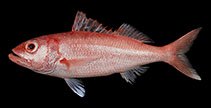
Rückenflossenstacheln (insgesamt) : 10; Rückenflossenweichstrahlen (insgesamt) : 11; Afterflossenstacheln: 3; Afterflossenweichstrahlen: 8. This species is distinguished by having the following characters: body relatively elongate, laterally compressed. Nostrils on each side of snout close together; lower jaw protruding slightly; premaxillae protrusible and maxilla extending to below middle of eye; both upper and lower jaws with conical teeth; 1 to several enlarged canines on each side of both jaws; vomer and palatines with teeth, those on vomer in a chevron-shaped patch; maxilla with scales,
but without longitudinal ridges. Interorbital region flattened; gill rakers of first gill arch 5-8 + 11-14 = 17-22 (including rudiments; dorsal fin continuous, but spinous portion of fin deeply incised at its junction with soft portion; last soft ray of both dorsal and anal fins produced, longer than next to last ray; caudal fin forked, the lobes relatively short (about 25-30% SL) compared with its congeners; pectoral fins fairly long (in specimens > 19 cm SL), length of pectoral fins about 80-90% of head length, with 15-17 rays; membranes of dorsal and anal fins without scales; tubed lateral-line scales 48-50. Colour: mainly pink to red, becoming white on lower sides and belly (Rfe. 9821).
Body shape (shape guide): fusiform / normal; Cross section: oval.
Adults inhabit rocky bottoms (Ref. 30573). Benthopelagic (Ref. 58302). Feed on fishes and larger invertebrates such as squids, shrimps and crabs; also takes planktonic organisms, including pelagic urochordates. An important food fish in some areas. Marketed fresh or frozen (Ref. 55).
Allen, G.R., 1985. FAO Species Catalogue. Vol. 6. Snappers of the world. An annotated and illustrated catalogue of lutjanid species known to date. FAO Fish. Synop. 125(6):208 p. Rome: FAO. (Ref. 55)
IUCN Rote Liste Status (Ref. 130435: Version 2025-1)
Bedrohung für Menschen
Harmless
Nutzung durch Menschen
Fischereien: hoch kommerziell; Sportfisch: ja
Tools
Zusatzinformationen
Download XML
Internet Quellen
Estimates based on models
Preferred temperature (Ref.
123201): 13.3 - 23.1, mean 18 °C (based on 290 cells).
Phylogenetic diversity index (Ref.
82804): PD
50 = 0.5312 [Uniqueness, from 0.5 = low to 2.0 = high].
Bayesian length-weight: a=0.01585 (0.01278 - 0.01966), b=2.95 (2.89 - 3.01), in cm total length, based on LWR estimates for this species (Ref.
93245).
Trophic level (Ref.
69278): 4.5 ±0.8 se; based on diet studies.
Widerstandsfähigkeit (Ref.
120179): sehr niedrig, Verdopplung der Population dauert mehr als 14 Jahre. (K=0.07-0.31; tmax=35).
Fishing Vulnerability (Ref.
59153): High to very high vulnerability (67 of 100).
🛈
Nutrients (Ref.
124155): Calcium = 44.5 [17.0, 103.8] mg/100g; Iron = 0.766 [0.383, 1.419] mg/100g; Protein = 18 [16, 20] %; Omega3 = 0.252 [0.142, 0.453] g/100g; Selenium = 106 [54, 230] μg/100g; VitaminA = 24.6 [7.7, 86.8] μg/100g; Zinc = 0.629 [0.408, 0.953] mg/100g (wet weight);