Environment: milieu / climate zone / rango de profundidad / distribution range
Ecología
marino demersal; rango de profundidad 5 - 73 m (Ref. 11295), usually 15 - 40 m (Ref. 11295). Tropical; 6°N - 3°S, 93°W - 85°W (Ref. 5222)
Eastern Pacific: Isla del Coco off Costa Rica and Galapagos Islands (Ecuador). Reports from Panama and Peru have been discounted (Ref. 6873).
Length at first maturity / Tamaño / Peso / Age
Madurez: Lm 65.3 range ? - ? cm
Max length : 120 cm TL macho / no sexado; (Ref. 5222)
Short description
Claves de identificación | Morfología | Morfometría
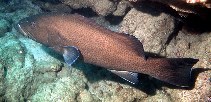
Espinas dorsales (total) : 11; Radios blandos dorsales (total) : 16 - 17; Espinas anales: 3; Radios blandos anales: 11. Distinguished by the following characteristics: dark to olive-brown body color with purplish and lighter brown spots, or plain dark brown; xanthic morph is bright yellow all over; depth of body contained 2.9-3.2 times in SL; head length 2.6-2.9 times in SL; slightly convex interorbital area; angular preopercle, with serrate lobe at angle; posterior nostrils of adults much larger than anterior ones (Ref. 89707).
Body shape (shape guide): fusiform / normal; Cross section: oval.
Found among rock walls, underwater lava ridges, and all kinds of well structured vertical rock formations (Ref. 11295). Juveniles found in shallow sandy lagoons (Ref. 5222), also in seagrass beds, mangrove lagoons, shallow lava reefs and inland lava ponds (Ref. 11295). Adults are mainly piscivorous, prey size increasing with predator size (Ref. 11295).
Life cycle and mating behavior
Madurez | Reproducción | Puesta | Huevos | Fecundidad | Larva
Heemstra, P.C. and J.E. Randall, 1993. FAO Species Catalogue. Vol. 16. Groupers of the world (family Serranidae, subfamily Epinephelinae). An annotated and illustrated catalogue of the grouper, rockcod, hind, coral grouper and lyretail species known to date. Rome: FAO. FAO Fish. Synop. 125(16):382 p. (Ref. 5222)
IUCN Red List Status (Ref. 130435: Version 2025-1)
Threat to humans
Harmless
Human uses
Pesquerías: comercial
Herramientas
Special reports
Download XML
Fuentes de Internet
Estimates based on models
Preferred temperature (Referencia
123201): 14.5 - 23.7, mean 19.3 °C (based on 4 cells).
Phylogenetic diversity index (Referencia
82804): PD
50 = 0.5000 [Uniqueness, from 0.5 = low to 2.0 = high].
Bayesian length-weight: a=0.00603 (0.00367 - 0.00990), b=3.02 (2.88 - 3.16), in cm total length, based on LWR estimates for this species & Genus-body shape (Ref.
93245).
Nivel trófico (Referencia
69278): 4.5 ±0.80 se; based on food items.
Resiliencia (Referencia
120179): Medio, población duplicada en un tiempo mínimo de 1.4-4.4 años (K=0.18; tm=3; tmax=7).
Fishing Vulnerability (Ref.
59153): High vulnerability (61 of 100).
🛈
Nutrients (Ref.
124155): Calcium = 63.5 [28.2, 126.1] mg/100g; Iron = 0.861 [0.465, 1.708] mg/100g; Protein = 18.1 [16.3, 19.8] %; Omega3 = 0.219 [0.129, 0.372] g/100g; Selenium = 66.8 [33.8, 142.8] μg/100g; VitaminA = 23.4 [7.5, 81.7] μg/100g; Zinc = 0.666 [0.455, 0.982] mg/100g (wet weight); based on
nutrient studies.